
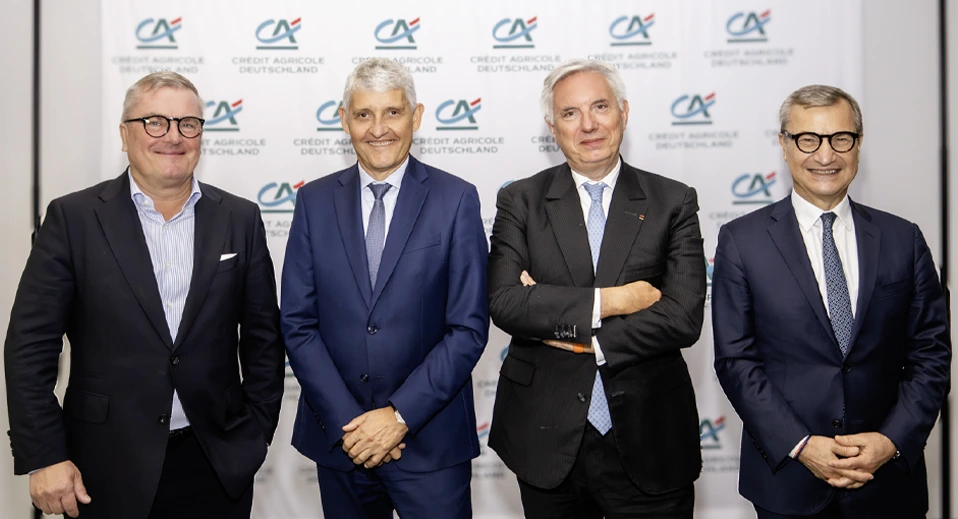
Crédit Agricole is preparing to bring its digital-first universal banking model to German retail customers, combining mobile banking, savings products, AI-enabled services, and local human support. The launch supports the group’s ambition to reach two million customers across its German businesses by the end of 2028.
French banking group Crédit Agricole is expanding its retail banking ambitions in Germany with the launch of Crédit Agricole Deutschland, a new digital-first universal bank designed to serve consumers in Europe's largest economy.
Announced in October 2026, the initiative marks another stage in the group's expansion beyond its established corporate, institutional, and specialist financial services businesses in Germany. The new bank will offer customers everyday banking and savings services through a digital platform, supported by a local branch network and access to customer service representatives.
The public launch is planned for the end of October 2026. Its initial offering will include current accounts with German IBANs, Visa cards, savings accounts, fixed-term deposits, and a mobile application for onboarding and account management. The bank also plans to broaden its services from 2027, adding wealth-building solutions, credit products, and enhanced advisory services.
The move forms part of Crédit Agricole S.A.'s ACT 2028 medium-term strategy, which aims to accelerate the group's growth in Europe and extend its universal banking model into markets where it already has an established presence.
According to the group's official announcement, Crédit Agricole already serves around one million retail customers in Germany through its existing businesses. It aims to double its customer base across its German businesses to two million by the end of 2028.
What Crédit Agricole Deutschland Will Offer
The new bank is designed to combine the convenience of digital banking with the breadth of services associated with a traditional universal bank.
At launch, customers will be able to open current accounts with German IBANs and access Visa cards. The bank says its cards will provide access to approximately 49,000 ATMs in Germany, as well as Visa-compatible ATMs worldwide.
Savings will be another central component of the initial proposition. Customers will have access to savings solutions, including overnight-access accounts and fixed-term deposits, giving the bank an opportunity to build relationships with customers who prioritize saving alongside everyday banking.
The mobile application will support onboarding, account management, and product subscriptions. Customers will also be able to contact the bank by telephone, email, and live chat, with telephone support planned from Monday to Saturday.
The offering is expected to expand progressively in response to customer needs and feedback. From 2027, Crédit Agricole Deutschland plans to introduce wealth-building products, credit solutions, enhanced advisory services, and premium packages. It also plans to add mobile wallet support, including Apple Pay and Google Pay.
This staged approach allows the bank to establish its everyday banking and savings proposition before broadening the range of financial products available to customers.
A Digital-First Model With Local Human Support
Crédit Agricole Deutschland is not being positioned as a fully branchless banking service. Instead, the group is combining a digital customer journey with physical locations and access to personal assistance.
The new bank will draw on Creditplus' existing workforce of approximately 600 employees and a network of 20 branches across Germany's main cities. Locations in Berlin, Stuttgart, Frankfurt, and Munich are expected to welcome visitors in dedicated spaces showcasing the bank's products and digital services. Other locations will serve as information and guidance hubs.
Account opening and product subscriptions will primarily take place through the mobile application, while branches and customer support will provide additional assistance.
The model reflects a broader strategic choice: use digital channels for convenience and efficiency without removing human support from the customer relationship.
For a bank entering a competitive retail market, that distinction could matter. Some customers are comfortable managing their finances entirely through an application, while others may want assistance when choosing savings products, understanding account features, or navigating more complex financial decisions.
Crédit Agricole's established local presence gives it a starting point for serving both groups. However, the effectiveness of the model will depend on the quality of its digital experience, the accessibility of its support, and the competitiveness of its products.
AI Will Support the Banking Experience
Artificial intelligence is part of the new bank's technology strategy, although Crédit Agricole has described its deployment as progressive rather than presenting a complete set of AI features at launch.
The group plans to use AI and data-driven capabilities where they can improve customer journeys, service efficiency, and, over time, personalized support.
Potential applications across digital banking include streamlining routine processes, helping customers navigate products and supporting service teams. These are examples of how AI can be used in banking; the announcement does not establish that every such capability will be available in Crédit Agricole Deutschland at launch.
The bank's stated approach is to introduce AI where it provides tangible value and contributes to service quality. That leaves room for the group to expand its capabilities as the proposition develops.
The strategy also highlights an important distinction in financial services: digitalization is not simply about moving existing services onto a mobile screen. Banks must ensure that technology improves usability while maintaining security, operational resilience, and appropriate oversight.
For Crédit Agricole Deutschland, the challenge will be to make its technology useful to customers rather than relying on AI as a marketing feature. A smooth onboarding process, clear product information, and reliable account management will remain fundamental to the customer experience.
Why Germany Is a Strategic Priority
Germany is a priority market for Crédit Agricole because of its economic importance, substantial savings market, and the group's long-standing local operations.
The French banking group has been present in Germany for more than 70 years. Its businesses span asset management, insurance, consumer finance, corporate and investment banking, leasing, factoring, and securities services.
The launch of Crédit Agricole Deutschland extends that presence by giving the group a more direct proposition for retail customers.
The move also follows the launch of Crédit Agricole Savings in Germany in April 2026, a digital platform focused on savings and fixed-term deposits. That platform is intended to collect deposits and expand the group's digital savings presence in Europe.
The new universal bank represents a broader step: rather than focusing only on savings, it will progressively bring together everyday banking, deposits, and additional financial products within a wider retail banking relationship.
The group has also outlined a plan to expand its German customer base and develop its presence through the ACT 2028 strategy. Its stated target is to reach two million customers across its German businesses by the end of 2028.
This is a group-wide target, not a disclosed customer acquisition target exclusively for Crédit Agricole Deutschland. The new bank is expected to contribute to that ambition by opening the group's services to more retail customers.
Competition in Germany's Retail Banking Market
Crédit Agricole enters a market with established domestic banks, savings banks, cooperative institutions, and a growing range of digital banking propositions.
Customers already have access to providers offering mobile accounts, savings products, card payments, and online financial services. Winning them will therefore require more than a digital interface.
Pricing, savings rates, customer service, product transparency, and trust are likely to influence the bank's ability to attract and retain customers. For savers, interest rates and access to funds can be especially important. For everyday banking customers, account features, payment convenience, and the reliability of service can shape their choice of provider.
Crédit Agricole's potential advantage is its combination of an established European banking group, specialist financial businesses, local operations, and a digital-first customer journey.
Its existing German workforce and branch network provide a foundation that a new entrant would otherwise need to develop. The group can also draw on expertise across its businesses as it broadens the range of products available to customers.
However, established presence does not guarantee retail banking growth. The bank will need to show that its proposition is competitive, that customers find it easy to use, and that its service model can support growth at scale.
From Savings to a Broader Banking Relationship
Savings are at the center of Crédit Agricole Deutschland's initial proposition. This gives the bank an entry point for customers who want to manage deposits and everyday transactions through a single provider.
Over time, the planned addition of credit products, wealth-building solutions, and advisory services could allow the bank to serve more of customers' financial needs.
A broader product range can deepen customer relationships and create opportunities for cross-selling. It also introduces additional responsibilities, including appropriate product suitability, risk management, customer support, and regulatory compliance.
The transition from a savings-led proposition to a more comprehensive banking relationship will therefore be an important phase of the bank's development.
The planned introduction of additional services from 2027 gives Crédit Agricole time to build its initial customer base and assess demand. The pace and success of that expansion will depend on customer feedback, execution and the bank's ability to maintain a consistent experience across its channels.
What the Launch Means for European Digital Banking
Crédit Agricole Deutschland illustrates how established banking groups are adapting their operating models to compete in digital financial services.
Rather than relying exclusively on acquisitions or launching a standalone mobile application, Crédit Agricole is extending its existing business in Germany through a new retail-facing brand. The approach combines group-wide financial capabilities with a local presence and a digital distribution model.
This strategy can help established banks use existing infrastructure and expertise while creating a customer experience designed around mobile access and streamlined services.
It also demonstrates that digital banking competition is not limited to technology-focused challengers. Large financial groups can bring capital, established risk frameworks, specialist products and existing customer relationships into the digital market.
For customers, increased competition may create more choice in accounts, savings products and service models. For banks, it raises the pressure to deliver convenient digital services while maintaining trust and operational quality.
Crédit Agricole's progress will ultimately depend on whether its proposition can attract customers in a crowded market and convert initial account relationships into long-term banking relationships.
Conclusion
Crédit Agricole's launch of Crédit Agricole Deutschland marks a significant extension of its retail banking strategy in Germany. The new digital-first bank will begin with everyday accounts and savings products, supported by mobile services, local branches and human customer assistance.
The group plans to broaden the proposition from 2027 with credit, wealth-building and advisory services. These developments support its ambition to reach two million customers across its German businesses by the end of 2028.
The strategy combines the reach of an established European banking group with a digital-led customer experience. Its success will depend on how effectively the bank competes on savings, convenience, service quality and trust.
For Germany's retail banking market, the launch adds another major European player seeking to combine digital convenience with the capabilities of a full-service bank.
Sources
Comments
No comments yet. Be the first to share your thoughts.
Leave a comment