
OpenAI and Anthropic are both reporting enormous revenue run rates, but the way each company accounts for cloud partner sales is complicating comparisons between them. As a result, investors are now asking a harder question: how should the AI leaders actually be valued?
The race between OpenAI and Anthropic is no longer just about which company builds the most capable artificial intelligence models. It is also becoming a contest over revenue growth, enterprise adoption, and the financial strength needed to sustain increasingly expensive AI infrastructure.
Yet investors face a real problem when comparing the two companies, since their headline revenue figures are not calculated on a directly comparable basis.
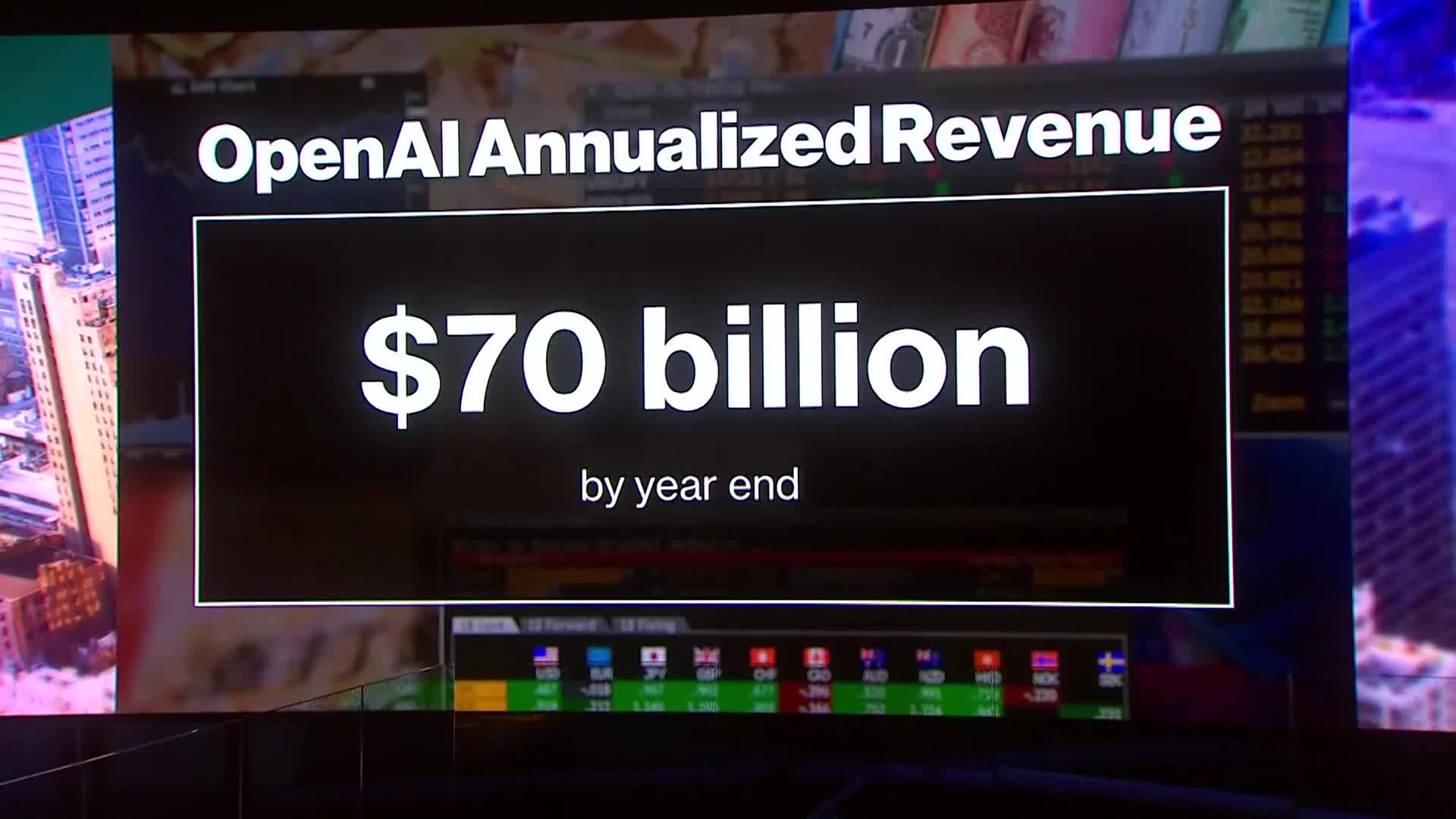
A Bloomberg report published on October 9 highlighted OpenAI's reported expectation of reaching or exceeding $70 billion in annualized revenue by the end of 2026, while Anthropic reached a reported annualized revenue run rate of $65 billion in July. On the surface, those figures suggest the two companies are operating at broadly similar levels of commercial scale.
However, later reporting complicated that comparison considerably. Axios reported on October 8 that OpenAI's annualized revenue was closer to $50 billion under its own accounting approach and that the $70 billion figure was an adjusted calculation meant to make its performance more comparable with Anthropic's. The difference centers on how the two companies account for sales made through cloud partners.
This distinction matters because revenue remains one of the most closely watched indicators of growth for private technology companies, particularly those preparing for potential public listings. If investors compare figures calculated on different bases, they could draw misleading conclusions about which company is growing faster, generating more sales or commanding a justified valuation.
None of this means either company is reporting revenue incorrectly. Instead, it shows how different commercial arrangements and accounting judgments can produce very different headline numbers.
OpenAI vs Anthropic: Why the Revenue Comparison Is Difficult
OpenAI and Anthropic have become two of the most closely watched businesses in generative AI. OpenAI operates ChatGPT and provides AI models and tools to consumers, developers, and enterprises. Anthropic develops the Claude family of models and sells access through its own products as well as third-party cloud platforms.
Both companies generate revenue from customers using AI services. Some of those customers, though, access the models through cloud providers that package or resell AI capabilities alongside broader computing services.
That setup raises an accounting question worth pausing on: when a customer pays for an AI service through a partner, should the AI company record the full customer payment as revenue, or only the portion it actually receives?
Anthropic has reportedly taken a gross revenue approach for certain cloud partner sales. It records the full amount of those sales as revenue and treats payments to cloud providers as expenses instead.
OpenAI, by contrast, records only its share of certain sales made through partners such as Microsoft, according to reporting by Axios and The Information.
That difference alone can make Anthropic's revenue figure look larger relative to OpenAI's, even when the two companies are serving customers through comparable distribution channels.
Consider a simplified example. A customer pays $100 for access to an AI service through a cloud platform. Under one accounting approach, the AI provider could report the full $100 as revenue and record the cloud partner's share as an expense. Under another approach, the provider could recognize only its share of the transaction as revenue. The underlying customer payment stays the same either way, yet the reported revenue differs sharply.
That is the core issue behind the current debate. Investors need to understand not just how much customers spend, but also how each company recognizes those payments and what costs it incurs to deliver the service.
Why OpenAI's $70 Billion Figure Needs Context
The reported $70 billion annualized figure drew attention because it suggested OpenAI was approaching a level of commercial scale comparable with Anthropic's reported $65 billion run rate.
However, Axios reported that OpenAI's $70 billion figure was an adjusted calculation designed to create a more direct comparison with Anthropic's approach to partner sales. Under OpenAI's own accounting methodology, its annualized revenue was reported at approximately $50 billion instead.
That distinction matters a great deal. The $70 billion figure should not be treated as equivalent to $70 billion in revenue recognized under OpenAI's normal accounting approach.
It also helps to separate annualized revenue from actual annual revenue. An annualized run rate takes a shorter period of sales and projects it across a full year. That calculation can help investors understand the current pace of a fast-growing business, but it is not the same as revenue actually earned over a completed twelve-month period.
For example, if a company generates $5 billion in a recent three-month period, multiplying that amount by four produces an annualized figure of $20 billion. That math assumes the pace continues. It does not establish that the company will actually generate $20 billion over the next year.
The distinction becomes especially important for AI companies, where revenue can grow rapidly as enterprise contracts expand, new models launch, and customer usage shifts.
A run rate can offer a useful snapshot of momentum, but it may also exaggerate or understate future performance if recent sales happen to be unusually high or low. For investors, the practical lesson is simple: identify the methodology behind each headline figure before using it to compare companies.
Anthropic's $65 Billion Run Rate Reflects Rapid Growth
Anthropic's reported annualized revenue reached $65 billion by the end of July 2026, according to Reuters, citing a person familiar with the matter. That figure marked a substantial increase from the reported $47 billion run rate in May and roughly $9 billion at the end of 2025.
That trajectory points to strong commercial momentum for Claude and Anthropic's wider AI business.
The company has built demand among developers and enterprises using AI models for software development, research, business workflows, and other applications. Cloud distribution also gives customers access to Claude through infrastructure providers they already rely on.
Still, the accounting distinction means the $65 billion figure should not be read as a straightforward measure of cash retained by Anthropic, nor as a direct measure of profitability.
Revenue simply measures sales recognized under a company's accounting policies. It does not reveal, on its own, how much the company spends on computing capacity, cloud partners, research, staff, sales, or other operating costs.
When a business records gross sales through a distribution partner, the partner's share may show up in expenses rather than reducing reported revenue. That treatment can make revenue look larger without necessarily increasing the company's economic benefit by the same amount. Investors therefore need to weigh both revenue and the costs tied to generating it.
Are OpenAI and Anthropic Using Different Accounting Rules?
The central debate comes down to how each company interprets its role in transactions conducted through cloud partners.
Accounting standards commonly distinguish between a principal, which controls a product or service before it reaches the customer, and an agent, which simply arranges a transaction on behalf of another party. That distinction can affect whether a company records the full transaction value or only a fee or commission.
The correct treatment depends on the facts of each arrangement, including who controls the service, who is responsible for delivering it, and the nature of the relationship with the customer.
According to reporting by Axios and The Information, Anthropic views itself as the principal in certain cloud partner transactions, which allows it to record gross revenue. OpenAI takes a different approach for some partner sales, recording its share instead.
Neither approach should be labeled incorrect simply because the resulting numbers differ. Both companies are reported to follow generally accepted accounting principles, yet their contractual arrangements and accounting judgments are not identical.
The more important question is whether investors receive enough information to understand these differences and make meaningful comparisons. That question matters even more when private companies share selected performance metrics with investors without publishing the full financial statements that would normally accompany a public company earnings report.
Why Revenue Transparency Matters Before an IPO
The debate could grow more consequential as major AI companies prepare for possible public listings.
Private companies often share financial information selectively with existing and prospective investors. Public companies, on the other hand, face formal disclosure requirements and close scrutiny from investors, analysts, and regulators.
An initial public offering would bring far greater attention to the accounting policies behind OpenAI's and Anthropic's financial performance. Investors would want to understand how revenue is recognized, how cloud partner arrangements work, and whether reported growth actually translates into sustainable economics. They would also examine expenses, margins, cash flow, contractual commitments, and capital requirements closely.
That broader analysis matters because AI development and deployment require substantial infrastructure investment. Companies must pay for computing capacity, data centers, chips, energy, model research, and product development. Strong revenue growth, on its own, does not guarantee that a company is profitable or generating positive cash flow.
For AI businesses, the relationship between revenue and computing costs may be particularly important. A company can attract millions of users or sign large enterprise contracts while still facing steep costs to train and operate its models. The revenue comparison, in other words, is only one part of the financial picture.
What Investors Should Compare Instead
The accounting differences do not make revenue irrelevant. They simply mean investors should evaluate it alongside other indicators.
First, investors should distinguish actual recognized revenue from annualized run rates and adjusted comparisons, since each measure answers a different question and should not be treated as interchangeable. Second, they should examine how much revenue comes from direct customer relationships versus sales through cloud partners, because distribution can accelerate growth even as partner economics affect how much value the AI provider ultimately keeps.
Third, operating costs and gross margins can help show how efficiently a company converts sales into financial returns, since cloud partner payments, computing expenses and other delivery costs may significantly affect profitability. Fourth, customer retention and recurring revenue can indicate whether growth is durable, because a short term surge in usage does not necessarily mean the same pace will continue.
Finally, investors should look closely at cash flow and capital commitments. AI companies need enough financial capacity to support ongoing research and infrastructure investment, especially as competition intensifies. A company with a smaller reported revenue figure could still have attractive economics, while a larger headline figure may simply reflect a different accounting treatment or a more expensive route to market.
The AI Race Is Becoming a Financial Reporting Test
OpenAI and Anthropic are competing to build powerful AI systems and secure enterprise adoption, and their reported revenue growth illustrates the commercial opportunity emerging around generative AI.
But the dispute over revenue measurement highlights a less visible part of that competition: how investors interpret the numbers in the first place.
A $70 billion annualized figure and a $65 billion run rate may appear easy to compare at first glance. Once accounting methodology, cloud partner sales and annualization enter the picture, that comparison becomes far more complicated. That does not erase either company's commercial progress, but it does mean headline numbers need context before they are taken at face value.
As the AI industry matures, investors will increasingly need to look beyond growth claims and assess how companies generate revenue, recognize partner transactions and manage the costs of delivering AI services.
The central lesson is simple. In the race between OpenAI and Anthropic, the size of the revenue number matters, but so does the method used to calculate it.
Comments
No comments yet. Be the first to share your thoughts.
Leave a comment