
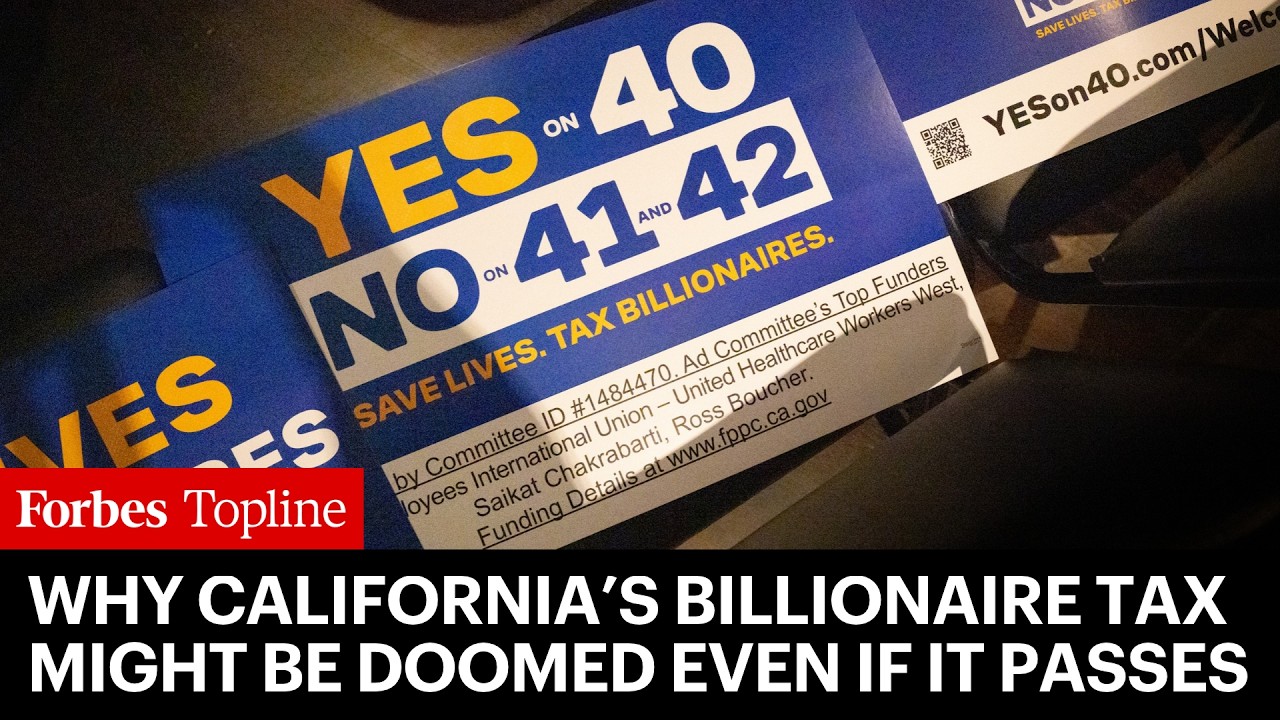
California’s proposed billionaire tax faces a major political challenge that could prevent it from taking effect, even if voters support it. Two rival ballot measures could undermine the proposal, turning the state’s wealth-tax debate into a wider fight over taxation, political influence, and the future of its technology economy.
According to a Forbes report published on October 27, 2026, Proposition 40 would introduce a one-time 5% tax on the wealth of roughly 250 of California’s richest residents. The proposal is intended to help fund state healthcare programs and offset cuts associated with US President Donald Trump’s One Big Beautiful Bill Act.
However, Propositions 41 and 42 could complicate its implementation. The measures target parts of Proposition 40’s proposed framework. Under the ballot arrangement described in the report, the measure receiving the most votes would be enacted. As a result, Proposition 40 could be nullified if either competing measure receives more votes.
The dispute highlights an important distinction: winning public support for a tax proposal may not guarantee that the policy can be implemented.
How California’s Billionaire Tax Proposal Works
Proposition 40 centers on a one-time 5% tax targeting approximately 250 of California’s wealthiest residents. Its stated purpose is to help support state-funded healthcare programs as California faces funding pressures linked to federal policy changes.
The proposal has attracted attention because of the potential scale of the tax and the wealth of the individuals it would affect. California is home to prominent technology founders, venture capitalists, and business leaders whose fortunes are closely linked to technology companies and financial investments.
However, the proposal has also raised concerns about whether a wealth tax could encourage wealthy residents to relocate. Critics argue that the departure of high-net-worth individuals could affect investment, business activity, and the state’s tax base.
The debate is therefore not limited to how much revenue the tax might generate. It also concerns how California balances public spending needs against the possibility of changes in where wealthy individuals choose to live and invest.
Why Propositions 41 and 42 Could Block the Tax
The opposition is pursuing a strategy through two separate ballot measures, each of which could affect the proposed tax in a different way.
Proposition 41 targets spending rules.
Proposition 41 would introduce audit requirements and restrict exemptions from state spending limits for revenue collected through new taxes. Such exemptions form part of Proposition 40’s proposed framework.
If adopted, these restrictions could affect how revenue from the billionaire tax is handled. The measure therefore challenges an important part of the proposed tax’s financial structure.
Proposition 42 targets wealth and retroactive taxes.
Proposition 42 would prohibit wealth taxes regardless of an individual’s net worth. It would also prohibit retroactive taxes of the kind proposed under Proposition 40.
The proposal is relevant because Proposition 40 would apply to billionaires who lived in California as of January 1, according to the Forbes report.
Neither Proposition 41 nor Proposition 42 directly names Proposition 40. However, both could restrict elements of the tax proposal or make its enforcement more difficult.
University of Southern California assistant economics professor David Schönholzer described the two measures as “essentially the poison pills to kill Proposition 40,” according to remarks cited by Forbes.
The ballot contest could therefore become decisive. Voters would not simply be choosing whether to support a billionaire tax. They would also be deciding between competing measures that could produce different outcomes for the state’s tax policy.
Tech Billionaires Are Funding the Opposition
The campaign has attracted substantial financial support from prominent figures in the technology and venture capital industries.
Forbes, citing an analysis by the nonprofit progressive publication Capital & Main, reported that Google co-founder Sergey Brin had contributed more than $100 million to Building a Better California. The political action committee created and submitted Propositions 41 and 42 and had spent more than $180 million promoting them, according to the report.
Other major donors include venture capitalist John Doerr and former Google CEO Eric Schmidt, who had each contributed more than $40 million. Stripe CEO Patrick Collison had donated more than $33 million.
The report also identified several other contributors who had each given more than $5 million. They include venture capitalist Vinod Khosla, Ripple co-founder Chris Larsen, venture capitalist Michael Moritz, Kavitark Ram Shriram, and former Snowflake CEO Frank Slootman.
These contributions demonstrate the scale of the financial resources behind the campaign. They also place technology executives and investors at the center of a broader debate about the role of private wealth in public policy.
Campaign funding does not, by itself, determine how voters will respond. Nevertheless, the reported figures show that the ballot measures have become a major issue for some of the individuals whose financial interests could be affected by California’s tax policies.
Gavin Newsom Also Opposes Proposition 40.
California Governor Gavin Newsom has opposed Proposition 40, arguing that it could encourage billionaires to leave the state. Forbes also reported that Newsom endorsed Proposition 42.
His position adds another dimension to the dispute. Opposition to the proposed tax is not confined to the business community, although different opponents may have different reasons for resisting it.
For policymakers, the central challenge is to assess whether a wealth tax can raise meaningful revenue without creating unintended economic consequences. For supporters, the proposal offers a potential way to help fund healthcare programs. For critics, it raises concerns about tax policy, competitiveness, and the movement of wealthy residents.
The competing ballot measures put these disagreements directly before voters.
What the Battle Means for Technology and Finance
The outcome could have implications beyond California’s immediate budget debate.
The state plays an important role in the global technology economy. Its founders, investors, and technology executives are connected to companies and investment networks that operate across the United States and international markets.
A major change in wealth taxation could influence how some high-net-worth individuals assess their financial and residential arrangements. However, the actual impact would depend on the final policy, its implementation, and the decisions made by affected residents.
The dispute also illustrates how ballot measures can shape economic policy. A proposal may attract public support but still face barriers if competing measures alter the rules under which it would operate.
For investors and financial services businesses, the debate is a reminder that tax policy and political developments can form part of the wider operating environment. It does not establish that wealthy residents will leave California or that investment activity will decline. Those outcomes remain uncertain.
What Happens Next?
The key question is which measure receives the most votes and how the resulting provisions affect Proposition 40’s enforceability.
Proposition 40 could receive substantial support and still face a challenge from Proposition 41 or Proposition 42 under the voting arrangement described by Forbes. The final result will determine whether California moves forward with the proposed tax or adopts restrictions that could prevent it from operating as intended.
The campaign also raises broader questions about the relationship between wealth, political influence, and public spending. Large donations can help fund political campaigns, but voters ultimately decide the outcome at the ballot box.
For now, California’s billionaire tax remains a contested proposal rather than a settled policy outcome. Its future will depend not only on support for taxing extreme wealth but also on the competing ballot measures designed to challenge its implementation.
Here’s Why California’s Billionaire Tax Might Be Doomed Even If It Passes
Comments
No comments yet. Be the first to share your thoughts.
Leave a comment