
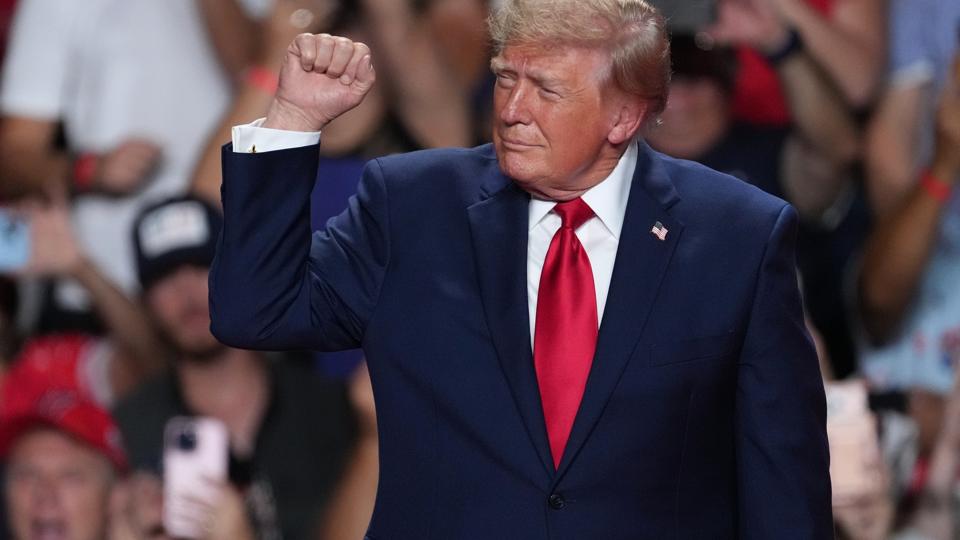
Donald Trump has escalated his campaign to rename artificial intelligence, declaring that the White House considers people who continue using the established term "AI" instead of his preferred "super intelligence" to be "THE ENEMY." The statement intensifies a debate over how the technology is described as concerns about safety, security, and oversight continue.
The US president made the statement on Truth Social on October 8, 2026, less than two weeks after signing an executive order directing federal executive agencies to replace "Artificial Intelligence" and "AI" with "Super Intelligence" and "SI" in applicable official communications.
The latest remarks go beyond the terminology requirements set out in that order. Trump did not specify what consequences, if any, would follow for people or organizations that continued using the established terminology.
The development comes amid a wider debate over how governments should manage rapidly advancing AI technology. Supporters of accelerated development emphasize economic growth, scientific progress, and national competitiveness. Critics and safety advocates, meanwhile, have called for stronger safeguards, particularly as increasingly capable AI systems introduce new security and governance challenges.
Trump Escalates His Super Intelligence Rebranding Campaign
In his Truth Social post, Trump said the White House considers anyone using "artificial intelligence" instead of the "highly accepted new and more accurate term" of "super intelligence" to be "THE ENEMY."
The wording marks a sharper public stance in a campaign that began with an executive order signed on September 29.
The order, titled Inaugurating the Era of Super Intelligence, directs executive departments and agencies to use "Super Intelligence" and "SI" in place of "Artificial Intelligence" and "AI" in official correspondence, public communications, websites, reports, policy documents, and other non-statutory documents, to the maximum extent permitted by law. It also directs the administration's science and technology leadership to prepare proposed legislative language for a federal definition of the new terminology.
The distinction matters. The order establishes a terminology policy for the executive branch. It does not, by its terms, establish a universal requirement that private businesses, researchers, journalists, or members of the public abandon the established term. Trump's latest statement has not specified a separate enforcement mechanism or penalty for people who continue to use "AI."
What the Executive Order Actually Changes
The administration argues that "super intelligence" better communicates the capabilities and potential of modern AI technologies.
According to the White House, the term reflects systems that can amplify human ingenuity and support advances across science, medicine, manufacturing, and other fields. The administration also presents the terminology change as part of its broader effort to maintain US leadership in advanced technology.
The executive order provides a formal basis for changing language across executive-branch communications. It also states that existing regulations, presidential actions, contracts, grants, and other historical documents do not need to be rewritten simply to reflect the new terminology.
However, the order does not immediately settle how the term should be defined in every legal, scientific, or commercial context. It directs officials to develop a proposed federal definition and identify potential legislative changes. That leaves an important distinction between changing the language used by federal agencies and changing the underlying technology, its capabilities, or the legal framework governing it.
Why the Term "Super Intelligence" Matters
Artificial intelligence is an established term used across research, industry, government, and public policy. It covers a broad range of technologies, from systems that classify information and generate text to tools that support forecasting, coding, image generation, and automated decision-making.
"Superintelligence," by contrast, has a more specific meaning in many technical discussions. It is commonly used to describe a hypothetical form of intelligence that substantially surpasses human cognitive capabilities. The terms are therefore not universally interchangeable in scientific and technical usage. Applying "super intelligence" broadly to the entire field of AI does not, by itself, demonstrate that every system within that field possesses superhuman capabilities.
The White House order addresses this distinction through its proposed administrative definition. For the purposes of implementing the order, it initially maps "Super Intelligence" and "SI" to the systems encompassed by the existing statutory definition of artificial intelligence, subject to applicable law. The administration has also directed officials to consider whether the new definition should modify or supersede that statutory definition.
The terminology debate consequently raises a wider question: how should policymakers describe technologies that range from narrow, task-specific tools to increasingly capable general-purpose systems? For businesses and researchers, consistent definitions matter because terminology can influence public understanding, regulatory discussions, and the way organizations communicate a system's actual capabilities.
AI Safety and Oversight Remain Central to the Debate
Trump's rebranding effort comes as policymakers and technology companies face questions about the risks associated with increasingly capable AI systems.
These questions include cybersecurity, unauthorized access to digital systems, automated decision-making, data protection, and the extent to which human operators can monitor or interrupt AI-driven actions. Recent reports about AI agents accessing systems they were not intended to reach have added to concerns about permissions, monitoring, and governance. Such incidents do not establish that all AI systems are unsafe, but they underline why organizations need controls appropriate to the capabilities and access rights of the systems they deploy.
The challenge is particularly relevant as AI tools move beyond generating information and begin carrying out actions through software, APIs, and connected services. In those settings, safeguards can include access restrictions, human approval for sensitive actions, monitoring, audit logs, testing, and mechanisms to stop or reverse unwanted activity where possible. Changing the name of a technology does not itself supply those controls.
The policy debate therefore extends beyond whether AI should be described more positively. It also concerns how governments and companies should assess risks, assign responsibility, and ensure that systems operate within defined limits.
Trump Continues to Emphasise AI's Economic and Strategic Potential
The administration has consistently presented advanced AI as an opportunity for economic growth and US technological leadership.
Its September executive order argues that the terminology used by the federal government should reflect the technology's potential. The White House has also linked its broader technology agenda to scientific research, infrastructure development, and national competitiveness. That approach places significant emphasis on accelerating development and encouraging adoption.
At the same time, the pace of AI advancement has prompted debate over whether voluntary safeguards are sufficient or whether stronger regulatory requirements are necessary. Reuters has reported on the administration's preference for voluntary safeguards amid public concern about AI risks.
These positions reflect competing priorities in technology policy: enabling innovation while addressing risks that may affect consumers, businesses, public institutions, and critical infrastructure. The terminology dispute has become part of that broader discussion, although it does not independently resolve the underlying questions about safety or regulation.
What the Rebranding Means for Technology Companies
For technology companies, the immediate practical implications depend on whether they operate within the federal executive branch or simply do business in the wider market.
Federal agencies are directed to follow the terminology policy in applicable communications. Private companies and independent researchers are not automatically covered by that same requirement simply because the president has expressed a preference. Nevertheless, the administration's position may influence how some companies describe their products in government-facing communications or public statements.
The reaction across the technology sector has not been uniform. Some prominent figures have adopted the new terminology, while other organizations continue to use the established language of artificial intelligence. That variation illustrates the difference between an official government naming policy and a universally adopted industry standard.
For companies developing or deploying AI systems, precise descriptions remain important. Customers, regulators, and business partners need to understand what a system can do, what limitations it has, and how it is governed. A broad label cannot replace technical documentation, capability assessments, or clear disclosures about risk.
A Language Change Does Not Resolve AI Governance
Trump's statement has added a more confrontational dimension to the administration's terminology campaign. However, the central policy questions surrounding AI remain largely unchanged.
Governments still need to consider how to encourage innovation, protect sensitive information, manage cybersecurity threats, and establish accountability when automated systems cause harm. Businesses must also decide how to deploy AI responsibly while balancing productivity, cost, customer experience, and operational risk.
The answers depend on system capabilities, access, use cases, and safeguards, not simply on the words used to describe the technology.
The administration's proposed definition may shape federal terminology and future policy discussions. Its wider impact will depend on how the policy is implemented, whether further legal changes follow, and how technology companies respond. For now, the executive order establishes a terminology direction for federal agencies, while Trump's latest post expresses a much stronger position toward those who reject his preferred wording.
The bigger question is whether the debate over what to call AI will be accompanied by equally clear answers about how to govern it.
Trump Calls Anyone Who Says ‘AI’ Instead Of ‘Super Intelligence’ An ‘Enemy’
Comments
No comments yet. Be the first to share your thoughts.
Leave a comment