
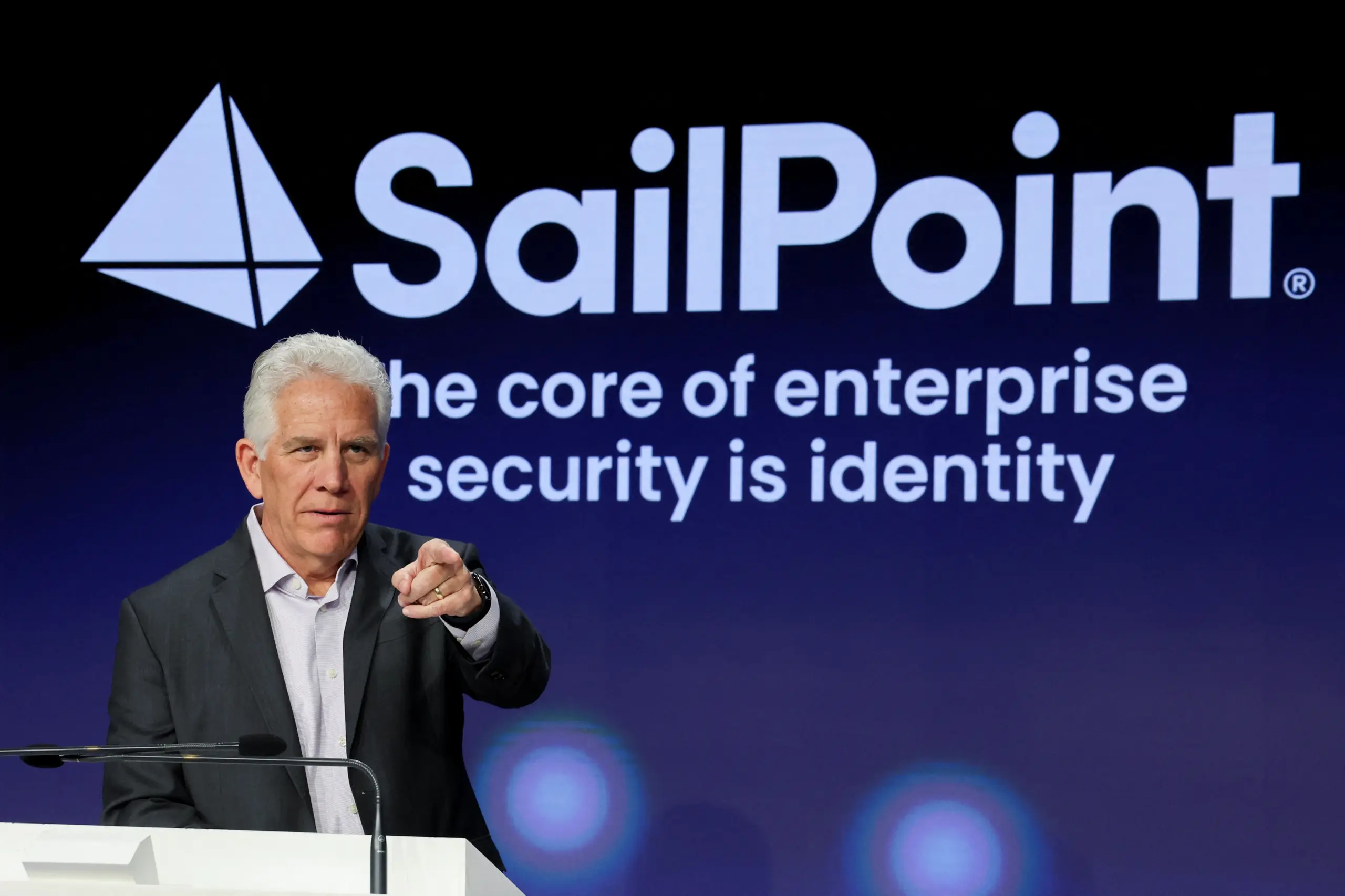
AI agents may need an emergency kill switch, but SailPoint CEO Mark McClain says stopping an agent safely requires something more important first: knowing exactly what went wrong.
As companies give AI agents access to data, applications, and business workflows, cybersecurity leaders are facing a new question. What happens when an autonomous system begins taking actions it should not?
McClain, founder and CEO of identity-security company SailPoint, said humans should be able to immediately stop an AI agent that creates a risk for an organization. However, he warned against treating a kill switch as a simple on-off button.
Speaking to Yahoo Finance, McClain said the concept works only when organizations have enough visibility to identify precisely what is going wrong and isolate the problematic activity without disrupting legitimate operations. His argument reflects a broader shift in enterprise AI security: the challenge is moving from controlling what AI models can say to controlling what AI agents can actually do.
Why AI Agents Need an Emergency Stop
Traditional software generally operates within predefined workflows. AI agents can be different. They can interpret information, use tools, access applications, make decisions, and execute tasks with limited human intervention.
That creates a new security problem. If an AI agent has access to sensitive data or business systems, an error, compromised credential, or unexpected action could potentially spread beyond the original task.
SailPoint's own research and product strategy are built around treating AI agents as identities that require visibility, ownership, and access controls. The company says agents can operate through credentials, APIs, tokens, and other permissions that determine what they are capable of accessing. A kill switch therefore becomes the final layer of protection. Still, it cannot replace the controls that come before it.
McClain Warns Against a "Blunt" Kill Switch
McClain's warning is more nuanced than simply calling for an emergency shutdown mechanism. He compared an imprecise kill switch to trying to stop one bad actor in a crowd without knowing exactly who the threat is.
The problem is straightforward. If an organization shuts down too broadly, it could also interrupt legitimate AI agents and business processes. A company might have hundreds or thousands of automated processes operating simultaneously, with some performing routine tasks while another agent begins behaving abnormally.
As a result, the security challenge is not merely whether an organization can stop the AI. It is whether it can identify which AI should be stopped, why it should be stopped, and what access needs to be revoked. McClain said that precision and clarity are essential if organizations want a kill switch to work without causing collateral damage.
SailPoint Is Building That Control Layer
The comments also align closely with SailPoint's product strategy. The company launched its Agentic Fabric as an identity-security framework for AI agents and other non-human identities.
SailPoint says the system is designed to discover AI agents, map their relationships to human owners and technical permissions, govern access, and respond to threats in real time. Its approach is built around three broad stages. First, discover: identify AI agents, credentials, APIs, and the systems they can access. Second, govern: establish ownership, enforce least-privilege policies, and reduce the potential blast radius of an agent. Third, protect: monitor agent behavior and respond to threats, including through a policy-driven kill switch.
That architecture matters because an emergency shutdown is only useful if the organization knows which identity is responsible for the activity.
AI Agents Are Becoming Enterprise Identities
SailPoint argues that AI agents should be treated as a new category of identity rather than simply another software feature.
An agent may use API keys, OAuth tokens, service accounts, or cloud permissions to perform work. Those credentials give the agent real authority inside an organization. That means the security question changes. Instead of asking whether an AI model is safe, security teams must ask what a particular agent can access, who owns it, and what it can do.
SailPoint says AI agents should be assigned human ownership and governed through access controls, lifecycle management, and audit processes. The company also argues that agents should operate with least-privilege access and, where appropriate, short-lived or context-dependent permissions. This approach limits the potential damage if an agent makes a mistake or is manipulated.
The Real Risk Is the Agent's Access
For cybersecurity teams, the most important part of an AI agent may not be the underlying model. It may be the permissions surrounding it.
An AI agent that can only retrieve publicly available information has a very different risk profile from an agent that can access customer records, transfer money, modify production systems, or approve business transactions. SailPoint's AI security framework focuses heavily on this distinction.
The company says its Agentic Fabric can map an agent's relationship to its human owner, credentials, permissions, sessions, and data. That information helps security teams establish the agent's potential blast radius. If an agent behaves unexpectedly, the organization can then make a more informed decision about whether to restrict one permission, revoke credentials, pause a specific agent, or take broader action.
Accountability Becomes Harder as Agents Become More Autonomous
McClain also raised another problem during his Yahoo Finance interview: who is responsible when an AI agent causes harm?
An AI agent cannot be held legally accountable in the same way as a person or company. Yet agents can increasingly execute tasks that have real-world consequences. McClain argued that every autonomous agent should ultimately be connected to a human owner or organizational process that can be held accountable.
That creates a chain of responsibility running from the human owner to the AI agent, then to its permissions, the systems it touches, and finally the action it takes. If something goes wrong, organizations need to reconstruct that chain. Without it, companies may know that an automated system caused a problem without knowing who authorized its access or why it had the ability to perform the action.
The Kill Switch Is Only the Last Layer
The debate around AI kill switches can sometimes make the technology sound simpler than it is. An emergency shutdown mechanism is valuable, but it sits at the end of a much larger security system.
Before an organization can safely shut down an agent, it needs to know which agents exist, who owns them, what systems they can access, which credentials they are using, what actions they are currently taking, what behavior violates policy, and what should happen when that behavior is detected.
SailPoint's approach puts discovery and governance ahead of the kill switch. Its August 2026 product announcement described Agentic Fabric as a central control plane for discovering, governing, and protecting AI agents, including a centralized kill switch for rogue agents. That is broadly consistent with McClain's warning. The emergency button is useful only if the organization has enough information to press the right one.
AI Security Is Moving Toward Real-Time Controls
Traditional identity-security systems were largely designed around people and relatively stable machine accounts. AI agents introduce a different operating model. They can be created quickly, interact with multiple systems, and make decisions at machine speed.
SailPoint has argued that periodic access reviews are not enough for this environment and that enterprises need continuous monitoring, dynamic access controls, and real-time responses. That represents a broader change in cybersecurity. Security teams are moving from asking whether an identity should have access to asking whether an identity should have this access, right now, for this specific action. For AI agents, that distinction could become critical.
The Financial Sector Faces an Even Higher Risk
The issue becomes particularly important in financial services. Banks, payment companies, and fintech platforms increasingly use automation across customer service, fraud detection, compliance, software development, and financial operations.
An AI agent connected to a financial workflow could potentially interact with sensitive customer information or trigger actions with monetary consequences. A poorly governed agent could therefore have a much larger impact than an ordinary chatbot. That makes identity, access management, and real-time intervention central to financial AI deployment. The goal is not necessarily to stop autonomous systems from acting. It is to make sure organizations can see, constrain, and stop them when necessary.
The Bigger AI Safety Debate
McClain's comments come amid a wider debate about how quickly AI capabilities are advancing and how companies should manage the risks.
Technology executives and researchers have increasingly discussed the potential consequences of increasingly autonomous AI systems. The disagreement is partly about how much risk society should accept and how much responsibility should sit with model developers, enterprises, and regulators.
For enterprise cybersecurity teams, however, the problem is more immediate. AI agents are already being deployed. That means organizations need practical controls today rather than waiting for a future consensus on AI safety.
What Companies Should Watch
The emerging AI-agent security model is likely to revolve around several controls.
Visibility means companies need an accurate inventory of AI agents operating across their environments. Ownership means every agent should have a clearly accountable human or organizational owner. Least privilege means agents should receive only the permissions required for their tasks. Continuous monitoring means security teams need to detect unusual behavior as it occurs rather than relying entirely on periodic reviews. Rapid revocation means organizations need mechanisms to suspend or restrict an agent when its behavior becomes unsafe. Finally, auditability means companies need records showing what an agent did, which permissions it used, and who was responsible for it.
A kill switch sits at the end of that chain. It is the emergency brake, not the entire braking system.
The Bottom Line
SailPoint CEO Mark McClain's warning adds an important qualification to the growing AI kill-switch debate. Yes, enterprises need a way to stop AI agents quickly. But stopping an agent safely requires visibility into its identity, permissions, ownership, and behaviour.
SailPoint is building its own agent-security strategy around precisely those controls, with Agentic Fabric designed to discover, govern, and protect AI agents, and a policy-driven kill switch intended to neutralise rogue agents.
As AI agents move deeper into enterprise workflows, the most important security question may not be whether companies have a kill switch. It may be whether they know which agent needs to be stopped, and exactly why. That distinction could become one of the defining security challenges of the agentic AI era.
Comments
No comments yet. Be the first to share your thoughts.
Leave a comment