
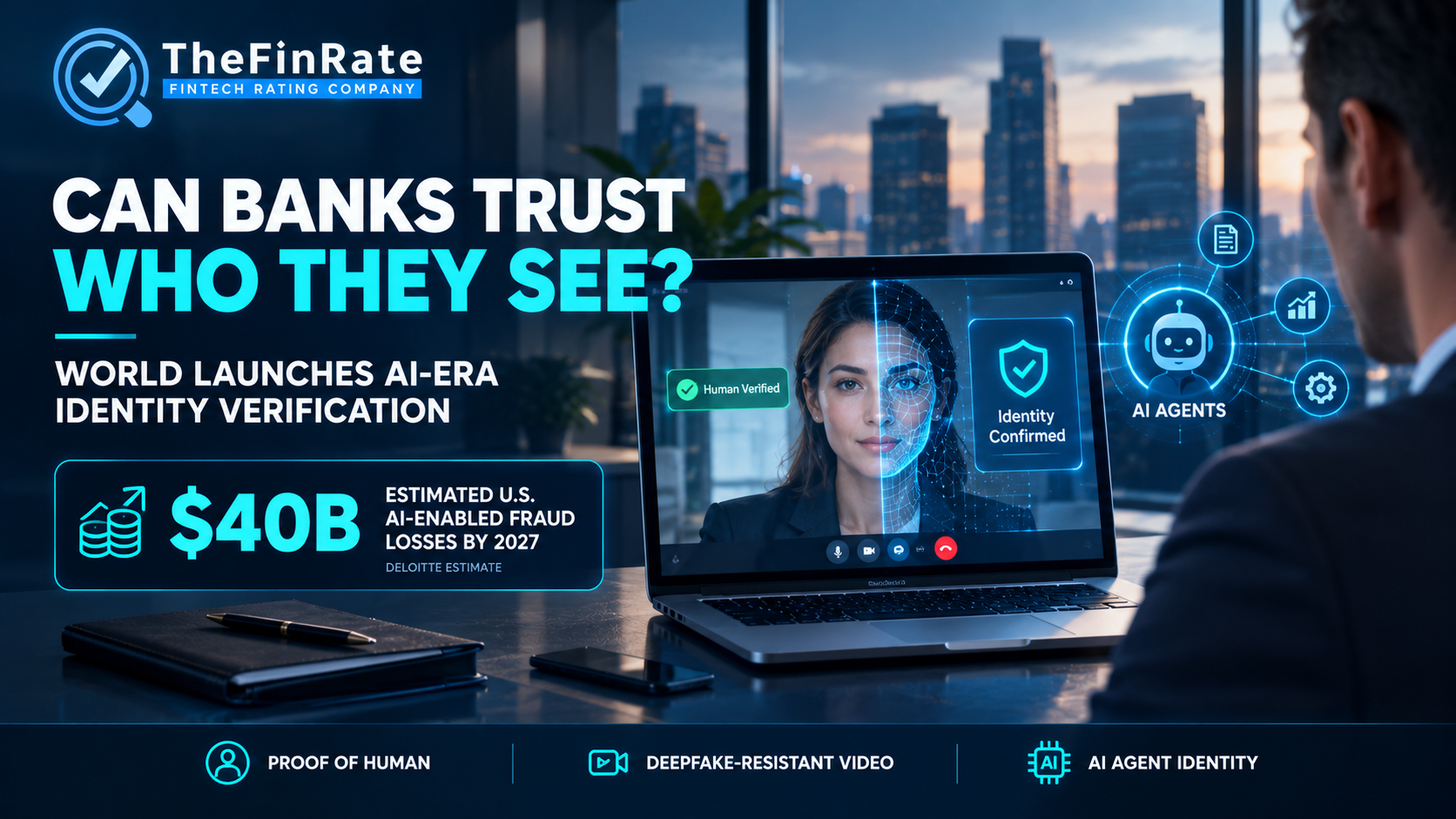
World, the digital identity project co-founded by OpenAI CEO Sam Altman, has launched a suite of tools designed to help banks and financial institutions address deepfake fraud, AI-driven impersonation, and emerging risks associated with autonomous AI agents.
Unveiled by World co-founder Alex Blania at Money20/20 in Las Vegas on 18 October 2026, the new offering brings together three products: the World ID app, World ID for Zoom, and World ID for Agents. The company says the combined technology can help financial institutions establish greater assurance around customer interactions, employee workflows, transactions, trades, and important video communications.
This marks the world's first industry-specific push into banking and finance. Rather than relying exclusively on conventional identity checks or AI systems that try to detect manipulated media, the offering centres on cryptographic proofs intended to establish whether a real person is behind an interaction.
The timing reflects a growing concern across financial services, as AI-generated voices, faces, and videos make fraudulent communications more convincing. Deloitte estimates that AI-enabled fraud losses in the United States could rise to $40 billion by 2027, up from an estimated $12.3 billion in 2023. These figures are estimates, not confirmed future losses, but they illustrate the potential scale of the challenge. For banks and fintech companies, the issue now extends beyond identifying suspicious messages to establishing whether a person is genuine and an instruction is authorized before consequential actions take place.
What Is World ID for Banking and Finance?
World ID for banking and finance combines three components. The World ID app lets people manage and present cryptographic proofs. World ID for Zoom helps participants verify that a person in a video meeting is human rather than a deepfake. World ID for Agents allows people to delegate identity proofs to AI agents so those agents can present the relevant proofs to third-party platforms.
The distinction matters because different financial interactions require different forms of assurance: a bank onboarding a customer needs to establish identity, an executive joining a video meeting needs protection against impersonation, and an agent carrying out a task needs to demonstrate authorization. The world's approach provides reusable proofs that support selected interactions without requiring every service to collect and store the same personal information independently.
The launch does not mean every bank has adopted the suite, though. The world has named initial design partners, but reported coverage did not identify a bank already deploying the product in production.
How the World ID App Establishes Proof of Human
The World ID app acts as an identity wallet in which users can claim, manage, and present proofs for participating digital services. The world's proof of human process uses an orb, a specialized hardware device that verifies a person's humanity and uniqueness through a one-time verification whose proof is then managed through the app.
The system lets participating services verify a particular fact about a user without necessarily receiving their full identity information, offering an additional signal for selected interactions, such as a service facing automated account creation requesting proof that an interaction involves a verified human.
Still, proof of human does not establish every fact a financial institution needs to know about a customer. Banks must still comply with know-your-customer requirements and apply appropriate transaction controls. The practical value will depend on how institutions integrate World ID with existing verification systems.
World ID for Zoom Targets Deepfake Video Impersonation
World ID for Zoom is designed to help participants establish that the person they are speaking with is human. Financial institutions use video meetings for client discussions and deal negotiations, but a live video image is no longer sufficient evidence of genuine participation, since AI-generated video and voice technologies can imitate real people.
According to World, the integration uses a cryptographic matching process involving an image from a person's prior Orb verification, a phone selfie, and the participant's image in the Zoom meeting, confirming the verified human is the person appearing in the meeting. The world says the integration analyses video rather than audio or transcripts. The product is now available to Zoom enterprise customers through the Zoom Marketplace, and World has joined Zoom's independent software vendor exchange program to support distribution.
Consider a hypothetical where a fraudster impersonates a finance executive during a video call and asks an employee to approve a large transfer. A signal confirming whether the person on screen is the verified human could warn against impersonation. That does not mean the tool validates the payment instruction itself, since a real executive could still be compromised or coerced. Institutions would still need independent approval procedures and callback verification. Verifying who appears in a meeting is one part of establishing trust, not a substitute for verifying the instruction.
World ID for Agents Addresses a New Financial Security Question
As businesses begin using AI agents to perform tasks, identity verification is expanding beyond human-to-human interactions. This raises a new question: how can a service establish that an AI agent has legitimate authorization from the person it claims to represent? World ID for Agents lets a person establish proofs about themselves and delegate them to an agent, which can then present those proofs to a third-party platform.
This differs from simply confirming an agent exists. The world's approach may help establish the human connection behind an agent, but identity proofs alone do not define every permission it should receive. A secure implementation still needs to determine which tasks the agent may perform and how the organization can revoke access if it behaves unexpectedly, especially where AI systems interact with payments or trading platforms.
The Financial Fraud Problem Behind the Launch
The growing use of generative AI has changed the economics of impersonation. Creating convincing synthetic media once required specialized skills, but modern AI tools make it easier to generate realistic voices, images, and videos. Financial services are particularly exposed because digital interactions often involve valuable assets and instructions that trigger consequential actions.
The concern is not confined to deepfake video calls. Fraudsters may use synthetic identities to target account opening or exploit weaknesses in account recovery, and if a service cannot distinguish an authorized agent from an unauthorized one, it becomes harder to trust an automated request.
These risks require layered protection. Identity verification helps establish who is involved, but institutions still need to monitor suspicious behavior, since an institution should not rely on a genuine-looking voice or video alone to approve an unusual transfer. Authentication establishes evidence about identity; authorization determines what that identity is allowed to do.
Privacy and Data Protection Remain Central
The world says its approach uses cryptographic proofs to let participating services establish selected facts without requiring them to receive or store all of a user's personal information. That model could appeal to institutions seeking stronger verification without creating additional centralized databases of sensitive identity information.
Still, privacy claims need to be assessed against the actual implementation. Institutions should examine how biometric verification works, where information is processed and what happens if a device is compromised, and must confirm the solution meets regulatory requirements in each market. Minimizing data disclosure is not the same as eliminating privacy risk, so the system still needs robust safeguards. Institutions will also need to weigh accessibility, since specialized hardware may not be equally convenient for every customer.
Who Is Testing the Technology?
The world has named Bain Capital, OpenExchange, Outtake, Pantera Capital, and VanEck Funds as initial design partners. Their participation signals interest, though design-partner status should not be confused with confirmed full-scale deployment, and World did not disclose pricing. Institutions will need to weigh the integration effort against existing fraud controls, and the technology's effectiveness will ultimately depend on how it performs against real impersonation attempts.
What the Launch Means for Banks and Fintech Companies
World ID's launch highlights three developments: proof of human identity may become an additional authentication layer, since passwords alone cannot establish that a live interaction involves the legitimate person; AI-agent authorization will require clearer boundaries; and financial security will increasingly depend on layered verification, since no single technology addresses every form of fraud. The challenge is introducing safeguards without unnecessary friction, applying stronger verification where risk warrants it while keeping routine interactions accessible.
The Bottom Line
The world is positioning its identity technology as infrastructure for an internet in which humans and AI agents increasingly interact, and its move into financial services targets a specific enterprise security problem. The opportunity is substantial if institutions find reusable proofs can strengthen verification across multiple channels, but adoption will depend on more than the underlying technology, as institutions weigh interoperability, privacy, reliability, and regulatory compatibility.
Verifying that someone is human does not establish that every instruction is legitimate, and proving an agent is linked to a person does not automatically authorize every action it can perform. As financial services become more automated, the critical question will not only be who is behind an interaction but also what they, or their AI agent, are actually authorized to do.
World takes on AI-driven impersonations with new suite for banking and finance
Comments
No comments yet. Be the first to share your thoughts.
Leave a comment