
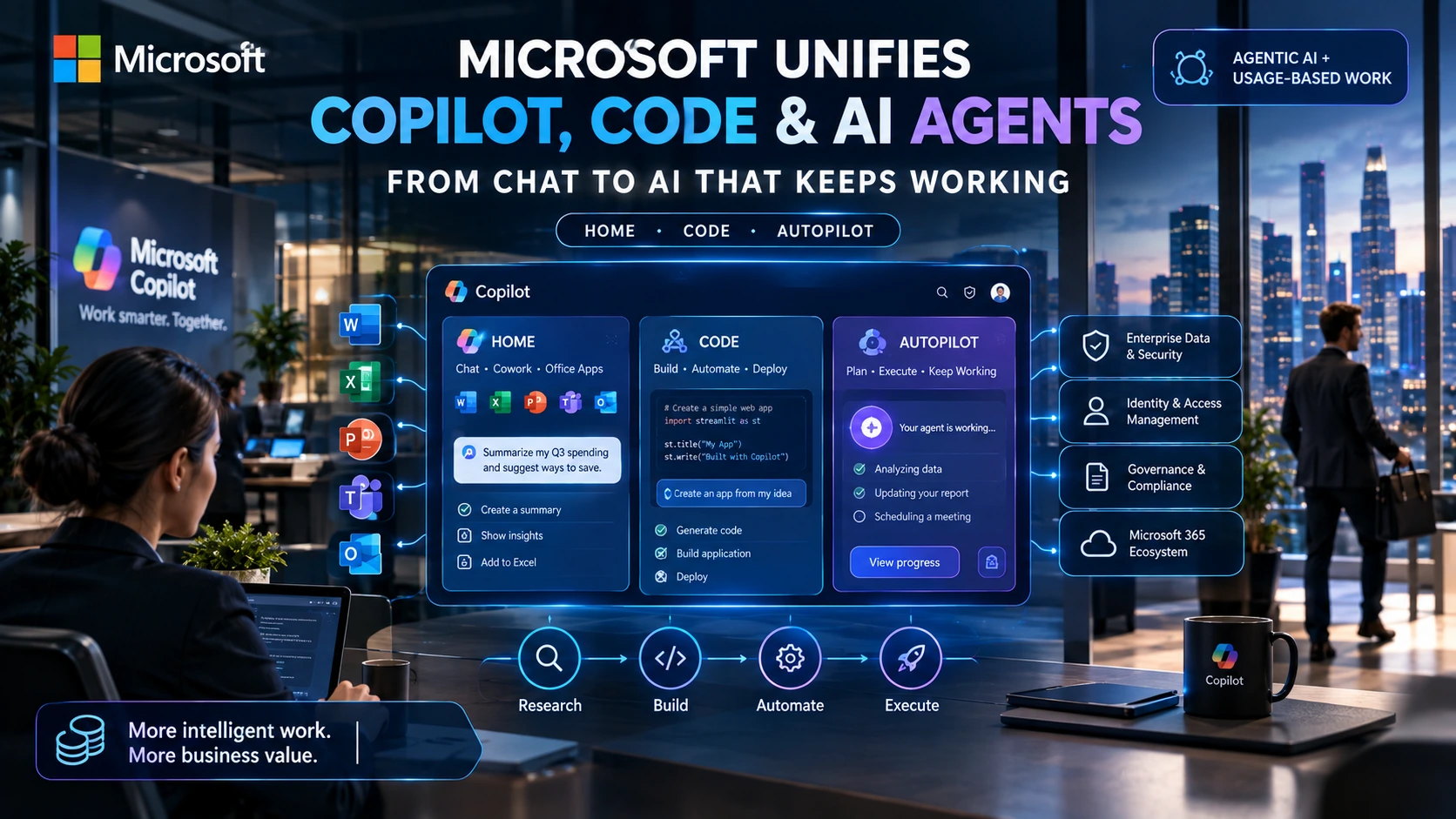
Microsoft is reshaping its Copilot strategy by bringing workplace productivity, coding, and autonomous AI agents into a single application. The company aims to make its enterprise AI platform more useful across everyday business workflows.
Microsoft introduced a redesigned Copilot on September 25, built around three experiences: Home, Code, and Autopilot. According to the company, this new structure brings AI-powered work, application development, and automation together, rather than requiring employees to move between separate AI products.
This move comes as enterprise AI competition intensifies. Companies such as Anthropic and OpenAI have been expanding products that combine multiple AI capabilities in increasingly accessible interfaces. Microsoft holds an additional advantage: its Copilot products sit alongside widely used workplace applications such as Word, Excel, PowerPoint, Teams, and Outlook.
Still, turning that distribution into widespread paid AI adoption remains a real challenge. Microsoft’s latest strategy attempts to address this by moving Copilot beyond a conventional chatbot and toward a platform where employees can ask questions, complete complex tasks, build applications, and delegate ongoing work.
Bringing Home, Code, and Autopilot together
The redesigned Copilot centers on three capabilities. Home combines Copilot Chat and Copilot Cowork into a central workplace experience. Microsoft is also bringing Word, Excel, and PowerPoint directly into the Copilot environment, letting users work with those applications without leaving the AI interface.
Code extends AI-assisted programming beyond traditional developers. According to Microsoft, users can describe what they want to build in natural language and create applications and automations using technology based on the same underlying technology as GitHub Copilot. This means employees who aren’t professional software developers can potentially use natural-language instructions to build tools for their own workflows.
Autopilot takes the concept further, letting users create a persistent AI agent that can continue working on assignments and interact with workplace applications such as Teams and Outlook. Microsoft describes Autopilot as a proactive capability designed to keep working even when the user isn’t actively interacting with it. The feature is scheduled to expand to private preview at the end of September.
Together, these three experiences represent Microsoft’s attempt to turn Copilot into a broader work platform, rather than simply another AI assistant.
The shift from chatbots to AI agents
Part of this announcement’s significance lies in how Microsoft is changing the role of AI inside the workplace. Traditional workplace AI assistants largely respond to prompts. An employee asks for a summary, drafts an email, or requests information, and the AI produces an answer.
Microsoft’s newer Copilot strategy, by contrast, is built around delegation. Cowork, which Microsoft made generally available worldwide to Microsoft 365 Copilot customers in June, handles longer-running and multi-step tasks. According to Microsoft, it can coordinate workflows and take action across Microsoft 365. Autopilot pushes that model further, toward persistent agents that can continue working toward an objective over time.
This reflects a broader shift across enterprise AI. Businesses are increasingly experimenting with systems that don’t simply generate content but instead perform sequences of actions involving documents, data, applications, and communication. The challenge, of course, is that autonomous systems also create additional requirements around security, permissions, oversight, and governance. As a result, Microsoft is positioning its Copilot environment not just as a place to use AI but also as infrastructure through which organizations can manage AI-generated work.
Microsoft wants more employees building with AI.
The new Code experience forms another important part of this strategy. Microsoft says Code lets users create applications and automations using natural-language instructions, based on the same underlying technology as GitHub Copilot, intended to make solution-building accessible to more knowledge workers.
The potential business impact extends well beyond traditional software development. An employee might use AI to create a workflow-specific application, automate a repetitive process, or build a small internal tool, all without waiting for a dedicated development team.
Microsoft is also introducing Copilot Managed Runtime in public preview. According to the company, this service can run code created through Copilot within the Microsoft 365 tenant boundary while still letting organizations apply IT governance and security controls. This infrastructure matters because AI-generated applications create a new operational problem for enterprises: building the application may become easy, but securing, deploying, and managing it can remain genuinely difficult.
Microsoft is not betting on one AI model.
Another notable part of Microsoft’s strategy is its continued support for multiple AI models. Microsoft has invested heavily in its own AI models while maintaining a close relationship with OpenAI. At the same time, Microsoft 365 Copilot has increasingly incorporated models from Anthropic and other providers.
Microsoft’s September 2026 Copilot documentation shows Anthropic’s Claude Fable 5.1 available in Copilot Cowork and Copilot Studio, alongside OpenAI models. This approach reflects Microsoft’s stated view that no single model is necessarily optimal for every task. In a September 23 post, Microsoft said its platform brings leading models from companies including Anthropic and OpenAI into the enterprise environment, rather than requiring customers to commit to one model provider.
This creates an interesting competitive position for Microsoft. The company competes with Anthropic and OpenAI at the application layer while simultaneously making some of their models available within its own enterprise ecosystem. For customers, that could make model selection more of a product feature than a separate purchasing decision.
Enterprise adoption remains the bigger test.
This redesigned Copilot arrives at a time when Microsoft already has a significant installed base of business software users. The opportunity is therefore enormous. Microsoft doesn’t need to convince every enterprise to adopt an entirely new workplace platform. Instead, it can introduce Copilot into environments that already use Microsoft 365.
The harder question is whether organizations will pay for and consistently use advanced AI capabilities at a real scale. The CNBC report accompanying the announcement noted that fewer than 7% of Microsoft’s more than 450 million commercial Office 365 seats had licenses for the AI addition, as of the company’s latest reported figure.
That gap illustrates both the size of the opportunity and the scale of the adoption challenge. Microsoft has already placed Copilot inside many of the applications businesses use every day. The next stage involves demonstrating enough value for organizations to expand usage beyond simple experimentation. The company is now attempting to make that value more tangible by giving employees tools that can actually perform work, rather than simply answer questions.
A different pricing model for AI work
Microsoft is also changing how customers pay for some of these new capabilities. The company says customers will pay for the Cowork, Code, and Autopilot portions of the new Copilot based on usage, rather than relying solely on a traditional fixed subscription model.
This approach aligns more closely with the economics of many AI services, where computing costs can vary significantly depending on the complexity and length of tasks. For enterprises, usage-based pricing can create flexibility, but it also introduces a new requirement: understanding and controlling AI consumption. Microsoft’s broader enterprise AI strategy includes governance and cost-management tools intended to help organizations manage that transition. These economics will only become more important as AI agents take on longer and more complex tasks.
Microsoft faces a crowded enterprise AI market.
This announcement arrives in a market where enterprise AI competition is moving quickly. Anthropic has gained attention among businesses for Claude’s coding and workplace capabilities, while OpenAI continues expanding its enterprise offerings. Other technology companies are also developing agentic AI systems designed to complete multi-step tasks.
Microsoft’s advantage remains its existing position in workplace software. Word, Excel, PowerPoint, Outlook, and Teams already sit inside many corporate workflows. By placing AI agents and application-building tools directly inside those same applications, Microsoft is betting that familiarity and existing distribution will matter as much as raw model capability in winning enterprise adoption. Whether that bet pays off will depend less on how impressive Copilot’s new features look in a demo and more on whether businesses actually change how their employees work day to day.
Comments
No comments yet. Be the first to share your thoughts.
Leave a comment