
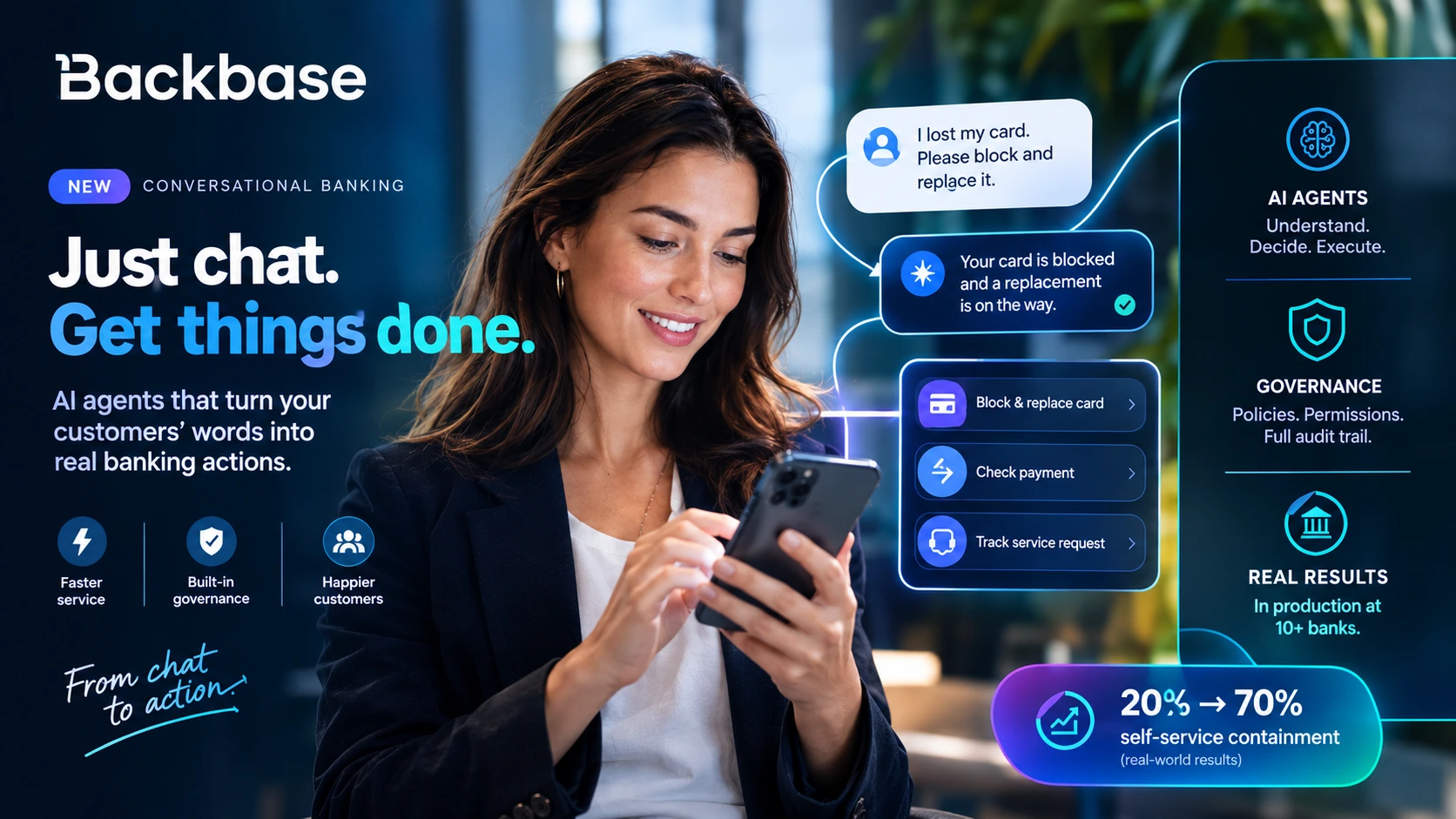
Backbase has launched Conversational Banking, bringing agentic AI into banking workflows that can execute customer and employee requests while maintaining governance and an audit trail of AI-driven decisions.
The Amsterdam-based banking technology provider said the solution is now generally available to financial institutions, allowing customers to use natural language to request actions such as blocking and replacing a lost card, checking a payment, or tracking a service request.
Rather than simply answering questions, the AI agents can translate customer requests into banking actions governed by the financial institution's existing policies, permissions, and approval workflows. That distinction marks an important change in how conversational AI is being deployed across financial services. The chatbot is no longer just answering the customer. It can help execute the customer's request.
At the same time, Backbase is positioning governance as a core part of the system, giving banks visibility into AI-driven decisions and providing employees with information about work already completed by agents.
Backbase Moves From Conversational AI to Agentic Banking
Traditional banking chatbots have largely focused on information retrieval.
Customers might ask about account balances, branch locations, payment status, or product information. The system responds, but the customer still needs to complete many actions through conventional digital banking interfaces.
Backbase's Conversational Banking model takes a different approach. Customers can describe what they want in natural language, and AI agents can interpret the request and initiate the appropriate banking workflow. For example, a customer who has lost a card can request that the card be blocked and replaced rather than navigating through multiple screens to complete the process. The same model can support payment inquiries and service requests.
The key change is therefore the movement from conversation to execution. Backbase is using its AI-native Banking OS as the foundation for the system, allowing Conversational Banking to work alongside existing digital banking environments rather than requiring banks to replace their existing mobile or online channels.
Governance Is Central to the Agentic Banking Model
Giving an AI agent the ability to perform banking tasks creates a much higher governance requirement than using AI to answer questions.
An incorrect answer can be frustrating. An incorrect action can have financial, operational, or regulatory consequences. Backbase addresses this by designing agentic execution around the bank's existing policies, permissions, and approval workflows. The objective is to allow agents to perform tasks within boundaries established by the financial institution.
That creates an important distinction between autonomous execution and uncontrolled autonomy. The bank remains responsible for defining what an agent can do, what permissions it has, and which workflows require additional approval.
The platform also creates an audit trail around AI-driven activity, giving financial institutions a way to review decisions and actions. For a regulated industry, that visibility can be just as important as the automation itself.
AI Agents Can Now Perform Banking Tasks
Backbase said Conversational Banking is already in production at more than 10 financial institutions.
The company said one of the four largest banks in South Africa has used the technology across 22 million customer interactions. According to Backbase, the deployment increased the institution's self-service containment rate from 20% to 70%. That means substantially more customer interactions could be resolved through self-service rather than being transferred to human employees.
The company also cites McKinsey data suggesting that this level of automation could reduce bank operating costs by 15% to 20% by automating routine information gathering and allowing employees to focus on advisory work and more complex cases. However, the figures are company-cited and should be viewed in that context. They demonstrate the potential economic case for agentic banking, but they do not represent a guaranteed saving for every financial institution.
From 20% to 70% Self-Service Containment
The reported South African bank deployment provides one of the clearest indicators of what Backbase is trying to achieve.
A self-service containment rate of 20% means most interactions still require escalation or human intervention. Backbase says the deployment raised that figure to 70%. If replicated across other banking environments, that kind of change could materially affect customer-service operations.
Routine requests could be handled by agents while human employees concentrate on cases involving exceptions, investigations, complex financial decisions, or situations requiring judgment. This creates a different role for employees. Instead of acting as the first point of contact for every customer request, employees can become escalation points for cases that genuinely require human involvement.
Conversational Banking Gives Employees an AI Audit Trail
Backbase's approach is not limited to the customer-facing experience.
The company says employees can use Conversational Banking as an internal knowledge resource, including summaries of work already completed by AI agents. This becomes particularly useful when a customer request moves from automated handling to human intervention. An employee does not necessarily have to reconstruct what happened from the beginning. Instead, the system can provide information about the actions already taken by the agent.
That creates a connection between automation and human oversight. It also makes the audit trail more valuable because it is not simply a record for compliance purposes. It can become part of the operational workflow.
Why Agentic AI Is Different From Banking Chatbots
The distinction between conversational AI and agentic AI is becoming increasingly important across financial services.
A conventional chatbot primarily responds. An agent can potentially plan, make decisions within defined boundaries, and execute tasks. That difference increases both the potential value and the risk.
Banking systems contain sensitive financial information and support transactions that can have immediate consequences. An agent therefore needs more than access to a large language model. It needs controlled access to banking systems, defined permissions, reliable data, and mechanisms for monitoring its actions.
Backbase is attempting to place those controls within the Banking OS itself. That approach reflects a broader industry shift toward treating AI agents as operational participants rather than simply digital assistants.
Backbase Wants Agentic AI to Work With Existing Banking Systems
One challenge for banks adopting agentic AI is legacy infrastructure.
Many financial institutions operate complex technology stacks containing core banking platforms, payment systems, customer-service tools, and numerous point solutions. Replacing those systems simply to deploy AI is not realistic for most banks. Backbase says Conversational Banking is designed to work alongside existing digital stacks.
That makes the engagement layer increasingly important. Instead of replacing the core banking system, the agent can interact with existing systems and workflows through the bank's digital infrastructure. The model effectively places AI at the interface between the customer and the operational systems that execute the request.
Backbase's Wider Agentic Banking Strategy
Conversational banking is part of a broader move by Backbase toward agentic banking.
The company has been expanding its focus from digital customer experiences toward AI-driven coordination and execution across banking operations. Its banking OS is positioned as the foundation for this strategy, while conversational banking provides a customer-facing entry point. Backbase has also been developing other capabilities around customer and relationship intelligence and customer operations.
The broader objective is to create an environment where AI agents can coordinate tasks across banking workflows while remaining subject to institutional controls. That strategy becomes particularly relevant as banks look for ways to scale AI beyond isolated pilots.
Mastercard Partnership Expands the Potential Reach
Backbase's agentic banking strategy also sits within a wider ecosystem of financial institutions and technology companies.
The company has previously partnered with Mastercard to bring agentic banking capabilities to more than 120 banks globally. That distribution potential is important because building agentic banking technology is only one part of the challenge. The technology also needs to reach financial institutions with different regulatory requirements, operating models, and technology stacks.
Backbase says its platform already serves more than 120 banks across 50 countries, providing a potential distribution base for its new agentic capabilities.
The Biggest Challenge Is Trust
The commercial opportunity for agentic banking is clear.
Banks could potentially automate large volumes of routine customer interactions, reduce service costs, and give customers a faster way to complete everyday tasks. But financial institutions cannot simply hand unrestricted authority to AI systems. An agent that blocks the wrong card, initiates the wrong action, or provides incorrect information can create consequences that extend well beyond customer frustration.
That makes governance critical. The most important question is therefore not simply whether an AI agent can perform a task. It is whether the bank can prove why the agent performed it, what information it used, what permissions it had, and whether the action complied with institutional policy. Backbase's audit-trail approach directly addresses that requirement.
Agentic Banking Needs More Than a Smart Model
The evolution from chatbot to agent also changes what banks need from their technology providers.
A powerful language model alone is not enough. Financial institutions need identity controls, permissions, workflow orchestration, policy enforcement, monitoring, and auditability around the model. That is why Backbase's positioning of Conversational Banking as part of its Banking OS is significant.
The company is effectively arguing that agentic AI should sit inside the bank's governed operational infrastructure rather than operate as a separate AI layer with broad access to banking systems. That architecture could become increasingly important as regulators and financial institutions demand greater accountability from AI systems.
What Backbase's Launch Means for Banking
Conversational Banking represents a broader shift in digital financial services.
The first phase of digital banking put banking services into customers' smartphones. The next phase used conversational AI to help customers find information. Agentic banking takes the next step. Customers describe what they want, and AI agents can help make it happen.
But execution changes the risk equation. Once AI moves from answering questions to changing account states and initiating banking workflows, governance becomes part of the product rather than an afterthought. Backbase's emphasis on policies, permissions, and audit trails reflects that reality.
The company's reported deployment results also show why banks are interested. A move from 20% to 70% self-service containment could significantly change how customer-service operations are structured if similar results can be achieved elsewhere. The challenge will be proving that automation can scale without compromising accuracy, security, compliance, or customer trust.
Backbase's Conversational Banking launch signals that the next generation of digital banking may not be defined by better interfaces, but by AI agents that can actually execute banking tasks, with the bank still firmly in control.
Comments
No comments yet. Be the first to share your thoughts.
Leave a comment