
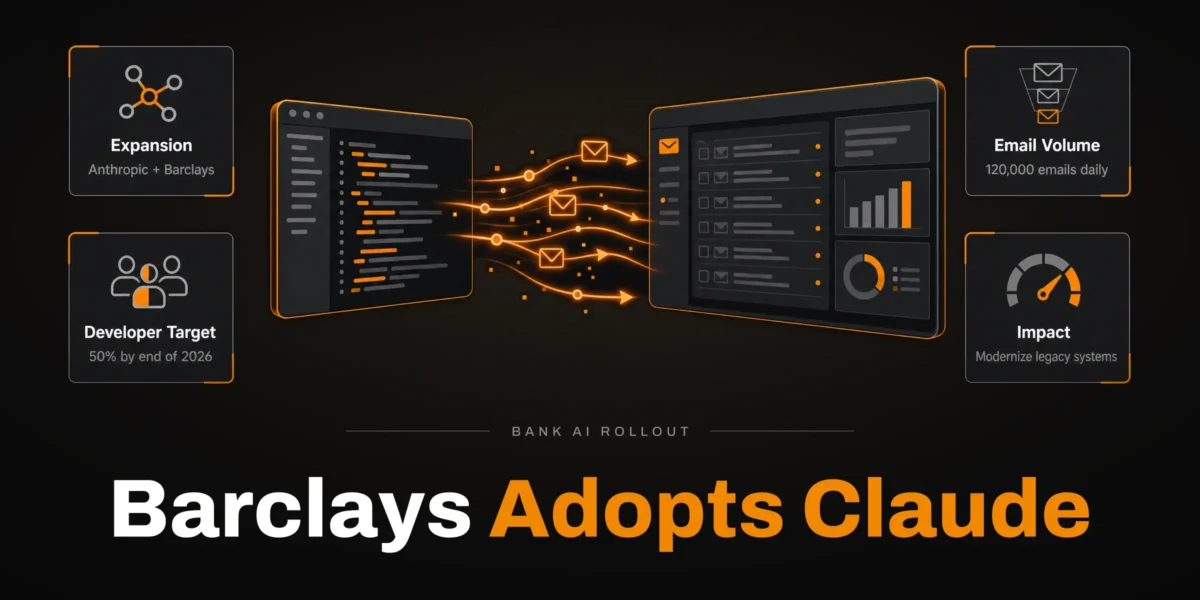
Barclays is pushing Anthropic’s Claude deeper into the bank. Half of its software developers are expected to use Claude Code by the end of 2026. The lender wants AI to speed up software development, modernize legacy systems, and cut routine work.
According to Anthropic, usage should rise to a majority of Barclays’ software engineers in 2027. The expansion shows where large banks are taking enterprise AI next. They are moving away from isolated experiments and toward software development and daily operations.
Claude moves into software development.
Barclays uses Claude to support software development and to modernize older technology. The bank says it helps technical teams work on legacy platforms and improve software quality. It also frees human experts to focus on harder engineering and cybersecurity problems.
Barclays is not treating Claude as a simple productivity assistant. It is building the tool into how software gets built, tested, secured, and run. Anthropic calls this a broader move toward agentic AI in enterprise technology.
The benefit could be large for banks. Many still run complex systems built over decades, and modernizing them takes heavy engineering effort. AI-assisted development can speed up parts of that work. Engineers stay responsible for validation, security, and deployment.
120,000 emails a day
Claude also works in Barclays’ Global Markets business, where it handles a large volume of client enquiries. The platform processes about 120,000 emails each day. It classifies and enriches incoming messages and decides the right processing route.
The goal is less manual handling and faster access to relevant information. This shows AI in finance going beyond text generation. It now sorts information, routes work, and supports operational decisions. At this volume, even small cuts in manual effort can add up to real efficiency gains.
16,000 colleagues use the knowledge assistant.
Barclays also runs a Colleague Knowledge Assistant, which helps employees find information while serving customers. It has been live since 2025 and runs on Claude through a retrieval-augmented generation setup.
More than 16,000 colleagues have adopted it, and it has handled over one million searches, according to Anthropic. It supports Barclays UK staff who serve more than 20 million retail customers. The model here is different from replacing customer service. AI helps employees find answers faster, so they can handle customers more efficiently.
An efficiency push
The Claude expansion fits a wider cost target. Bloomberg reported that Barclays aims for about £2 billion ($2.7 billion) in efficiency savings, with AI expected to contribute.
The impact reaches beyond engineers. AI can help with information retrieval, document processing, communications, coding, and workflow management. The hard part is turning individual time savings into measurable gains across a huge organization.
Why banks are adopting AI faster
Banks operate at an enormous scale. They handle millions of transactions, documents, and internal requests, which creates many structured workflows where AI can help.
Yet banks also face higher barriers than most tech firms. AI must work within security controls, data-protection rules, model governance, and human oversight. Anthropic says Barclays applies governance, security controls, and human oversight as it expands Claude. That layer will matter even more as AI moves from answering questions to taking actions inside company systems.
What it means for Anthropic
The deal matters for Anthropic too. The company competes for enterprise customers against OpenAI and Google. Financial services is a key market, with big technology budgets and many AI use cases. Barclays adds another high-profile example of Claude running at scale. That helps Anthropic as it prepares for a potential public listing and tries to prove steady commercial demand.
From experiments to infrastructure
Early enterprise AI focused on pilots, chatbots, and employee experiments. The next phase embeds AI in core workflows. At Barclays, that means software engineering, customer-service knowledge, and global markets operations.
The value of enterprise AI will depend less on how many staff can open a chatbot. It will depend on how deeply AI sits inside the processes that run the business. Barclays’ plan to put Claude Code in front of most engineers in 2027 suggests it sees AI-assisted development as a long-term capability.
Three trends to watch
The partnership highlights three trends:
- AI is moving into bank tech teams. Software engineering is one of the clearest enterprise uses.
- Scale matters. Handling 120,000 emails a day shows AI working on high-volume workflows, not occasional tasks.
- Governance sets the limit. Banks cannot separate productivity gains from security, oversight, and accountability.
The next stage of banking AI will be less about picking the best model. It will be about building reliable systems around that model. For Barclays, Claude is becoming part of that infrastructure.
Comments
No comments yet. Be the first to share your thoughts.
Leave a comment