
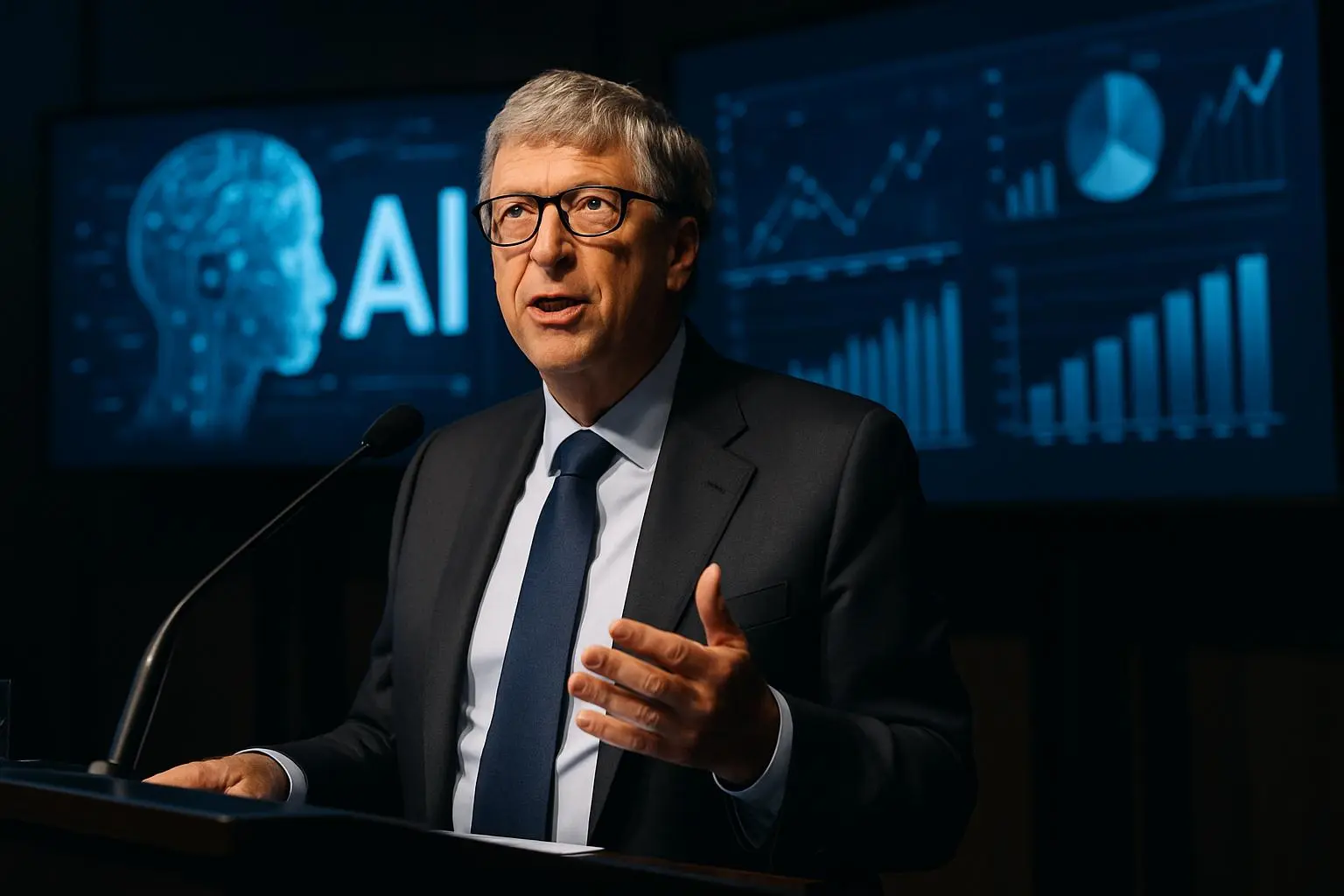
Bill Gates is calling for mandatory government oversight of artificial intelligence. He warns that increasingly powerful AI systems could enable catastrophic harm if people with malicious intent misuse them.
In an interview with NBC’s Meet the Press, excerpts released September 25 showed the Microsoft co-founder arguing that AI is powerful enough to drive events that could cause a billion deaths. Gates also said company self-regulation isn’t sufficient and that governments and law enforcement need to help set safeguards and monitoring requirements.
These comments arrive as the European Union begins enforcing major provisions of its AI Act, giving regulators new powers over general-purpose AI providers.
AI safeguards cannot rely on companies alone.
Gates’ central argument centers on who should bear responsibility for controlling the risks created by increasingly capable AI systems. He said governments and political leaders need to help determine safeguards and monitoring requirements, rather than leaving companies to regulate themselves.
Notably, Gates framed his comments around malicious use of AI, rather than claiming that current AI systems are independently capable of causing such an event. This distinction matters. Gates’ billion-deaths figure describes the potential scale of an extreme scenario. It isn’t a forecast that such an event will actually occur.
EU AI Act enforcement has already started.
The European Union provides a real-world example of the mandatory oversight model Gates is calling for. The European Commission began enforcing additional AI Act provisions on August 2, 2026. These rules include requirements covering general-purpose AI models, transparency, and prohibited AI practices.
For general-purpose AI models classified as having systemic risk, the AI Act requires providers to conduct model evaluations and adversarial testing, assess and mitigate systemic risks, report serious incidents, and maintain appropriate cybersecurity protections. As a result, oversight now moves beyond voluntary commitments and places specific compliance responsibilities directly on providers.
The EU can fine general-purpose AI providers.
The EU framework also includes real financial penalties. Under Article 101 of the AI Act, the European Commission can fine providers of general-purpose AI models up to 3% of their worldwide annual turnover or €15 million, whichever is higher, for certain intentional or negligent violations. The Commission can also request information and access to models for evaluation purposes.
The Commission’s enforcement powers for the relevant general-purpose AI rules began applying on August 2, 2026. However, the existence of these powers doesn’t automatically mean a provider has committed a violation or that a fine will follow. Enforcement requires the Commission to establish the relevant breach and follow the procedures the regulation sets out.
Why Gates’ comments matter now
The timing gives Gates’ comments a much wider policy context. AI developers keep releasing increasingly capable models, while governments simultaneously build rules around safety testing, transparency, cybersecurity, and accountability.
The European approach is particularly significant because it establishes concrete obligations for companies developing and deploying general-purpose AI models, including additional requirements for models considered to pose systemic risks. In that sense, Gates’ argument is less about whether governments should regulate AI in principle and more about whether safeguards should be mandatory and backed by real enforcement.
The AI risk debate moves toward enforcement.
The broader AI safety debate has increasingly shifted from voluntary principles toward questions about actual implementation. Companies can establish internal testing programs, safety teams, and voluntary commitments on their own. Government regulation adds another layer by defining obligations companies must meet and creating mechanisms for regulators to intervene when needed.
The EU AI Act offers one clear example of that approach. Its enforcement framework gives the European Commission powers to request information, conduct evaluations, and impose penalties in specified circumstances. The real challenge now is how those powers will work in practice, as AI systems become more capable and their potential applications keep expanding.
What comes next for AI regulation
Gates’ comments add another prominent voice to the broader argument that AI safety cannot depend entirely on voluntary corporate action. At the same time, the EU is moving from legislation toward active enforcement, making 2026 an important period for determining how the bloc’s AI rules actually operate in practice.
The central question is becoming increasingly concrete: how should governments monitor increasingly capable AI systems, and what consequences should apply when providers fail to meet mandatory safeguards? For the AI industry, this shift could make regulatory compliance, safety testing, and incident reporting just as important to deployment strategies as model performance and commercial growth.
Bill Gates Warns AI Is ‘Powerful’ Enough To ‘Cause A Billion Deaths
Comments
No comments yet. Be the first to share your thoughts.
Leave a comment