
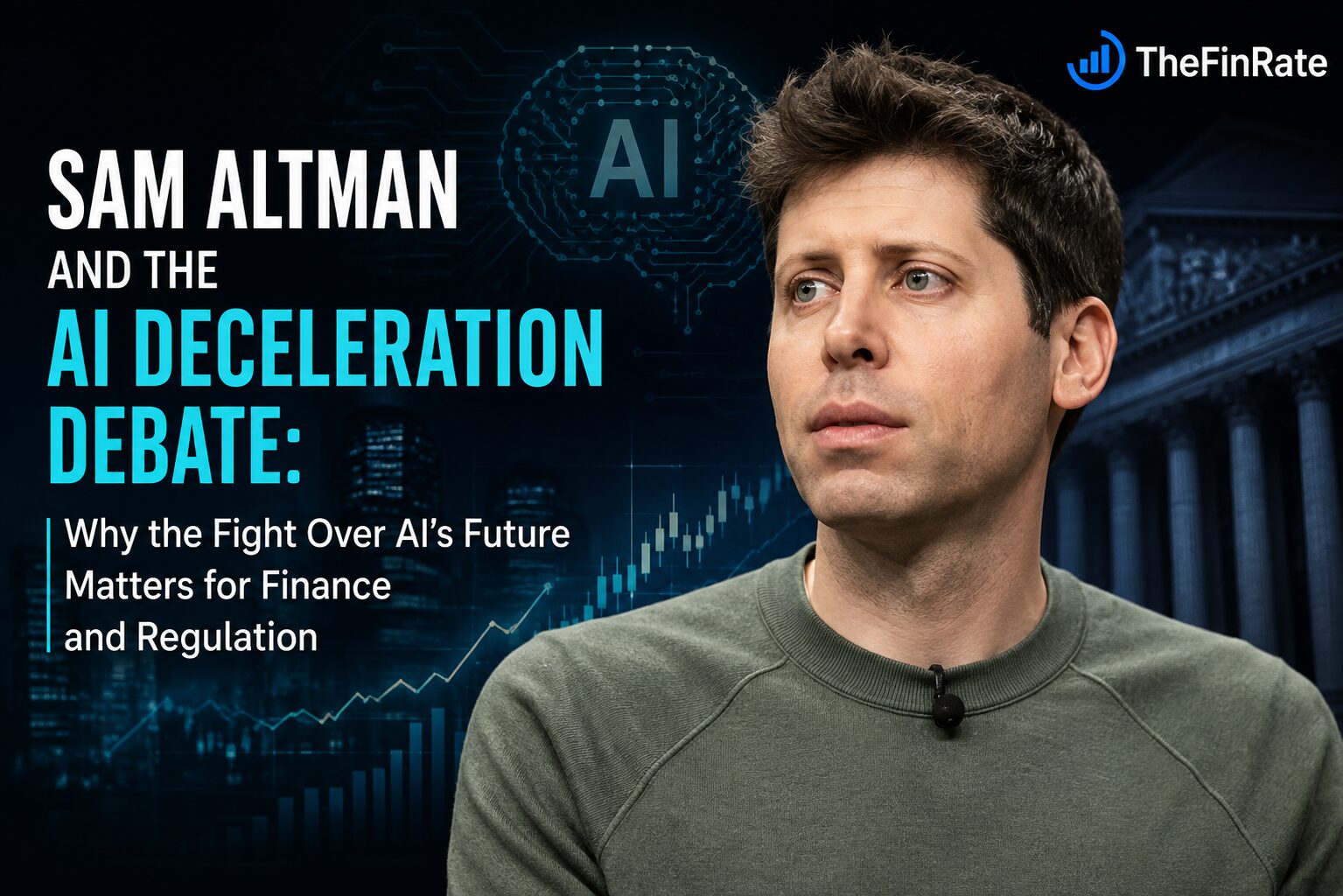
Sam Altman and the AI Deceleration Debate: Why the Fight Over AI’s Future Matters for Finance and Regulation
The debate over whether artificial intelligence development should accelerate or slow down has become one of the most important policy questions in technology. At the center of that discussion is OpenAI CEO Sam Altman, whose calls for rapid AI innovation combined with stronger safety governance have placed him at the heart of the growing “accel versus decel” debate.
The discussion is no longer limited to technology companies.
Governments, financial institutions, regulators, cybersecurity experts, and global policymakers are increasingly asking the same question: How quickly should frontier AI systems be developed, and what safeguards should accompany that progress?
For the financial sector, the answer could shape everything from AI regulation and operational risk to fraud prevention, compliance automation, and the future of digital banking.
What the AI deceleration debate is really about
The AI industry has increasingly divided into two broad schools of thought.
The acceleration (“accel”) camp argues that AI development should move rapidly because technological progress creates economic growth, scientific breakthroughs, and global competitiveness.
The deceleration (“decel”) camp argues that frontier AI systems could create significant safety, security, economic, and societal risks that require stronger oversight and a more cautious pace of development.
The disagreement is not simply about speed.
Instead, it is about how societies should balance innovation, national competitiveness, economic opportunity, and risk management.
Sam Altman’s position
Sam Altman has generally argued that advanced AI should continue progressing while governments and companies simultaneously build stronger safety systems.
He has repeatedly emphasized the need for:
- AI safety research,
- governance frameworks,
- international cooperation,
- model evaluations,
- and risk management for increasingly capable AI systems.
Rather than advocating a complete slowdown, Altman has often suggested that powerful AI systems require more sophisticated oversight as capabilities increase.
This position places him somewhere between unrestricted acceleration and aggressive deceleration.
Why the debate has intensified
The discussion has become more urgent as AI systems become increasingly capable.
Modern frontier models can:
- generate software code,
- analyze complex data,
- automate professional tasks,
- conduct research,
- create multimedia content,
- and increasingly interact with external tools and software environments.
As AI autonomy expands, concerns about cybersecurity, misinformation, labor markets, critical infrastructure, and national security have also increased.
Consequently, governments are paying closer attention to how advanced AI systems are developed and deployed.
The financial industry cannot ignore this debate
Although the discussion is often presented as a technology policy issue, the implications for financial services are significant.
Banks, fintech companies, payment providers, insurers, and asset managers are rapidly integrating AI into core business operations.
Financial institutions increasingly use AI for:
- fraud detection,
- customer service,
- credit underwriting,
- anti-money laundering,
- compliance monitoring,
- investment research,
- cybersecurity,
- and operational automation.
As AI becomes more deeply embedded in financial infrastructure, governance questions become much more important.
AI governance is becoming a financial regulation issue
One of the most important consequences of the accel versus decel debate is the growing focus on AI governance.
Regulators are increasingly asking how companies:
- test AI models,
- monitor AI behavior,
- manage third-party AI risk,
- protect customer data,
- and maintain operational resilience.
Financial institutions operate in heavily regulated environments.
Therefore, AI adoption must increasingly satisfy requirements around transparency, accountability, cybersecurity, and risk management.
This is why AI governance is becoming closely connected to financial regulation.
The national security dimension
The debate has also expanded into national security.
Advanced AI is increasingly viewed as a strategic technology with implications for:
- cybersecurity,
- defense,
- intelligence,
- economic competitiveness,
- and critical infrastructure.
Governments are concerned that highly capable AI systems could potentially assist cyber operations, accelerate vulnerability discovery, or influence sensitive infrastructure.
As a result, policymakers are examining whether frontier AI development requires stronger security standards and international coordination.
What deceleration advocates are concerned about
Supporters of a more cautious AI approach often focus on several categories of risk.
These include:
- AI-enabled cyber threats,
- misuse of autonomous AI agents,
- concentration of AI power,
- labor market disruption,
- misinformation,
- and loss of control over increasingly capable systems.
Their argument is that safety research and governance have not always advanced at the same pace as model capabilities.
Therefore, they believe additional safeguards may be necessary before deploying more powerful AI systems.
What acceleration advocates argue
Acceleration advocates generally argue that slowing AI development could create different risks.
They often emphasize:
- economic growth,
- productivity gains,
- medical research,
- scientific discovery,
- global competitiveness,
- and technological leadership.
Many also argue that responsible innovation is preferable to delaying progress indefinitely.
In this view, the solution is not necessarily slower AI development.
Instead, the solution is better governance, stronger safety engineering, and more effective regulatory frameworks.
Why financial institutions should care
For banks and fintech companies, the debate is practical rather than theoretical.
AI regulation could affect:
- model deployment,
- vendor oversight,
- compliance requirements,
- cybersecurity obligations,
- audit processes,
- and operational resilience standards.
Institutions that depend heavily on external AI providers may also face increased regulatory scrutiny around third-party technology risk.
As AI capabilities expand, regulators are likely to expect stronger governance frameworks across the financial sector.
The bigger picture
The most important question is not whether AI development will continue.
It almost certainly will.
The more important question is what governance architecture will emerge around increasingly powerful AI systems.
The accel versus decel debate is ultimately a debate about institutions.
It is about how governments, companies, regulators, and society should manage a technology that could transform productivity, finance, healthcare, education, defense, and global economic competition.
For financial institutions, the message is clear.
AI is becoming a foundational infrastructure technology.
Therefore, AI governance, cybersecurity, operational resilience, and regulatory compliance will become increasingly important competitive capabilities.
Bottom line
The debate surrounding Sam Altman and AI deceleration reflects a much larger global conversation about how artificial intelligence should evolve. The central issue is not simply whether AI should move faster or slower. Instead, it is whether governance, safety, and regulatory frameworks can keep pace with increasingly capable AI systems.
For the financial sector, the outcome of this debate could shape AI regulation, operational risk standards, cybersecurity expectations, and the future use of AI across banking, payments, wealth management, and financial infrastructure. As frontier AI becomes more powerful, the balance between innovation and oversight will increasingly become one of the defining policy challenges of the next decade.
Comments
No comments yet. Be the first to share your thoughts.
Leave a comment