
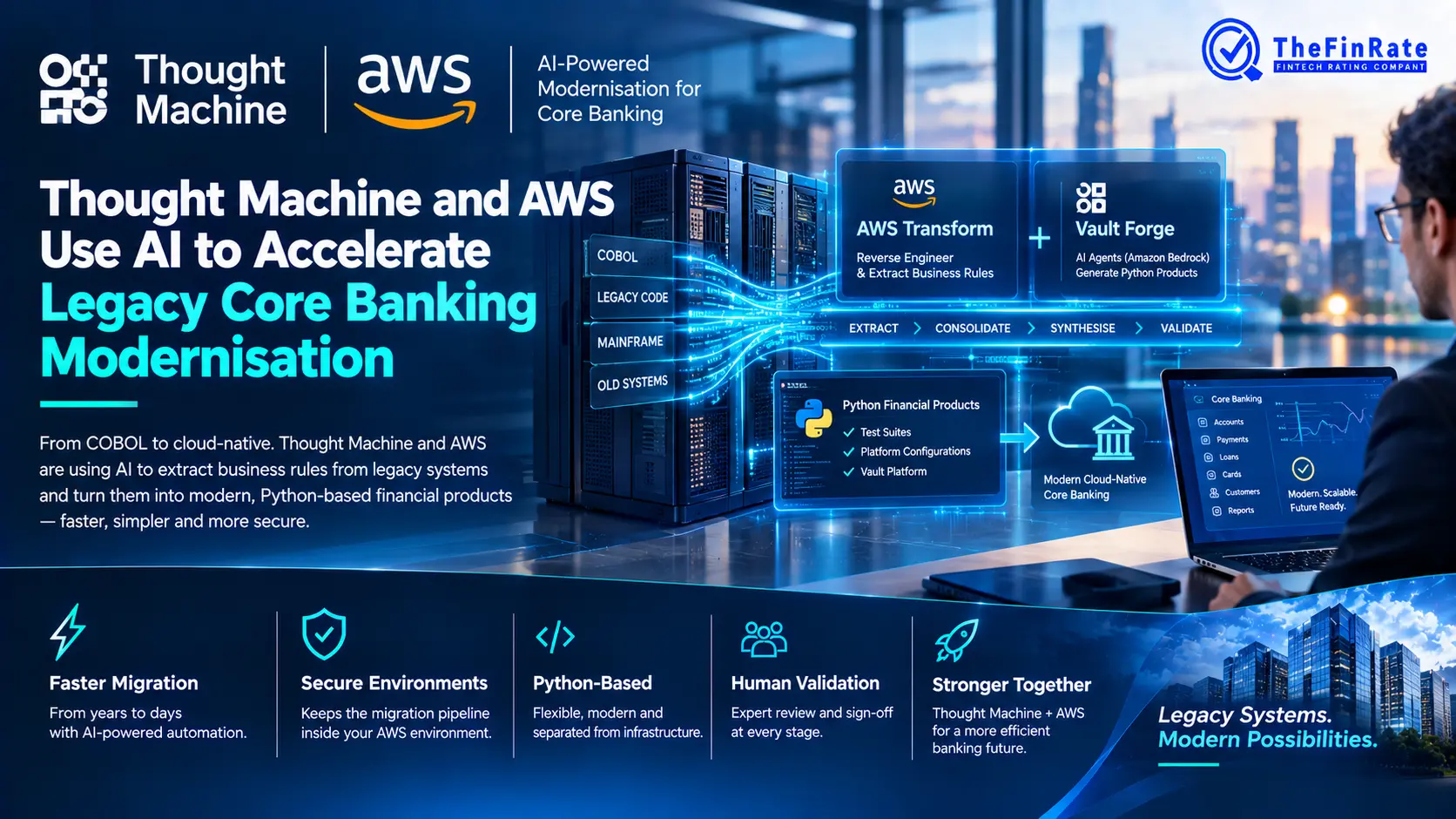
Thought Machine has partnered with Amazon Web Services (AWS) to use AI for one of banking’s most difficult technology problems: converting legacy mainframe systems into modern cloud-native financial products.
The cloud-native core banking and payments technology company said its new migration solution combines AWS Transform with Thought Machine’s Vault Forge, an AI tooling suite powered by Amazon Bedrock.
Instead of translating millions of lines of legacy code line by line, the approach extracts the underlying business rules from systems such as COBOL-based mainframes and converts them into simulation-tested Python financial products.
Thought Machine says the process can compress migration programs that traditionally take years into days while allowing banks to keep the migration pipeline inside their secure AWS environments.
AI Takes a Different Approach to Legacy Banking Migration
Legacy core banking systems often contain decades of financial-product logic embedded deep inside applications and database infrastructure.
That makes replacing them difficult.
A bank may have millions of lines of code covering interest calculations, fees, repayment schedules, account lifecycles, and other product rules. Simply translating that code into another programming language can preserve the technical complexity that banks are trying to remove.
Thought Machine and AWS are taking a different approach.
The joint solution uses AWS Transform to reverse engineer legacy applications and identify the business logic contained within them. That logic is then processed by Vault Forge, which uses specialized AI agents through Amazon Bedrock to generate Python-based financial products for Thought Machine’s Vault platform.
The objective is to extract what the legacy system actually does rather than reproduce every line of the old implementation.
From COBOL to Business Rules
The migration pipeline has four main stages: extraction, consolidation, synthesis, and validation.
During extraction, AWS Transform performs discovery and reverse engineering of legacy applications. The resulting business logic is structured using Easy Approach to Requirements Syntax (EARS) specifications.
The consolidation stage then addresses another common problem in legacy banking environments: duplicated product variations.
Banks can accumulate hundreds of versions of similar financial products over time. The new pipeline is designed to consolidate these variations into more streamlined business specifications before the modern product is generated.
Vault Forge then moves into the synthesis stage.
Using Amazon Bedrock, specialized AI agents generate SDK-compliant Python financial products, test suites, and platform configurations.
The final stage is validation.
Banks retain human review gates and explicit sign-off authority before generated products move into a Vault platform sandbox for further evaluation.
That human-in-the-loop element is important because financial-product migration involves more than software compatibility. Banks need to establish that the resulting product behaves according to the intended financial rules.
Why Python Matters to the Modernization Strategy
Thought Machine’s Vault platform uses Python to define financial products as code.
This separates product logic from the underlying core infrastructure.
For example, rules covering interest calculations, fee structures, repayment workflows, and account lifecycles can be represented as financial-product logic rather than being tightly coupled to database infrastructure.
That architecture gives the AI migration pipeline a cleaner target.
Rather than reproducing the structure of a legacy mainframe, the system can translate extracted business intent into higher-level financial-product code.
The distinction could be important for banks attempting to modernize systems that have accumulated decades of technical debt.
AWS Transform and Vault Forge Create an Automated Pipeline
The partnership connects two parts of the modernization process.
AWS Transform focuses on understanding and reverse engineering legacy applications.
Vault Forge then orchestrates AI agents that can turn the extracted specifications into financial products and associated testing infrastructure.
The result is a pipeline that moves through discovery, simplification, code generation, and validation.
Thought Machine says banks can receive a validated migration proof earlier in the process rather than waiting until a large-scale transformation program is near completion.
The company also says the solution operates entirely within the bank’s secure AWS environment.
That could be particularly relevant for financial institutions handling sensitive customer and transaction data during core-system migrations.
Banks Still Need Human Validation
AI-generated financial products do not remove the need for governance.
Thought Machine’s process includes human review gates before the generated products can proceed to further evaluation.
This matters because migration errors can have consequences beyond ordinary software bugs.
A small difference in an interest calculation, fee rule, or repayment workflow could affect customer accounts and financial reporting.
The validation stage therefore provides a control point between automated code generation and deployment.
The approach also gives banks an opportunity to compare the behavior of the modernized product with the legacy system before moving further into production migration.
Thought Machine Launches Core Modernization Accelerator
Alongside the technology, Thought Machine is launching a Core Modernization Accelerator program.
The program will bring technical architects, product specialists, and forward-deployed engineers into bank teams to support delivery, governance, and architecture setup.
This reflects the broader challenge of core banking transformation.
Replacing a legacy core is not simply a software exercise. Banks also need to understand existing products, dependencies, data structures, operational processes, and regulatory requirements.
The accelerator is intended to provide additional support around those implementation challenges.
AI Could Change the Economics of Core Banking Migration
Paul Taylor, CEO of Thought Machine, said the AWS partnership is intended to change the economics of core modernization by allowing banks to use AI to convert complex mainframe specifications into cloud-native financial products.
Charith Mendis, Head of Worldwide Banking, Financial Services Industries at AWS, described the partnership as a way to create a more continuous and automated route from mainframe code to cloud-native core banking.
The announcements point to a broader shift in how financial institutions may approach legacy technology.
For years, core modernization has involved large teams manually analyzing existing systems and gradually rebuilding functionality on newer infrastructure.
AI introduces another possibility: analyze the legacy system, identify the underlying business intent, generate the new implementation, and test the result in a controlled environment.
That does not eliminate the complexity of migration. But it could change where much of the manual work happens.
What the AWS and Thought Machine Partnership Means for Banks
The immediate significance of the partnership is not simply that AI can generate code.
The more important change is the attempt to separate business intent from legacy implementation.
Banks do not necessarily need to preserve the architecture that originally delivered a financial product. They need to preserve the rules and behavior that the product requires.
AWS Transform and Vault Forge are designed around that distinction.
If the approach performs as described, banks could spend less time translating obsolete technical structures and more time validating the financial products they want to operate on modern infrastructure.
For institutions with decades of mainframe technology, that could make core transformation more manageable.
The technology will still need to prove itself across complex real-world banking environments, particularly where legacy systems contain undocumented dependencies or highly customized product rules.
But the partnership represents a notable change in the modernization playbook: rather than asking AI to translate every line of old banking code, Thought
Comments
No comments yet. Be the first to share your thoughts.
Leave a comment