
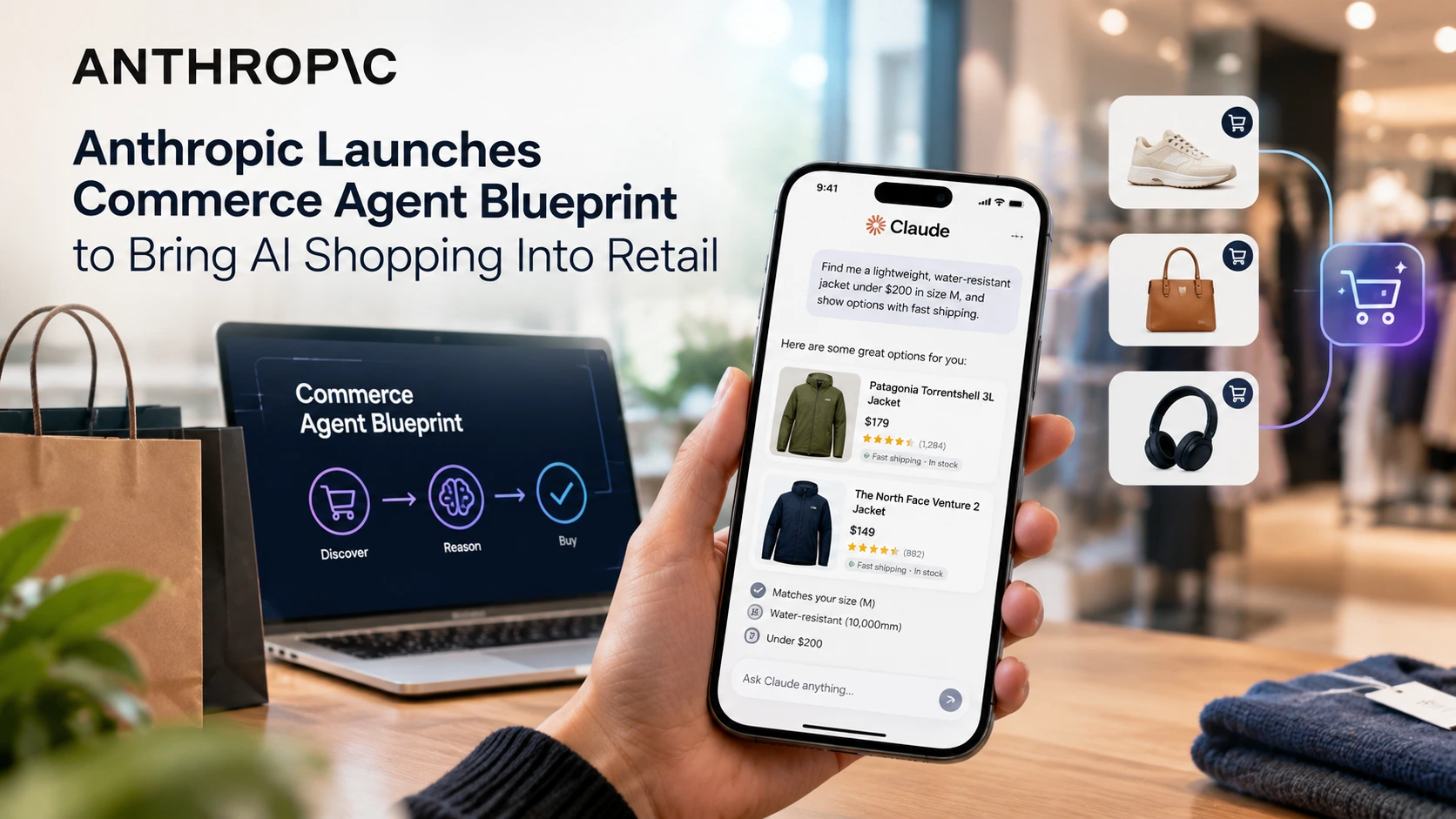
Anthropic is moving deeper into AI-powered commerce with a new commerce agent blueprint for Claude, giving retailers and other businesses a ready-made framework for building AI agents that can search products, compare options, manage carts and support customers.
The company announced the blueprint on September 2, saying it includes the tools, patterns and guardrails needed to build commerce agents. Anthropic has also released working reference implementations for both shopping agents and merchant agents.
The move could push AI shopping beyond simple product recommendations. Instead, Claude-powered agents could become part of the buying journey, helping customers discover products, make decisions and prepare purchases through natural-language conversations.
Anthropic says retailers running shopping agents on Claude have seen carts up to 35% larger and shoppers 60% more likely to complete a purchase. Those figures are company-reported results and should not be treated as independently verified industry benchmarks.
Anthropic Opens Its Commerce Agent Blueprint
The new blueprint is designed to give engineering teams a starting point for building commerce agents rather than requiring them to develop every component from scratch.
Anthropic says the package contains complete implementations for shopping and merchant agents. Developers can customize the systems for their own catalogs, policies, brands and customer experiences.
The project is available through Anthropic’s public GitHub repository and supports several Claude deployment paths, including the Claude API, Amazon Bedrock and Microsoft Foundry. Anthropic’s documentation also details support for Google Cloud Vertex AI.
The company is also working with ecosystem partners including Accenture, Mastercard and Visa to help businesses use the commerce-agent framework.
That partner strategy matters because AI shopping will require more than a language model. Retailers need connections to product catalogs, inventory, customer accounts, checkout systems and payment infrastructure.
What the Shopping Agent Can Do
The shopping agent is designed to operate inside a retailer’s existing application or website.
Instead of navigating multiple product pages, a customer can describe what they need in ordinary language. The agent can then search the catalog, compare products and assemble a selection.
For example, a customer could ask for equipment for a family camping trip. The agent can identify relevant products, consider the customer’s preferences and create a cart.
Anthropic’s blueprint includes integrations for:
- Product catalog search
- Multi-item shopping requests
- Customer preferences
- Product comparisons
- Cart creation
- Order history
- Customer service
- Returns and exchange information
- Checkout handoff
The agent can also answer questions about an existing order without forcing customers to leave the conversation and search through separate support pages.
However, Anthropic does not position the reference implementation as an autonomous payment system.
The blueprint leaves payment to the retailer’s existing checkout or an agentic payments provider. The public repository also states that its demo does not place orders or charge cards. Instead, checkout renders the cart for the host application to complete.
That distinction is important as retailers consider how much control to give AI agents over financial transactions.
Merchant Agents Target the Other Side of Commerce
Anthropic’s blueprint is not limited to consumers.
The company has also created a merchant agent designed to help employees manage the operational side of a retail business.
A merchant could ask the agent which products are performing poorly or which inventory is approaching a shortage. The system can analyze store data and provide recommendations.
The reference implementation covers areas such as:
- Sales performance
- Inventory management
- Pricing
- Promotions
- Marketing campaigns
- Catalog management
- Business analytics
For example, a merchant could ask which products should be discounted to clear older inventory.
The agent can analyze the retailer’s own information and recommend an action. However, Anthropic has built an important human checkpoint into the system.
Merchant-side changes are staged until a person approves them. The agent can recommend or prepare an action, but it does not independently publish changes to a live store in the reference implementation.
That approach reflects a broader shift in enterprise AI toward human-supervised agents rather than completely autonomous systems.
AI Shopping Could Change the Customer Journey
Traditional online shopping generally follows a familiar sequence.
A customer searches for a product, opens several pages, compares prices and specifications, adds items to a cart and eventually checks out.
Commerce agents can compress much of that process into a conversation.
Instead of searching for individual products, customers can describe an outcome they want. The agent can interpret the request, search available products and present a tailored selection.
That could change the role of the retailer’s website.
The website would no longer be the only place where customers browse and make decisions. An AI assistant could become an additional interface between the customer and the merchant.
For retailers, that creates both an opportunity and a risk.
A better conversational experience could reduce friction and increase conversion. At the same time, merchants will need to make sure their product information, pricing and inventory data are accurate enough for an AI agent to use.
Payments Remain a Critical Piece
The biggest challenge for commerce agents may not be product discovery.
It could be payments.
An AI agent can identify a product and build a cart relatively easily. Completing the transaction introduces additional requirements around authorization, identity, fraud prevention, payment credentials and consumer protection.
Anthropic’s current blueprint reflects that reality by keeping payment within the retailer’s existing checkout or an agentic payments provider.
That creates room for payments companies to become an important part of the emerging agentic-commerce ecosystem.
Networks, processors, wallets and payment technology providers could provide the infrastructure that allows agents to move from recommendation to transaction while maintaining appropriate controls.
Anthropic’s collaboration with Mastercard and Visa is therefore notable. It suggests that the development of commerce agents is increasingly intersecting with the payments industry rather than remaining solely an AI or retail technology story.
Guardrails Are Built Into the Framework
Giving AI agents access to commerce systems introduces obvious risks.
An agent that can search products, manipulate carts or recommend promotions needs access to business data and operational systems. Poorly designed agents could also make incorrect recommendations or expose customers to unwanted purchasing behavior.
Anthropic says its blueprint includes guardrails designed to keep shopping recommendations grounded in actual catalog data and prevent manipulative upselling patterns.
The repository also includes safety mechanisms and separates the agent’s reasoning from the host application’s authorization and business rules.
The merchant implementation goes further by requiring human approval before changes are applied.
Those controls will become increasingly important as companies give AI agents access to more sensitive commercial workflows.
From Retail to Travel and Ticketing
Anthropic is positioning the framework beyond traditional online retail.
The public repository includes examples covering retail, travel, telecom and entertainment. Both shopping and merchant-agent concepts are demonstrated across these verticals.
That broadens the potential market considerably.
A travel agent could help compare and organize a trip. A telecom agent could help customers select plans or devices. An entertainment platform could use similar technology to help customers find and purchase tickets.
The common element is the same: customers describe what they want in natural language, while the agent connects that request to a company’s underlying products and services.
A New Layer Between Customers and Businesses
The launch also highlights a broader change in the relationship between AI and commerce.
For years, retailers invested heavily in search engines, mobile applications, recommendation systems and personalized advertising. Generative AI introduces another interface that can sit between customers and those systems.
Instead of asking a customer to learn how a retailer’s website works, an agent can interpret the customer’s intent and interact with the retailer’s systems on their behalf.
That could make commerce more conversational.
It could also shift competition toward the quality of a company’s underlying data and APIs. If an agent cannot access accurate inventory, pricing, product information and customer policies, even an advanced model will struggle to deliver a reliable shopping experience.
Anthropic’s blueprint therefore focuses heavily on the connection between the AI agent and the merchant’s existing systems.
What Anthropic’s Move Means for FinTech
For the fintech sector, the development points toward a future in which payments become part of an agent-to-business interaction.
Today, most digital payments require the customer to actively interact with a checkout interface.
Agentic commerce could eventually make that interaction less visible. A customer could authorize an agent to complete certain purchases under predefined rules, while payment providers handle the underlying transaction.
That model raises important questions around authentication, transaction limits, fraud detection and liability.
It also creates opportunities for financial institutions and payment companies to develop infrastructure specifically designed for machine-initiated transactions.
The current Anthropic blueprint does not solve all of those issues. Instead, it provides an early framework for connecting AI agents with commerce systems while leaving payment execution under the control of the host business.
What Comes Next
Anthropic has made the commerce-agent blueprint publicly available, allowing developers to test the reference implementations and adapt them to their own systems.
The project supports multiple Claude deployment environments, while Anthropic’s ecosystem partnerships could help extend adoption among retailers and other commerce businesses.
The next phase will likely focus on how businesses connect these agents to real-world catalogs, customer accounts, inventory systems, checkout infrastructure and payment providers.
For retailers, the question is no longer simply whether AI can recommend products.
The bigger question is whether an AI agent can become a trusted interface through which customers discover, decide and ultimately buy.
Conclusion
Anthropic’s new commerce-agent blueprint represents a significant step toward making AI agents part of everyday commerce.
The company is giving businesses working reference implementations for both customer-facing shopping agents and merchant-side assistants. Those systems can search catalogs, compare products, build carts, answer customer questions and support business operations.
However, Anthropic has kept important controls in place. The reference implementation does not independently charge cards or place live orders, while merchant changes require human approval.
That balance could prove important as agentic commerce develops.
The technology has the potential to reduce friction across shopping and business operations. At the same time, its success will depend on accurate data, reliable integrations, strong security and payment infrastructure that can safely support transactions initiated by AI.
For fintech and payments companies, that makes the rise of commerce agents a trend worth watching closely.
Comments
No comments yet. Be the first to share your thoughts.
Leave a comment