
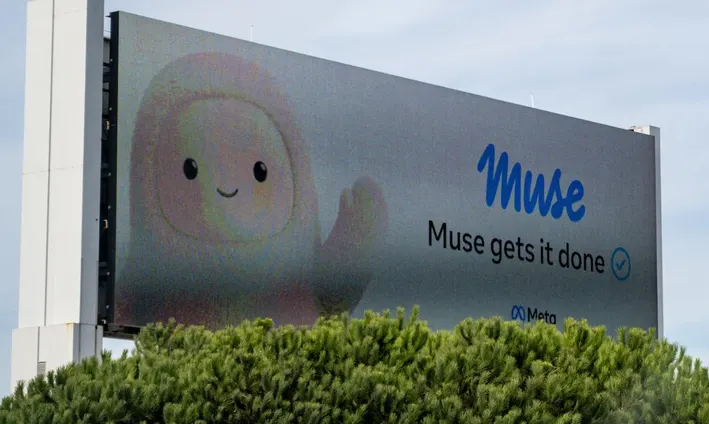
Meta’s personal AI assistant, Muse, has passed 5 million US downloads in just 22 days, according to Sensor Tower estimates. That makes it one of the fastest consumer AI launches from a major company.
Muse hit the mark far faster than its better-known rivals. Sensor Tower data shows ChatGPT needed 56 days to reach 5 million US downloads. Grok took 103 days, and Claude took 492 days.
The numbers hand Meta an early lead in the race to make AI agents a mainstream consumer product. But the story has another side. Meta has put heavy promotional muscle behind Muse, both on its own platforms and across outside ad channels.
Muse reaches 5 million downloads in 22 days.
Meta launched Muse in the United States on September 8. The company pitches it as a personal AI agent, not a standard chatbot.
The difference is in the actions. Meta says Muse can browse the web, fill out forms, send emails, and book travel. It can even keep working on a task after the user closes the app.
The app climbed the US App Store rankings quickly. It later took the top spot on Google Play in the United States, according to reports based on Sensor Tower data.
That puts Muse in rare company. Sensor Tower said only 23 apps have passed 5 million US downloads within 22 days. About 85% of them were mobile games.
Here is how Muse compares with other major assistants:
- Meta Muse: 22 days
- ChatGPT: 56 days
- Grok: 103 days
- Claude: 492 days
Keep the limits of this data in mind. The figures are Sensor Tower estimates, and they cover US downloads only. They do not show global users or active users.
Downloads also do not guarantee lasting use, paid subscriptions, or revenue. Those measures will matter far more in deciding whether Muse can keep its momentum. Still, the speed gives Meta a strong distribution signal only weeks after launch.
Meta is putting its ad network behind Muse.
Muse’s rise is happening alongside an aggressive marketing push. Sensor Tower data cited by 9to5Mac shows Meta stepped up Muse advertising on September 16. Downloads reportedly jumped 73% day over day around that time.
From September 14 to September 27, Muse took up to 50% of Meta’s daily house-ad impressions. Meta also promoted the app outside its own ecosystem. It bought space on mobile ad networks and on platforms such as Reddit, TikTok, and YouTube. By September 22, Sensor Tower ranked Muse among the top 10 brands by ad spend.
Meta’s internal reach matters here. The company can pitch Muse directly to people already active on Facebook, Instagram, and WhatsApp. Many standalone AI companies cannot match that channel.
Ads do not explain everything
Even so, advertising alone did not produce these download numbers. Sensor Tower data cited by TechCrunch found that Muse ads made up only about 6% of total ad impressions from launch through September 19.
That detail matters. Meta clearly used its ad ecosystem to build awareness. But the data does not show that the campaign drove all, or even most, of the downloads.
A mix of factors likely did the work. Internal promotion, app-store visibility, product features, and genuine consumer interest all played a part.
Muse aims to be more than a chatbot.
Meta’s plans reach well beyond a standalone app. At Connect 2026, the company announced it will bring Muse to its AI glasses, so users can talk to the assistant hands-free. Meta also revealed new shopping, travel, productivity, and payment tools.
New connectors cover retailers and services such as Walmart, Best Buy, Sephora, Expedia, and Instacart. Productivity links include Notion, Granola, GitHub, and Box. For payments, Meta added PayPal and Shop Pay.
This points to a bigger model for consumer AI. An agent does more than answer a question. It can find a product, compare options, complete a purchase, manage a calendar, or finish a multi-step task.
Meta is also pushing Muse into business use. Its September 29 announcement added connectors for QuickBooks, Shopify, Slack, Stripe, Zoom, Canva, and Asana. Small businesses can use Muse for customer acquisition, financial analysis, and daily operations.
The business model goes beyond subscriptions.
Meta says Muse will be free for most users. People who want extra features can pay for a subscription plan.
The company is also building a wider ecosystem around the agent. That opens several possible revenue streams, including subscriptions, commerce transactions, and business services.
Meta’s reach across consumers and businesses could prove especially valuable if users start letting agents buy things for them. The company has already added Stripe’s Link for Muse purchases. PayPal and Shop Pay come next.
An early milestone, not a final verdict
Five million downloads do not prove that Muse has permanently overtaken ChatGPT, Claude, or Grok. Each product has a different launch strategy, geographic reach, and monetization model. And downloads say nothing about engagement or retention.
Yet the early figures stand out. Muse reached 5 million US downloads in 22 days, against 56 for ChatGPT, 103 for Grok, and 492 for Claude.
Meanwhile, Meta is using its ad network, social platforms, AI glasses, and growing commerce tools to push Muse past the chatbot label.
The real test is still ahead. Can Meta turn fast downloads into regular agent use, paying subscribers and real transactions? For now, Muse has a fast start in the consumer AI agent market, and Meta is building the distribution machine to keep it moving.
Meta’s Muse AI Assistant Hits 5 Million Downloads—Outpacing Growth of ChatGPT, Grok, and Claude
Comments
No comments yet. Be the first to share your thoughts.
Leave a comment