
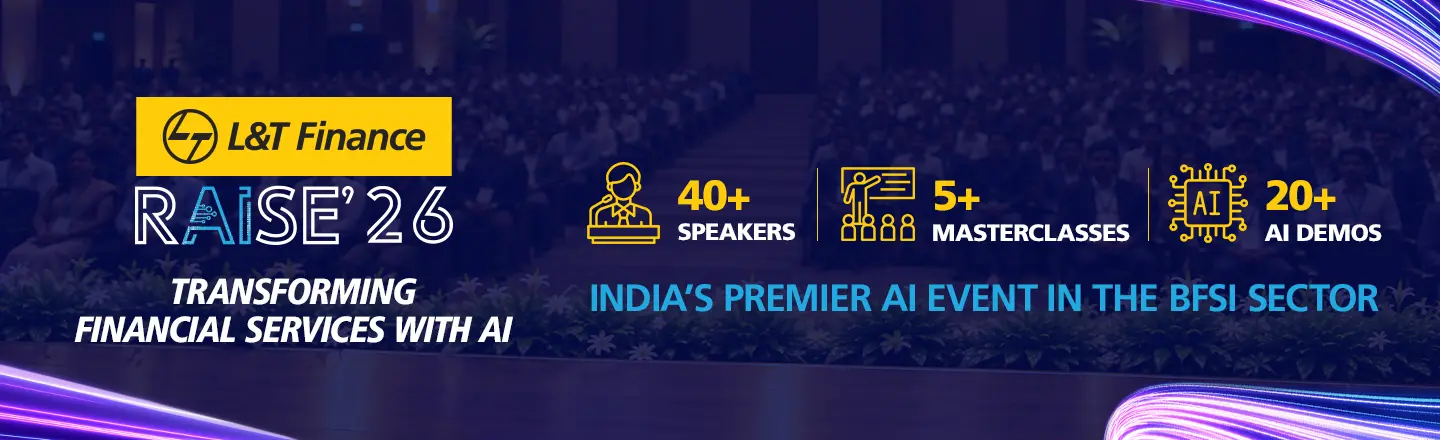
RAISE'26 will bring AI, technology, and financial services leaders to Mumbai on December 16, as L&T Finance puts enterprise agentic AI at the center of its third annual BFSI-focused AI event. The gathering arrives at a moment when banks, non-bank financial companies, and fintechs are moving past chatbots and basic automation toward systems that can interpret objectives, make decisions within defined parameters, and execute multi-step workflows on their own.
Event Overview
- Dates: December 16, 2026
- Venue: Jio World Convention Centre, Mumbai
- Organizer: L&T Finance
- Edition: Third annual RAISE event
- Focus: Enterprise Agentic AI across banking, financial services, and insurance
- Speakers: 40 plus
- Demos: 20 plus
- Masterclasses: 5 plus
- Startup program: Pitch Point, with applications open until October 31, 2026
That shift toward autonomous execution will be the central theme of RAISE'26, the third edition of L&T Finance's AI event for the BFSI sector. L&T Finance says the event will focus on enterprise agentic AI, examining how goal-driven AI agents can reason, adapt, and execute complex enterprise workflows using secure and scalable frameworks. The event is expected to bring together leaders from financial services, technology, cybersecurity, enterprise software, and policy.
From Automation to Execution
L&T Finance describes the broader shift in enterprise technology as a move from passive automation toward autonomous execution, and that distinction matters. Traditional automation generally follows predefined rules. Generative AI can produce text, code, or recommendations in response to prompts. Agentic AI aims to go a step further by letting AI systems work through a sequence of tasks to achieve a defined objective.
In financial services, that could eventually mean AI systems supporting workflows involving research, document processing, customer interactions, risk analysis, operational decisions, and other enterprise processes. The technology still requires controls, permissions, and human oversight, particularly when financial decisions or customer data are involved. Still, the underlying direction is clear: financial institutions are exploring AI not only as a tool for employees but also as a system capable of participating directly in business processes. That makes agentic AI a significant topic for banks, NBFCs, and fintech companies, and RAISE'26 is built around exactly that transition.
Why Agentic AI Matters to BFSI
Financial institutions operate some of the most complex workflows in the economy. A single process can involve customer information, financial records, compliance requirements, risk controls, multiple software systems, and decisions that require an audit trail. AI can already assist employees with individual tasks, but the next challenge is connecting those capabilities across an entire workflow.
For example, an AI system could potentially gather information, analyze it, identify the next step, and prepare an action for approval. In a more advanced setup, multiple AI agents could coordinate different parts of the process while operating inside defined permissions. That creates potential applications across banking and financial services, including:
- Customer service and support
- Credit and lending workflows
- Fraud detection
- Risk analysis
- Compliance operations
- Document processing
- Financial research
- Software development
- Internal knowledge management
- Back-office operations
- Data analysis
The opportunity is not simply to make individual tasks faster. The larger ambition is to redesign how work moves through financial institutions, which is why enterprise agentic AI is becoming such an important discussion in the BFSI sector.
Speakers
The speaker lineup reflects an effort to connect different parts of the AI and financial services ecosystem. Keynote speakers include:
- S. N. Subrahmanyan, Chairman and Managing Director, Larsen & Toubro
- Sanjeev Sanyal, Member of the Economic Advisory Council to the Prime Minister, with the rank of Secretary
- Amitabh Kant, Chancellor, NIIT University, and member of the Larsen & Toubro board
- Dr. Pramod Varma, Co-Founder and Chief Architect, Networks for Humanity
The wider speaker lineup includes executives and specialists from technology, cybersecurity, financial services, and legal sectors:
- Vinayak Godse, CEO, Data Security Council of India
- Prith Banerjee, Senior Vice President of Innovation, Synopsys
- Cyril Shroff, Managing Partner, Cyril Amarchand Mangaldas
- Anand Raman, General Manager for Global AI and Data Commercial Business, Microsoft
- Souvik Das, Chief Technology Officer, Clearwater Analytics
- Sudipta Roy, Managing Director and CEO, L&T Finance
- Dr. Debarag Banerjee, Chief AI and Data Officer, L&T Finance
This combination matters because deploying AI in financial services requires more than models alone. Institutions also need secure data environments, governance, cybersecurity, legal frameworks, technology infrastructure, and clear accountability.
AI Governance Becomes Critical as Agents Gain More Responsibility
The move from generative AI to agentic AI also creates a different set of governance questions. A chatbot that produces an incorrect answer can simply be corrected by a user. An AI system that initiates a workflow or makes a recommendation that triggers another process can create consequences that reach well beyond the original interaction.
That makes permissions and controls increasingly important. Financial institutions need to know what an AI system can access, which decisions it can make, when human approval is required, and how actions can be reviewed after the fact. Cybersecurity is another major consideration, since connecting AI systems to internal data and enterprise applications means security controls must cover both the underlying technology and the actions an agent can perform.
RAISE'26's combination of agentic AI, financial services, and technology therefore places the governance question alongside the innovation opportunity. The objective is not simply to make AI more autonomous. It is to make AI useful within secure, scalable, and controlled enterprise environments, which is also how the official RAISE'26 site frames the event.
Financial Services Could Become a Major Testing Ground
BFSI may be one of the most important sectors for enterprise agentic AI because financial institutions already operate highly structured digital workflows. Banks and NBFCs have large volumes of data, standardized processes, and significant demand for automation. At the same time, the sector carries strict requirements around security, privacy, compliance, and customer protection.
That creates a difficult but potentially valuable environment for AI agents. A successful financial services deployment cannot simply optimize for speed. It must also provide reliability, explainability, security, and appropriate human intervention. This could make financial services a testing ground for how enterprises deploy increasingly capable AI systems, with lessons that could extend beyond banking into insurance, asset management, payments, and other regulated industries.
Demos and Masterclasses
The event is not positioned only as a conference built around keynote speeches. L&T Finance says RAISE'26 will feature more than 40 speakers, over 20 demos, and five or more masterclasses. That format could give attendees a more practical view of how enterprise AI is actually being applied, since demos can show what AI systems do rather than relying entirely on high-level discussion, while masterclasses can provide deeper technical or strategic perspectives.
For financial services executives, this distinction matters. AI adoption decisions increasingly depend on whether a technology can move from experimentation into a secure production environment. A successful proof of concept is only the beginning. Institutions must then address integration, data quality, governance, security, employee adoption, and measurable business outcomes.
A Window for AI Startups
The event's startup component adds another dimension to the program. L&T Finance is promoting Pitch Point, an AI startup platform connected to RAISE'26. Current event communications say the initiative offers 25 lakh rupees in prize money, funding opportunities through the L&T Innovation Fund, and a chance to develop a proof of concept with L&T Finance. Applications for Pitch Point are open until October 31, 2026.
That gives the event a potential bridge between established financial institutions and emerging AI companies. For startups, access to a financial services organization can be valuable because BFSI products often require more than technology. They require domain knowledge, regulatory understanding, security controls, and access to real operational environments, so a proof-of-concept opportunity can be more significant than a conventional pitch competition if it leads to genuine enterprise testing.
What Agentic AI Could Mean for Banks and NBFCs
The most important question for financial institutions is not whether AI can generate content. It is whether AI can reliably complete useful work, whether that involves reducing manual processing, helping employees navigate complex information, accelerating software development, or coordinating multiple steps in an operational workflow. For banks and NBFCs, even small improvements across high-volume processes can potentially create significant operational benefits.
Still, the economics will depend on implementation. Financial institutions need to invest in data infrastructure, model governance, cybersecurity, and integration with existing systems. They also need to determine where autonomy adds value and where human decision-making should remain central. As a result, the transition will likely be gradual. AI agents may initially operate within narrow workflows, with clear permissions and human approval, and as institutions gain confidence, those systems could potentially handle more complex processes over time.
RAISE'26 Comes as AI Moves Deeper Into Financial Infrastructure
The timing of RAISE'26 reflects a broader change across financial technology. AI is increasingly appearing across payments, fraud prevention, lending, customer service, software engineering, compliance and financial research. The industry is now moving toward a more difficult question: what happens when AI does not simply answer a financial services employee but becomes part of the workflow itself?
That is the territory enterprise agentic AI seeks to address. The answer will depend on how financial institutions balance autonomy with control. For banks and NBFCs, the value of an AI agent will ultimately be measured not by how impressive its demonstrations look, but by whether it can operate reliably inside the institution's security, compliance and technology framework. RAISE'26 is positioning itself squarely around that transition.
What to Watch
The most interesting part of RAISE'26 will be whether the discussion moves beyond the familiar promise of AI productivity. The financial services industry has already spent several years experimenting with generative AI, and the next stage is more operational. Institutions want to understand how AI can work across systems, execute multi-step tasks and support decisions while remaining inside appropriate governance frameworks.
- How much autonomy should financial AI agents receive?
- How will banks secure agent access to sensitive systems?
- Where should human approval remain mandatory?
- How can institutions audit actions taken by AI agents?
- Which BFSI workflows are ready for agentic AI today?
- How can financial institutions measure the business value of AI deployment?
The answers could help determine whether agentic AI becomes another enterprise software layer or develops into a more fundamental part of financial infrastructure.
Why RAISE'26 Matters
RAISE'26 comes at a point when financial institutions are moving from experimenting with AI toward figuring out how to deploy it at scale, and its focus on enterprise agentic AI reflects that change. The event brings together financial services executives, technology leaders, cybersecurity specialists, policy voices and AI experts to examine how goal-driven systems could operate within complex enterprise environments. L&T Finance is positioning the event around the transition from passive automation to autonomous execution.
For India's BFSI industry, that is an important conversation. The next phase of AI adoption will not be determined solely by the capabilities of models. It will depend on whether institutions can build the infrastructure, controls and operating models needed to let those systems perform meaningful work. RAISE'26 will put that question at the center of its December 16 gathering in Mumbai, asking how far enterprise agentic AI can move financial services from AI that assists people toward AI that can execute work.
Comments
No comments yet. Be the first to share your thoughts.
Leave a comment