
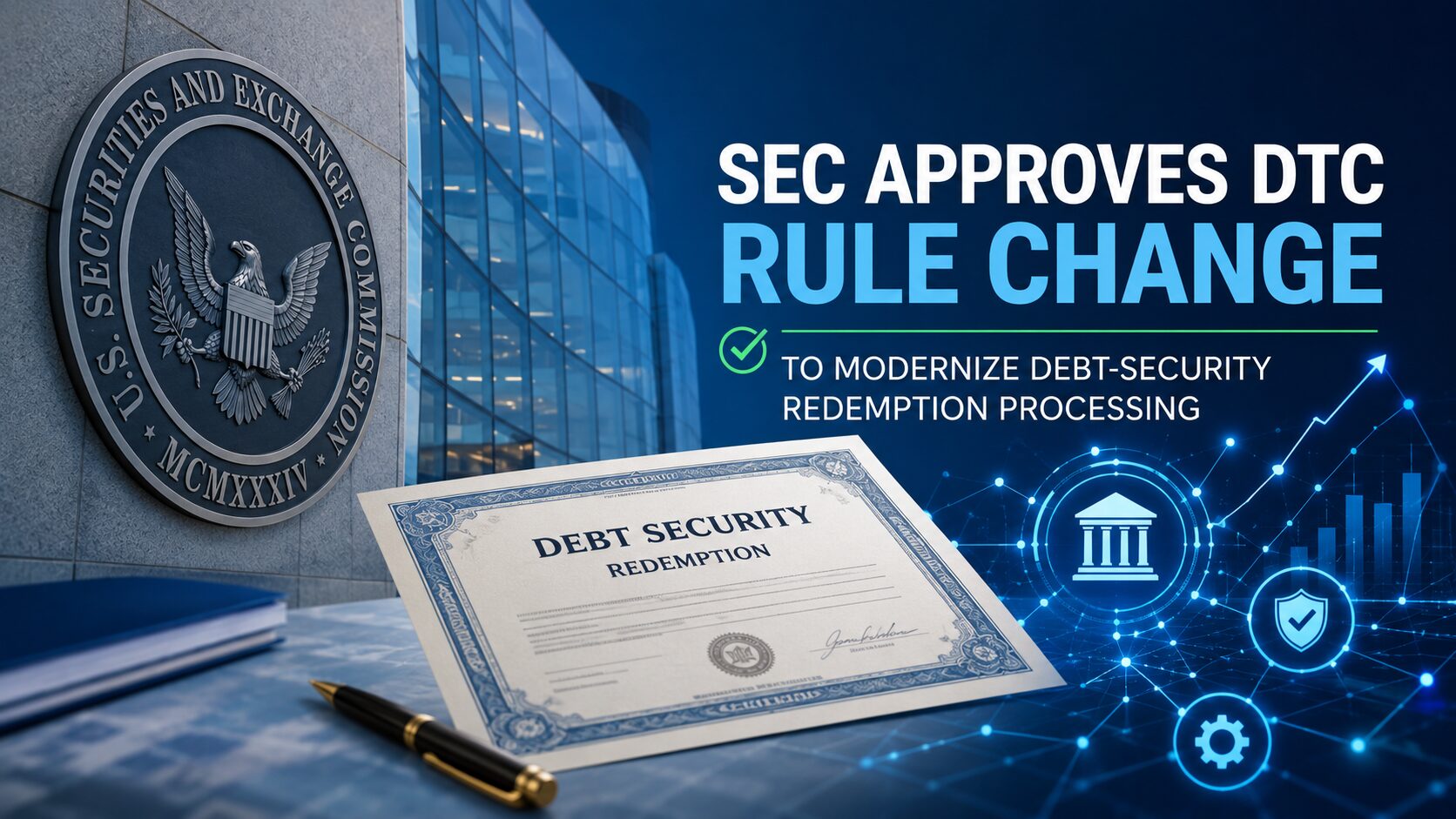
SEC Approves DTC Rule Change to Modernize Debt-Security Redemption Processing
The U.S. Securities and Exchange Commission has approved a Depository Trust Company rule change. The change modernizes the process used to handle debt-security redemptions and maturities. It marks an important infrastructure upgrade for the U.S. securities settlement system.
The approved rule change, SR-DTC-2026-009, replaces paper-based procedures with automated electronic processing. As a result, it reduces reliance on physical debt certificates and improves the efficiency of redemption payments across the market.
The SEC said the changes should reduce risk, improve reconciliation, and support prompt and accurate clearance and settlement of securities transactions.
A major infrastructure modernization
DTC plays a central role in U.S. financial markets.
As a securities depository, it holds securities electronically. It also facilitates the movement of securities and related payments between issuers, paying agents, banks, brokers, and other market participants.
The approved changes focus on DTC’s Payment without Presentation process. This process governs how certain debt securities are handled when they mature or are redeemed before maturity.
Previously, some eligible redemption events required the presentation of physical debt certificates and related documentation. As a result, payments could not be processed until that step was completed.
Under the new framework, DTC can rely on electronic notifications and book-entry records. Therefore, it can allocate redemption proceeds without requiring physical certificate presentation for eligible securities.
How the new process works
The modernization introduces important operational changes.
For eligible redemption and maturity events, issuers and paying agents can send automated electronic notices. These notices contain key payment information, including CUSIP numbers, payment dates, and redemption amounts.
DTC will then use its electronic ownership records to distribute redemption proceeds through its book-entry system.
Although physical certificates will no longer be required for eligible processing events, DTC will retain them for at least 90 days. After that, it will destroy them in accordance with established procedures.
The rule change also makes participation in the PWP process generally mandatory for eligible securities. However, limited exceptions will still apply.
Why the SEC approved the change
The SEC concluded that the modernization should improve the efficiency and reliability of the redemption process.
By reducing dependence on physical documentation, the new framework aims to:
- reduce processing delays,
- minimize reconciliation errors,
- improve payment accuracy,
- lower operational risk,
- and strengthen the resilience of securities settlement infrastructure.
The Commission said the changes are consistent with the Securities Exchange Act. In particular, they support prompt and accurate clearance and settlement of securities transactions.
What it means for market participants
For investors, the changes are largely invisible.
However, for banks, broker-dealers, custodians, issuers, paying agents, and institutional market participants, the modernization could significantly streamline back-office operations.
Electronic processing reduces manual document handling. In addition, it allows redemption payments to move through existing book-entry infrastructure more efficiently.
The upgrade is particularly relevant for institutional debt markets. In those markets, operational efficiency and settlement certainty are critical.
A broader trend toward digital market infrastructure
The approval reflects a broader trend across global financial markets.
Central securities depositories, clearinghouses, and payment infrastructures are increasingly replacing paper-based and manual processes with automated workflows.
These efforts have accelerated in recent years. Regulators and market operators are focusing on settlement modernization, operational resilience, and technology-driven efficiency improvements.
Although the DTC rule change does not involve blockchain, tokenized securities, or a new digital asset framework, it represents an important step in the digital transformation of core securities infrastructure.
Why this matters beyond one rule filing
Infrastructure changes at DTC often have wider implications. That is because the organization sits at the center of the U.S. securities settlement ecosystem.
The modernization demonstrates how financial-market infrastructure continues to evolve through automation, electronic recordkeeping, and standardized processing.
As capital markets increasingly adopt real-time processing, digital settlement technologies, and more advanced market infrastructure, operational improvements like these become an important foundation for future innovation.
The bottom line
The SEC’s approval of DTC’s Payment without Presentation modernization marks a meaningful upgrade to the operational infrastructure that supports debt-security redemptions and maturities.
By eliminating certain physical certificate requirements and expanding automated electronic processing, the new framework should reduce operational risk. It should also improve payment efficiency and strengthen the reliability of the U.S. securities settlement system.
While the changes are primarily aimed at institutional market participants, they represent another important step in the ongoing modernization of financial-market infrastructure and capital-markets technology.
Comments
No comments yet. Be the first to share your thoughts.
Leave a comment