
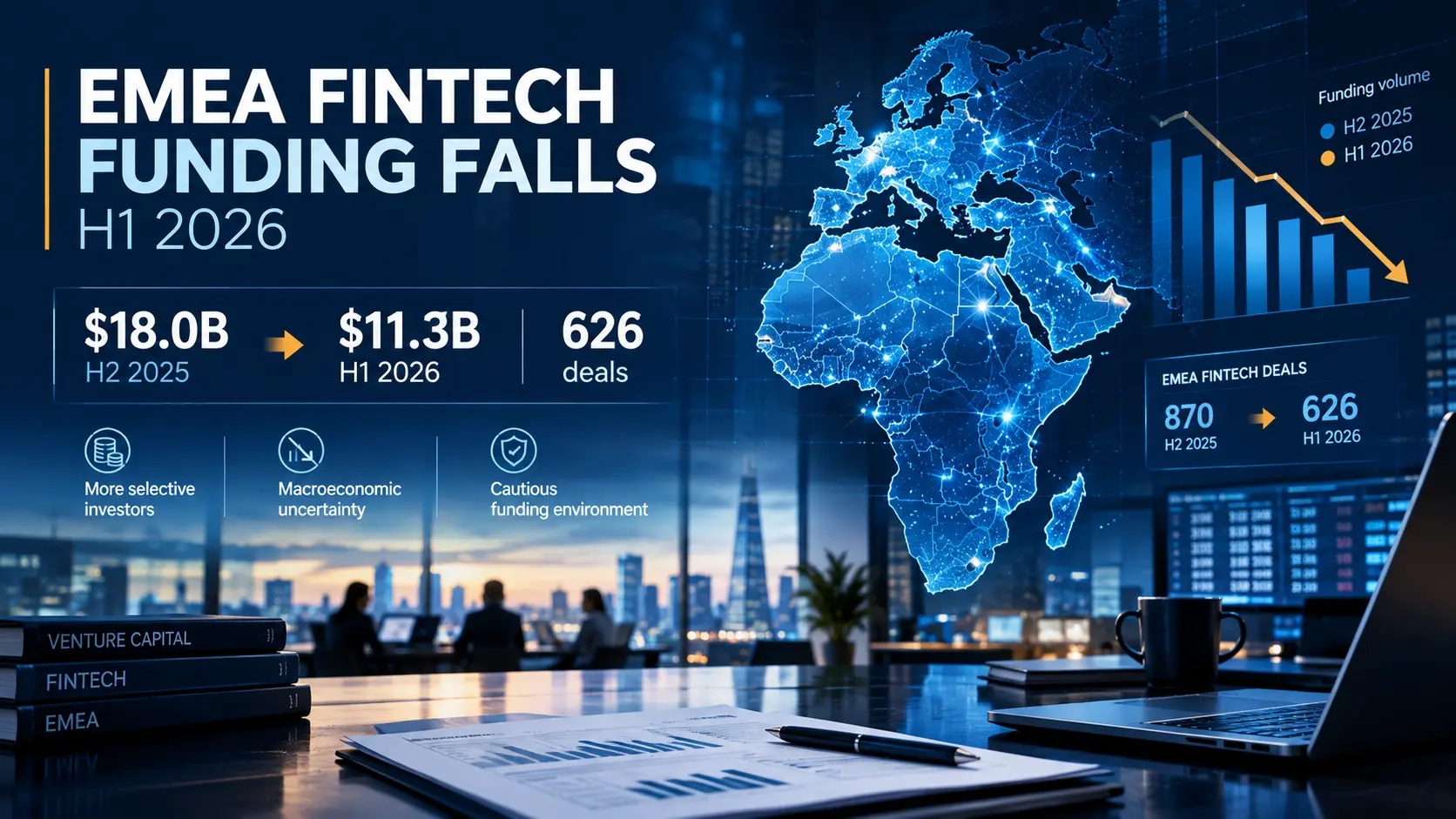
Fintech funding across Europe, the Middle East and Africa fell sharply in the first half of 2026, even as global investment reached its strongest level in four years, highlighting a growing divide in where investors are deploying capital.
Fintech companies across the EMEA region attracted $11.3 billion across 626 deals in H1 2026, according to KPMG’s latest Pulse of Fintech report.
That represents a significant decline from the $18 billion invested across the region in H2 2025. KPMG said geopolitical and macroeconomic uncertainty contributed to the softer investment environment, while a shortage of very large transactions also weighed on the headline figure.
The slowdown stands in sharp contrast to the global fintech market.
Worldwide fintech investment increased from $72.2 billion in H2 2025 to $103.1 billion in H1 2026, with global deal value benefiting from several major transactions. KPMG said the current pace puts global fintech investment on track for a four-year high.
EMEA Fintech Funding Loses Momentum
The decline in EMEA fintech funding was broad enough to put the region on pace for a decade-low in both investment value and deal volume, according to KPMG.
The report points to continued geopolitical and macroeconomic uncertainty as key factors behind the weaker performance. Domestic political and tax uncertainty in the UK also contributed to the softer environment.
However, the numbers do not necessarily suggest that investors have lost interest in fintech altogether.
Instead, capital is becoming more concentrated around companies with stronger business models, proven market traction and clearer paths to scale.
That trend is visible globally. KPMG said global investment increased even as the overall number of deals declined, reflecting greater investor selectivity and a preference for larger, established opportunities.
UK Remains EMEA’s Largest Fintech Market
The UK continued to attract the largest share of fintech investment in EMEA during H1 2026.
UK fintech companies raised $2.5 billion across 205 deals, putting the country well ahead of Germany, which attracted $1.6 billion across 36 deals.
The figures underline the UK’s continued importance to the European fintech ecosystem despite the broader funding slowdown.
The Middle East attracted $1.4 billion across 50 deals, while African markets accounted for $403 million across 44 deals during the first half.
The distribution also shows that EMEA’s fintech market remains highly concentrated. A relatively small number of large transactions can materially influence regional investment totals.
Large Deals Were in Short Supply
One of the defining characteristics of EMEA’s H1 performance was the lack of mega-deals.
KPMG identified three of the region’s largest fintech transactions during the period: a $1.2 billion buyout of a Denmark-based digital investment bank, a $1 billion acquisition of a minority stake in a Belgium-based real-time trade intelligence company, and a $738.7 million growth round for a UK-based cross-border payments platform.
The Middle East’s largest transactions included a $250 million investment in a payments and data-intelligence company and a $230 million seed round for an AI-native Islamic bank, both in the UAE.
Africa’s largest deal was an $80 million VC raise by a Seychelles-based stablecoin platform.
These transactions show that significant capital is still available in the region. However, the overall funding environment is being shaped by fewer large transactions.
Investors Are Becoming More Selective
The EMEA numbers reflect a broader shift in fintech investing.
Rather than funding growth at almost any cost, investors are increasingly looking for businesses that can demonstrate sustainable economics, differentiated technology and a credible route to profitability.
KPMG’s global findings reinforce this shift. Global fintech deal volume fell from 2,500 transactions in H2 2025 to 2,100 in H1 2026, even as total investment increased.
That means more capital is flowing into fewer opportunities.
For fintech founders, the implication is significant. Companies may need stronger revenue visibility and more evidence of product-market fit to attract institutional capital, particularly at later stages.
Payments Remain a Major Investment Theme
Despite the overall funding slowdown, payments continue to attract substantial investor attention.
KPMG’s global data shows that fintech investment in payments reached $44.2 billion in H1 2026, compared with $20.2 billion across all of 2025. Much of that increase came from a $24.3 billion acquisition of a global payments company.
However, the number of payments deals fell sharply.
KPMG recorded 168 payments deals in H1 2026, compared with 577 during all of 2025. The pattern suggests investors are putting larger amounts of money into fewer, more established payments businesses.
That dynamic could have important implications for EMEA, where payments remains one of the region’s most mature fintech segments.
Digital Assets Continue to Attract Attention
Not every part of EMEA fintech is slowing.
Digital assets and stablecoins continued to attract investor interest during H1 2026. KPMG said the region benefited from greater regulatory clarity around digital assets, including the implementation of the EU’s Markets in Crypto-Assets framework.
The firm also noted growing participation from traditional banks in the digital-assets market, although differences in how stablecoins and other digital assets are regulated remain a concern for investors.
That creates an interesting contrast with the wider funding market: while general fintech investment has slowed, specific technology and infrastructure themes continue to attract capital.
What the Funding Slowdown Means for EMEA Fintech
The H1 numbers point to a more disciplined investment environment rather than a complete retreat from EMEA fintech.
Investors are still backing companies operating in payments, digital assets, AI, financial infrastructure and other areas with clear commercial potential.
But the bar is rising.
KPMG’s findings suggest that companies with proven business models and market leadership are better positioned to attract capital, while early-stage companies without clear paths to scale may face a more difficult fundraising environment.
This could also accelerate consolidation across parts of the fintech sector.
KPMG expects consolidation to intensify, particularly in payments, as established players look to expand their market presence and private-equity investors seek opportunities to consolidate businesses that have struggled to attract capital independently.
EMEA Fintech Faces a More Selective Second Half
The first half of 2026 has created a clear divergence in the global fintech funding landscape.
Global investment has accelerated, but EMEA has moved in the opposite direction. The region’s $11.3 billion across 626 deals represents a substantial decline from the previous six months.
Still, the underlying market is not without momentum.
The UK remains a major fintech hub, the Middle East continues to produce sizeable funding rounds, and digital assets are gaining traction as regulatory frameworks mature.
The key change is the behaviour of investors.
Capital is still available, but investors are demanding more proof before deploying it.
For EMEA fintechs, the second half of 2026 could therefore be less about chasing headline funding totals and more about demonstrating sustainable growth, strong economics and technology that solves clear financial-services problems.
Comments
No comments yet. Be the first to share your thoughts.
Leave a comment