
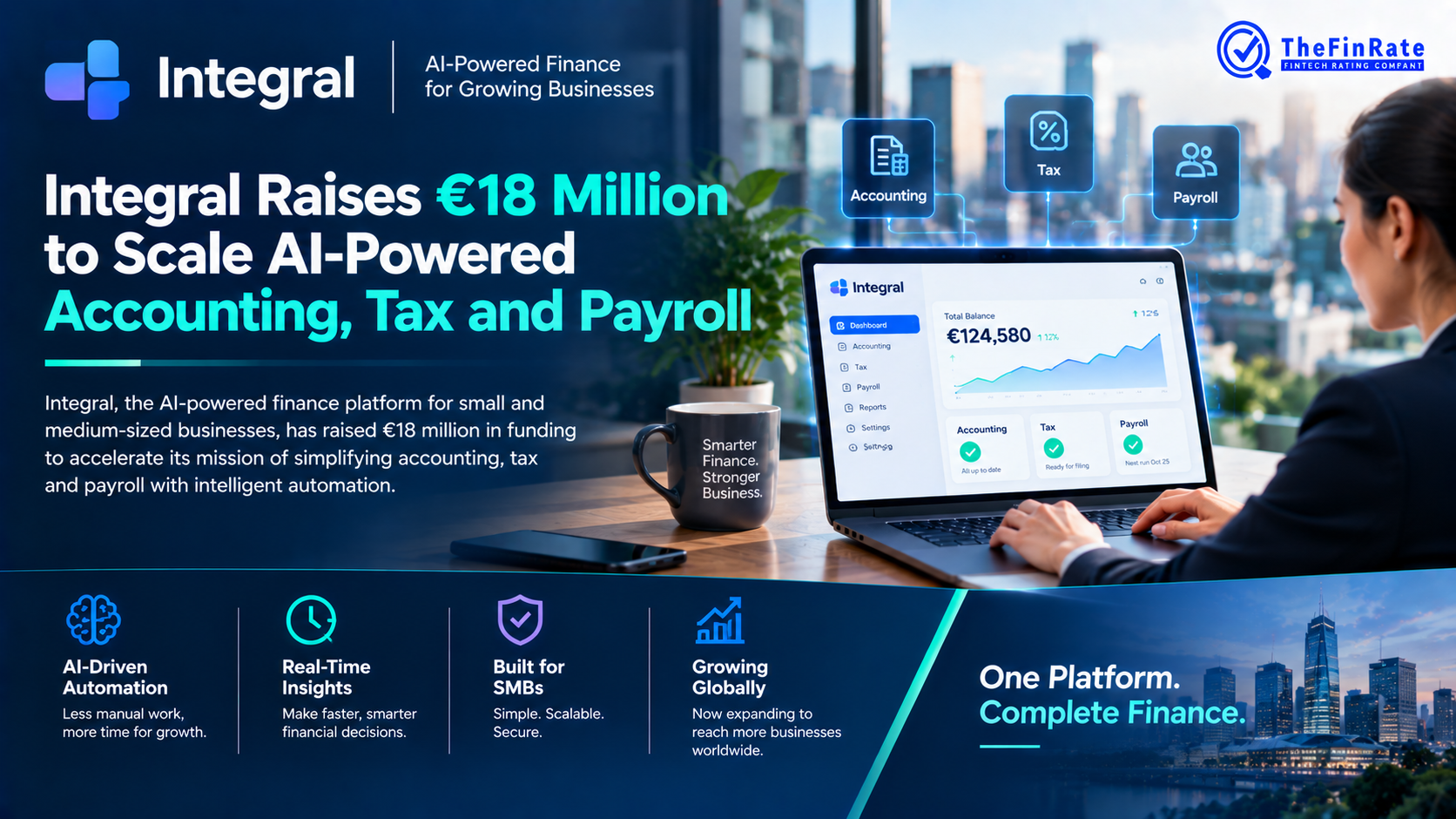
Berlin-based fintech Integral has raised €18 million in a new funding round, giving the company more capital to expand its AI-powered accounting, tax, and payroll services for small and medium-sized businesses.
The Series A was co-led by Mosaic Ventures and Reid Hoffman, with existing backers Cherry Ventures, General Catalyst, and Puzzle Ventures also participating.
The new investment brings Integral’s total funding to more than €30 million since the company was founded less than two years ago.
The raise comes as businesses are increasingly looking for ways to automate financial administration without giving up access to qualified accounting and tax professionals.
Integral Builds AI Around Everyday Finance Work
Integral is taking a different approach from traditional accounting software.
Rather than simply giving businesses digital tools to complete tasks themselves, the company combines AI agents with licensed professionals to handle much of the work.
Its platform can reconcile invoices and bank transactions, create accounting entries, prepare payroll runs, and assist with tax filings.
The aim is to reduce the amount of repetitive work that businesses and their finance teams have to manage themselves.
Integral describes its model as AI-native professional services, with technology handling repeatable work while accountants, tax advisers, and other specialists remain involved where professional judgment is needed.
That combination is becoming increasingly relevant for SMEs.
Smaller companies often need the same core financial processes as large organizations, but they may not have the resources to build large internal finance and compliance teams.
Automation can potentially reduce that burden while keeping access to specialist expertise.
New Funding Will Expand AI Automation
Integral says the Series A will be used to push automation further across its accounting, tax, and payroll workflows.
The company also plans to increase hiring across AI engineering, licensed professionals, and commercial teams.
That means the new capital is not just being directed toward software development.
Integral wants to grow both sides of its model: the AI technology and the professional expertise that supports it.
The company argues that this combination is important because financial operations cannot always be reduced to simple rules.
Accounting and tax workflows involve exceptions, regulatory requirements, and business-specific decisions.
AI can handle structured and repetitive work, while professionals can step in when judgment or interpretation is required.
From Invoices to Tax Filings
Integral’s platform is designed to cover a broad part of the back office.
Its technology can connect bank feeds, invoices, receipts, payroll information, and other financial data into a single workflow. The company says it currently brings accounting, tax, and payroll together on one platform, with professionals working alongside the technology.
That is important because finance teams often work across multiple systems.
A business may receive invoices in one application, store payroll data somewhere else, and use separate tools for banking, accounting, and tax.
Moving information between those systems creates administrative work and increases the possibility of errors.
Integral’s model is designed to bring more of those processes into one connected environment.
Its technology also integrates directly with financial tools. In April 2026, Integral said its platform went live with Qonto, allowing German customers to manage accounting, payroll, and tax processes directly through their business account.
An AI Model With Professionals in the Loop
The company’s approach reflects an important question facing AI-driven fintechs: how much of financial work should be automated?
Integral is not positioning its platform as a replacement for human expertise.
Instead, it says professionals remain behind the system while AI handles repeatable work.
The company describes this as “experts in the loop,” with tax advisers, accountants, payroll specialists, operators, and engineers working together to build and monitor the platform.
For highly regulated areas such as tax and payroll, that distinction matters.
A calculation can often be automated.
But determining how a rule applies to a specific business may require professional judgment.
A system that can combine both capabilities has the potential to automate more of the workflow without removing human oversight entirely.
Founders Bring Financial Services Experience
Integral was founded by Lukas Zörner and Anil Can Baykal.
Both founders have previous experience building financial services businesses.
Zörner previously co-founded Penta and later served as Germany’s head of Qonto, while Baykal has a background in payments and financial technology.
That experience gives the company a practical understanding of the problems small businesses face when managing financial administration.
Integral’s earlier funding round was announced in February 2025, when it raised €6.3 million led by General Catalyst and Cherry Ventures, with participation from Puzzle Ventures and European entrepreneurs.
The company later acquired German digital payroll and HR provider Cleverlohn and announced additional funding in November 2025, bringing total funding at that point to €12 million. (integral.de)
The latest round therefore represents another significant step in Integral’s expansion.
Why SMEs Are a Natural Market for AI Finance Tools
Small and medium-sized businesses are under constant pressure to manage costs while keeping financial operations accurate.
Accounting, payroll, and tax compliance are essential, but they do not directly generate revenue.
That makes them natural targets for automation.
If software can reduce the time required to reconcile transactions, prepare filings, or run payroll, business owners and finance teams can spend more time on activities closer to growth.
Integral’s current platform data points to this demand.
The company says it now serves more than 800 clients, while 78% of surveyed customers report reduced effort, and business owners save an average of 18 hours per month. These are company-reported figures and should be treated as such.
The challenge is turning those early efficiency gains into a scalable business model across a much larger customer base.
Investors Bet on AI-Native Professional Services
The participation of Mosaic Ventures and Reid Hoffman adds another dimension to the funding round.
Mosaic says it invests in early-stage AI companies in Europe, while Hoffman, the co-founder of LinkedIn, has joined Mosaic as an advisory partner.
His involvement reflects broader investor interest in companies applying AI to established professional services industries.
Accounting and tax are particularly interesting because they combine large volumes of structured data with rules-based processes.
That creates room for automation but also demands high levels of accuracy and accountability.
For Integral, the investment provides capital to keep expanding that model.
Automation Is Moving Beyond Bookkeeping
AI in accounting is not new.
Businesses have used software for bookkeeping, expense categorization, invoice processing, and financial reporting for years.
What is changing is the level of automation.
AI agents can potentially move information between systems, make decisions based on defined rules, identify exceptions, and trigger the next step without requiring a person to manually start every process.
Integral is aiming to apply that approach across a much larger portion of the financial back office.
That could eventually include everything from transaction reconciliation through payroll and tax compliance.
The more of the workflow the system can handle, the more important reliability becomes.
An error in a routine business process can quickly become a financial or regulatory problem.
For that reason, Integral’s combination of AI and licensed professionals is central to its strategy.
Germany Is the Starting Point
Integral began by focusing on Germany before expanding its ambitions across Europe.
Its company history shows the business was founded in 2024 after research into agentic tax advisory and has since expanded its platform and customer base.
Germany is a useful launch market because its tax and accounting environment is complex, creating a clear need for automation.
But the company’s longer-term goal is broader.
Integral says it wants to build an AI-native professional-services group serving businesses across Europe and eventually beyond.
The latest funding gives it more resources to pursue that ambition.
What the Funding Means for Integral
The €18 million Series A gives Integral the opportunity to accelerate several parts of the business at once.
More AI engineers can expand the capabilities of its agents.
More licensed professionals can help support customers and handle complex work.
And additional commercial hires can help the company reach more SMEs.
That combination matters because Integral’s proposition depends on scale.
The more businesses it serves, the more financial workflows the platform can support and the more opportunities there are to automate repetitive processes.
At the same time, the company needs to maintain accuracy and service quality as it grows.
The Wider Shift in Fintech
Integral’s funding round reflects a broader trend across fintech.
The first generation of fintech largely focused on digitizing financial services.
The next generation is increasingly trying to automate the work behind those services.
That includes payments operations, compliance, financial reporting, lending decisions, and now accounting and tax.
AI agents are becoming particularly important because they can connect individual tasks into longer workflows.
Instead of simply suggesting an accounting entry, an agent could potentially reconcile the transaction, update the ledger, flag an exception, and prepare the next compliance step.
That is the direction companies such as Integral are pursuing.
The Road Ahead
The next challenge for Integral is proving that its AI-native approach can work reliably at a much larger scale.
Financial administration is repetitive, but it is also unforgiving.
Businesses need accurate books, timely filings, and compliant payroll.
That means AI systems must be able to deal with exceptions as well as routine cases.
Integral’s investment in both AI engineering and licensed professionals suggests the company is preparing for that challenge.
Its expansion with Qonto and its growing client base also give the company a foundation for broader adoption.
With €18 million in fresh capital, the company can now accelerate the next stage of that strategy.
TheFinRate Take
Integral’s €18 million Series A is more than another European fintech funding round.
It reflects a growing effort to rebuild traditional professional services around AI.
The Berlin startup is combining AI agents with licensed experts to handle accounting, taxation, and payroll for SMEs, while bringing more of those processes into a single connected platform. (integral.de)
The funding gives Integral room to expand its technology, hire more specialists, and reach more businesses.
The bigger question is how far this model can go.
If AI can reliably take care of the repetitive parts of financial administration while professionals remain responsible for complex decisions, services that have traditionally required significant manual work could become much more automated.
For SMEs, that could mean less time spent on paperwork and more time spent running the business.
For fintech, it points to a broader shift: AI is no longer being added to financial software as a feature. It is increasingly being used to rebuild the underlying service itself.
Comments
No comments yet. Be the first to share your thoughts.
Leave a comment