
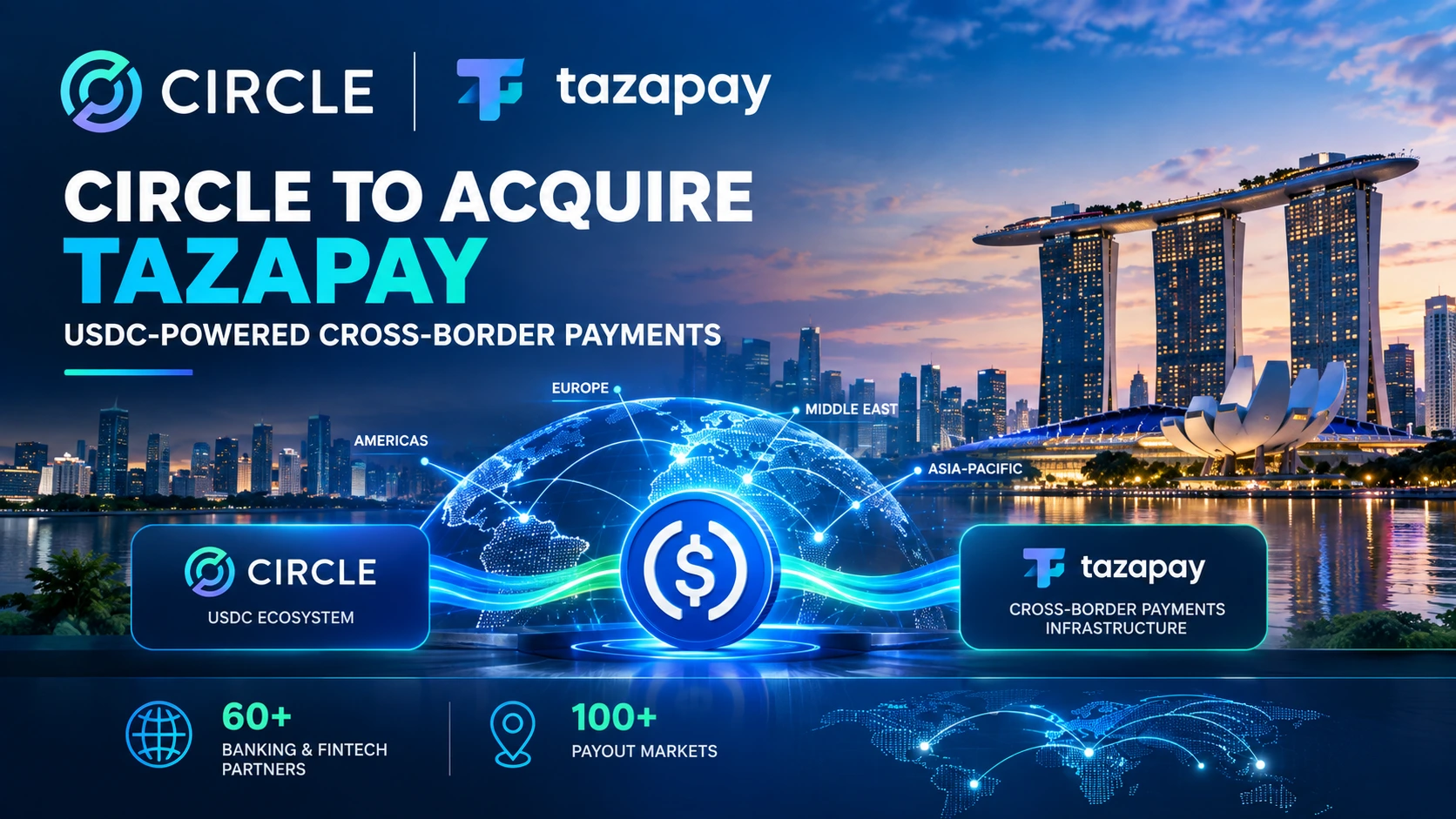
Circle has agreed to acquire Singapore-based cross-border payments infrastructure firm Tazapay to extend the reach of the stablecoin payments network.
Circle Internet Group, which issues the USDC stablecoin, announced on September 8, 2026, that it has entered into a definitive agreement to acquire Tazapay, with the deal set to close in 2027.
The transaction is subject to customary closing conditions, including regulatory approvals, with the Monetary Authority of Singapore (MAS) needing to approve the deal.
The purchase price for the buyout was not disclosed in the release.
While the rationale for the acquisition, in terms of financials, is not explicitly stated, combining Tazapay’s banking connections, local payout rails, and institutional payments network with Circle’s stablecoin infrastructure makes strategic sense.
Tazapay Gives Circle Access to Local Payout Markets and Partnerships
Based in Singapore, Tazapay is a business-to-business regional cross-border payments infrastructure provider with a focus on payment service providers and banks.
The acquisition of the firm will enable Circle to benefit from its:
• $25B+ annual payment volume,
• 60+ banking and fintech partners,
• Local payout rails spanning over 100 markets,
• Institutional customer base across the APAC region and emerging markets,
• Stablecoin exposure covering 60% of use cases by value.
Such qualities were not unimportant for Circle, since they allow it to facilitate transactions involving stablecoins on a much larger scale.
Crucially, stablecoins can offer the settlement layer, but physical banks and regional payout rails are required to complete end-to-end payments.
This is especially important in emerging markets, where local banks often need to be involved in the transaction.
While USDC can settle on-chain, actual money needs to be transferred to local accounts using conventional methods.
Circle Sees the Stablecoin Network as a Strategic Asset
The company has been working to turn the USDC stablecoin into a strategic asset for years.
The firm has been developing financial infrastructure around the stablecoin, such as the Circle Payments Network and the enterprise-grade blockchain Arc.
The acquisition of Tazapay fits into the larger strategy of enabling cross-border payments with the aid of stablecoins on a 24/7 basis.
Irfan Ganchi, SVP of Payments at Circle, stated that the acquisition will play a role in furthering the company’s efforts to originate and terminate payments worldwide.
The company’s vision is to enable seamless money movement in a matter of seconds, which goes far beyond just facilitating another type of international payment.
Circle envisions USDC as integral to the financial infrastructure of tomorrow.
It aims to offer an alternative to correspondent banking, acting as the settlement layer in international transactions with the help of stablecoins.
Local Payout Markets Are Critical for Completing Transactions
An intriguing aspect of the acquisition announcement concerns the stablecoin transaction volume settled on the Tazapay network.
According to the release, approximately 60% of Tazapay’s transactions involve stablecoins.
This is not surprising given that the two firms have had a symbiotic relationship since Tazapay joined the Circle Payments Network as an official design partner back in 2025.
In other words, Tazapay has been acting as a local payment partner for Circle, facilitating cross-border transactions.
Therefore, the acquisition of Tazapay by Circle cannot be seen as simply “adding another payments provider,” since the firm has experience operating within the stablecoin ecosystem.
The fact that Tazapay processes stablecoin payments highlights the importance of local rails for enabling end-to-end transactions.
While stablecoins can make value transfer faster and more efficient, they are only one component of the payments infrastructure.
Merchants and financial institutions will still need to settle funds in local currency and utilize domestic payment rails to transfer money to beneficiaries.
This is where the network of local partnerships controlled by Tazapay becomes invaluable to facilitating seamless stablecoin transactions.
The fact that Tazapay’s network spans over 100 payout markets suggests that the acquisition will greatly benefit from synergies enabled by the connection between stablecoins and local payments infrastructure.
It also provides the firms with a unique selling point over competitors, as it will be able to offer businesses a complete end-to-end solution involving stablecoins.
The Acquisition Strengthens Circle’s Position in the APAC Region
The target of the acquisition, Tazapay, is based in Singapore.
The company has built out its infrastructure across the Asia-Pacific region and emerging markets.
This serves to provide better localized support for businesses utilizing the payments infrastructure provided by Tazapay.
It also enables firms to operate in multiple currencies and payment systems, which is a necessity for international trade.
For Circle, building out its regional presence is of utmost importance, as it enables it to serve a wider customer base.
The more local connections it has, the more attractive its stablecoins are as a settlement asset.
It builds a network effects-driven flywheel: the more local banks and payment processors bind to the USDC stablecoin, the more valuable it becomes to transacting parties.
The Deal Is Not Yet Closed—Regulatory Approval Needed
While the strategic rationale for the transaction is compelling on both sides, the acquisition has yet to close.
The deal is set to be completed in 2027, which suggests that there are several steps that need to be taken before Tazapay joins the Circle ecosystem.
Both firms note that the deal is subject to customary closing conditions and approvals from regulators.
Notably, the release specifically mentions that approval from the Monetary Authority of Singapore is needed for the transaction to go through.
This means that the announcement should be regarded as a proposal, rather than a confirmation that the deal has closed.
Meanwhile, Tazapay customers can expect business operations to continue as usual, with no disruptions to their platforms and support services.
What This Deal Means for Cross-Border Payments
The acquisition announcement captures the shift in the global payments landscape.
Traditional cross-border payments infrastructure requires a series of intermediaries.
With the rise of stablecoins, a new “layer” has been added to the payments stack.
Yet it is evident that stablecoins, by themselves, cannot fulfill all functions that traditional financial instruments can.
The competition between traditional payment processors and stablecoin wallets will be fierce.
However, it is likely that the largest winners will be those who take a holistic approach to end-to-end payments.
Circle appears to be taking this approach, as it looks to occupy both sides of the payments “dividing line”: on one end, blockchain settlement; on the other, local fiat currency payouts.
Tazapay will serve as the bridge between the two, connecting them to enable seamless cross-border transactions.
The Larger Stablecoin Competition: Distribution Channels and Infrastructure
At this point, the stablecoin market is entering the next stage of competition.
The mere idea of a digital dollar has already been proven to have a use case.
Now the focus is shifting toward who has the best infrastructure and distribution channels.
Who has the connections to enable stablecoins to be transferred and spent?
Who has the banking relationships to allow stablecoins to be converted into local currency?
Who has the payout infrastructure to make fiat funds available to beneficiaries?
Who can make all this transparent and seamless for businesses and consumers?
The acquisition of Tazapay by Circle indicates that the firm intends to compete on all fronts.
If completed, the deal will significantly bolster Circle’s position in the stablecoin payments space.
It will enable the firm to provide end-to-end cross-border payments solutions, with Tazapay facilitating local fiat payouts across over 100 markets.
This will increase the adoption of the USDC stablecoin by businesses and individuals, which will, in turn, benefit Circle by fueling demand for its products and services.
The future of payments is not exclusively about blockchain or traditional finance.
It is about infrastructure, which connects the two, enabling seamless value transfer in an efficient manner.
Comments
No comments yet. Be the first to share your thoughts.
Leave a comment