
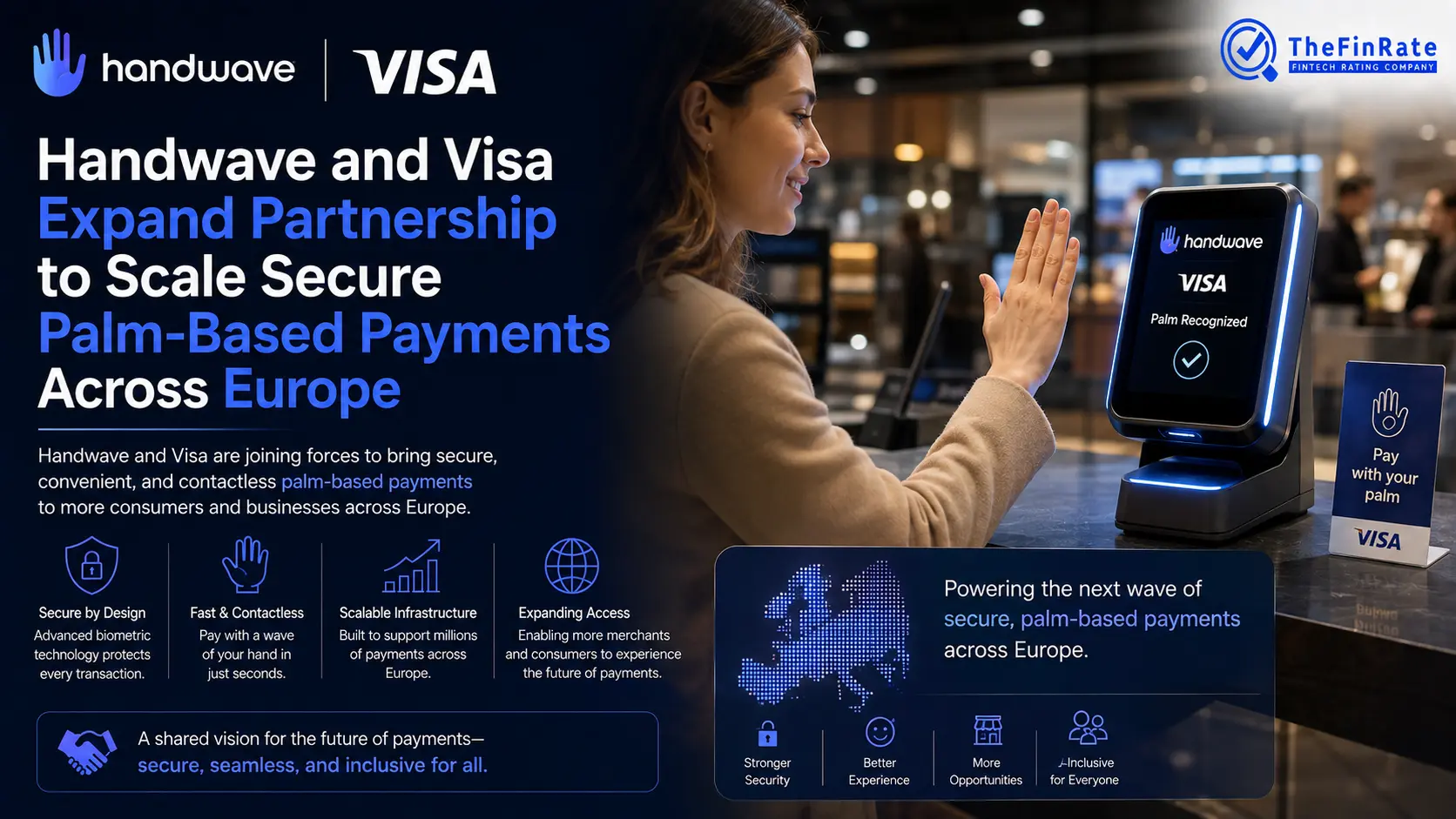
Handwave has expanded its partnership with Visa to accelerate the adoption of biometric payments across Europe, combining palm-based payment technology with Visa’s tokenisation, authentication and fraud-prevention capabilities.
The expanded agreement is designed to make card onboarding within Handwave’s biometric payment platform faster and more secure. Users will be able to link payment cards to their palm through the platform, enabling palm-based transactions without requiring a physical card or smartphone at checkout.
Visa Technology Strengthens Handwave’s Biometric Payments
Under the expanded agreement, Handwave will integrate Visa’s tokenisation and authentication technologies into its palm-based payment platform.
Tokenisation replaces sensitive card information with secure digital tokens, helping protect payment credentials while allowing cards to be connected to a user’s biometric identity.
Handwave will also use Visa’s fraud-prevention and risk-management capabilities, including Visa Decision Manager, to support real-time monitoring of biometric transactions.
The goal is to ensure that palm-based payments can deliver the convenience of biometric authentication while maintaining security and compliance standards expected from traditional card payments.
Palm Payments Move Closer to Mainstream Adoption
Biometric payments are attracting growing attention as payment providers look for ways to make checkout faster and less dependent on physical devices.
Handwave says its research published in March 2026 found that nearly half of US consumers would use palm-based payments if security and privacy were guaranteed.
Younger consumers appear particularly receptive to biometric technology. According to the company’s research, 46% of consumers aged 25–34 trust biometric recognition as a secure way to make payments or process loyalty-related transactions, compared with 28% of consumers aged over 55.
Across all age groups, 48% said they would regularly use palm payments if they were confident about how their biometric data was handled.
That highlights one of the biggest challenges facing biometric payments: trust.
Consumers may welcome faster and more convenient checkout experiences, but widespread adoption will depend on strong privacy protections, secure authentication and transparent data practices.
Visa to Support European Expansion
The partnership extends beyond technology integration.
Visa will support Handwave with market development, marketing initiatives, data-driven insights and access to its broader partnership network as the fintech expands across Europe.
The Baltics will serve as Handwave’s initial launch market for biometric payments and identity verification, with the company evaluating additional European markets for future expansion.
Handwave is also working toward integrating its solution with the Visa Acceptance Platform.
If implemented, the integration could make it easier for acquirers and merchants already connected to Visa infrastructure to adopt Handwave’s biometric payment technology.
That could significantly expand the potential distribution of palm-based payments by allowing the technology to work alongside existing payment infrastructure rather than requiring merchants to completely replace their systems.
Handwave Targets Retail Payment Pilots
Handwave is currently in discussions with banking and retail partners in the Baltic region and is preparing pilot programmes designed to bring palm-based payments into everyday retail environments.
The company expects to move toward production deployments during 2026.
The approach reflects a broader trend in payments: new technologies are increasingly being designed to work on top of existing financial infrastructure rather than replace it.
For merchants and banks, this can reduce the complexity associated with adopting emerging payment methods.
For consumers, the proposition is straightforward: authenticate with a palm instead of presenting a physical card or smartphone.
The Bigger Biometric Payments Trend
The Handwave-Visa partnership comes as the payments industry explores new forms of authentication that can combine convenience with stronger security.
Biometric payments could eventually extend beyond palm recognition to support broader use cases, including:
- Contactless payments
- Loyalty programmes
- Age verification
- Identity authentication
- Digital wallets
- Customer onboarding
However, biometric payments also introduce important questions around privacy and data governance.
Unlike a payment card, biometric characteristics cannot simply be replaced if compromised. As a result, companies developing biometric payment systems will need to demonstrate robust protection of biometric information and clear controls over how that data is stored, processed and used.
For this reason, Visa’s role in tokenisation, authentication and fraud prevention could be important as Handwave moves from pilot programmes toward broader commercial deployment.
What Comes Next for Handwave?
The immediate focus will be on launching pilot programmes with banking and retail partners in the Baltics and preparing the technology for production use.
The longer-term opportunity is much larger.
If biometric payments can deliver fast checkout while maintaining consumer trust and strong security controls, palm-based authentication could become another important layer within the global payments ecosystem.
The Handwave-Visa partnership therefore represents more than a technology integration. It is a test of whether biometric payments can move from an emerging concept into a scalable, everyday payment experience.
The key question is whether consumers will ultimately trust their palm as much as they trust their payment card.
Comments
No comments yet. Be the first to share your thoughts.
Leave a comment