
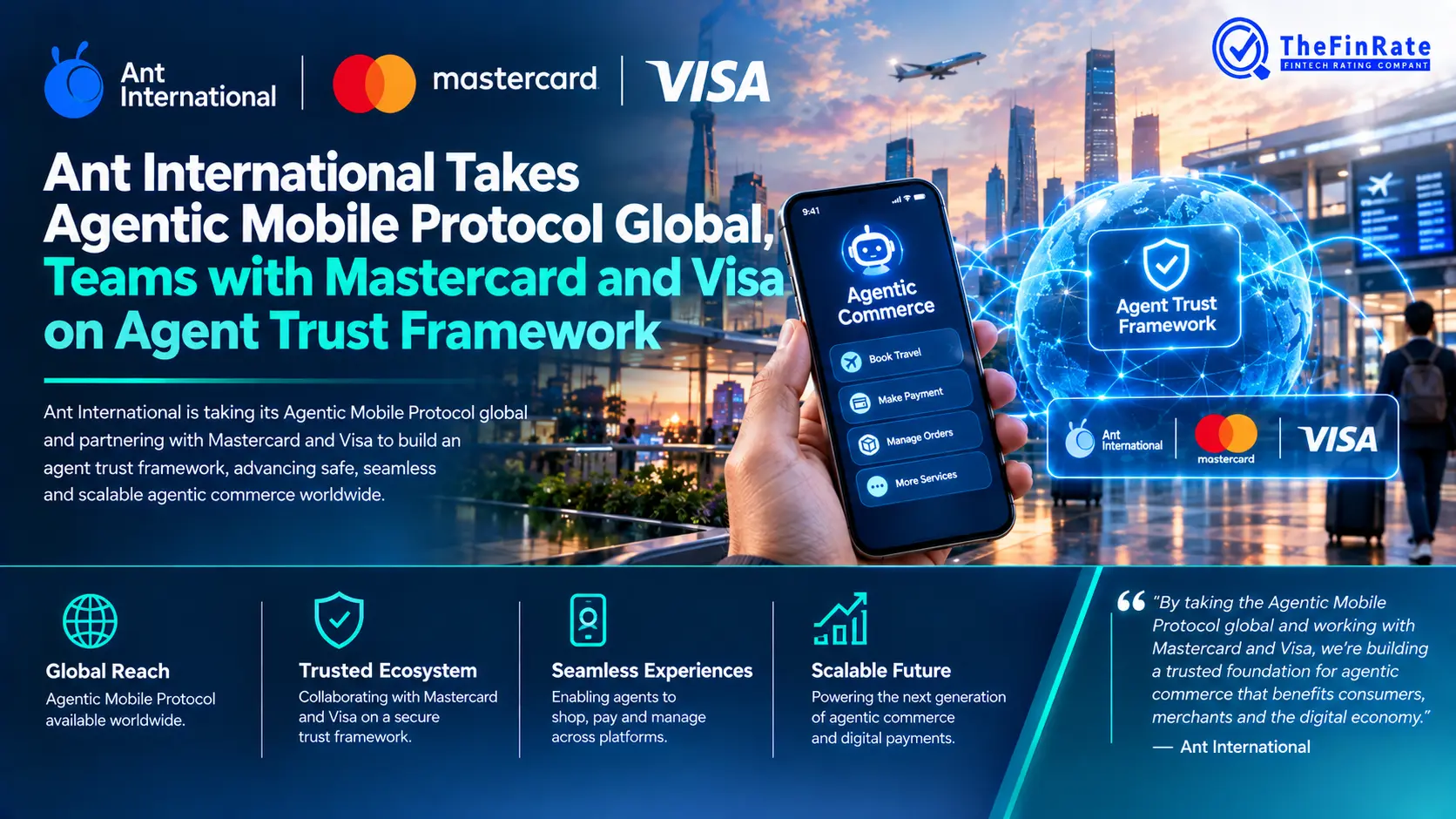
The fintech giant opens-sources its AMP protocol and joins forces with the world’s two biggest card networks to standardise how AI agents are identified, verified, and trusted across payment rails.
Ant International has expanded its Agentic Mobile Protocol (AMP) globally and started a Know-Your-Agent (KYA) framework collaboration with Mastercard and Visa. The announcement marks a significant step toward standardizing how AI agents operate within payment networks. Moreover, it signals that the industry’s biggest players now treat agentic commerce as a near-term reality rather than a distant experiment.
The move comes just five months after Ant International launched AMP in April 2026. Since then, wallets and payment partners have accelerated their AI strategies, according to the company. Consequently, the global rollout reflects growing demand for a common standard that lets AI agents transact safely across mobile interfaces.
What Is the Agentic Mobile Protocol?
AMP is a protocol built to support agent-led transactions across mobile interfaces such as smartphones and AR glasses. Crucially, it does not require users to switch applications or change existing payment habits. Instead, the protocol works quietly in the background. As a result, consumers can delegate tasks to AI agents while continuing to use the wallets and apps they already trust.
The company states that AMP reduces the number of steps needed to link a payment agent to a wallet by 50%. That reduction matters because friction kills adoption. If linking an agent takes too long or feels too complicated, users abandon the process. By cutting the steps in half, Ant International removes a major barrier to entry.
Beyond convenience, AMP includes a KYA framework that establishes an agent’s digital identity and certifies its authorized capabilities through an Agent Trust Rating. Additionally, it introduces AgentSafePay, which provides a money-back guarantee for merchants against agentic-specific risks. Furthermore, the protocol supports a high-frequency agent-to-agent settlement mechanism for automated transactions.
Global Rollout Across the Alipay+ Ecosystem
Ant International is now deploying AMP across its Alipay+ network. That network connects more than 50 mobile payment partners, more than ten national QR schemes, and multiple merchants and consumer accounts. In this first phase, ten Alipay+ digital wallets are integrating AMP into their own agent security architecture. The list includes Alipay, AlipayHK, DANA, GCash, KakaoPay, MPay, TNG eWallet, TrueMoney, Toss, and Starryblu.
Seven acquiring partners are also participating in this phase. They include Adyen, Allinpay, Checkout.com, Fiserv, Global Payments, Nuvei, and Worldline. That roster spans major markets across Asia, Europe, and North America. Consequently, AMP launches with meaningful scale from day one rather than as a limited pilot.
Open-Sourced on GitHub
Ant International has open-sourced AMP on GitHub. The company has made source code, developer SDKs, and technical documentation available to developers, AI platforms, wallets, acquirers, and financial institutions. That decision is strategic. By opening the protocol, Ant International invites the broader ecosystem to build on its foundation rather than compete with it.
Open-sourcing also builds trust. When developers can inspect the code, they can verify claims about security and functionality. Moreover, they can contribute improvements. As a result, the protocol evolves faster than any single company could manage alone. For an industry that worries about black-box AI systems, transparency matters enormously.
Collaboration with Mastercard and Visa on KYA
Ant International, Mastercard, and Visa have begun collaborating on a KYA interoperability framework. The initiative aims to help card networks, digital wallet ecosystems, agent platforms, and marketplaces streamline agent onboarding and identification. At the same time, it preserves each network’s own verification and decisioning processes.
That balance is important. Card networks guard their risk models closely. They will not hand over decision-making authority to a third party. However, they recognise that fragmentation hurts everyone. If every network builds its own agent identity system, wallets and merchants face a nightmare of integrations. Consequently, a shared framework reduces complexity while respecting each network’s autonomy.
The initiative builds on the Safeguards for Agentic Finance at Runtime (SAFR) framework. Furthermore, it will advance through BuildFin.ai, an industry platform convened by the Monetary Authority of Singapore (MAS). That platform brings financial institutions, technology providers, and researchers together on responsible AI development for financial services.
Why Agent Trust Matters
Agentic commerce depends entirely on trust. When a human clicks “buy,” they accept responsibility for the decision. When an AI agent acts on their behalf, the question of accountability becomes murky. Who is liable if the agent makes a mistake? How does a merchant know the agent is authorised? What happens if an agent is compromised?
These questions have slowed adoption. However, frameworks like KYA and tools like AgentSafePay begin to answer them. KYA establishes who the agent is and what it can do. AgentSafePay protects merchants against losses. Together, they create a safety net that makes agentic transactions viable at scale.
Jiang-Ming Yang, Chief Innovation Officer at Ant International, framed the protocol as a way to let agents enter existing mobile payment systems as trusted actors. He noted that wallets and payment partners are accelerating their AI strategies a few months after AMP’s launch. Additionally, he emphasised that mass adoption of agentic commerce depends on a foundation of trust. Consequently, Ant International is committing to work with card networks and policy bodies such as MAS on accountability mechanisms for agentic transactions across markets and payment rails.
The Competitive Landscape
Ant International is not alone in pursuing agentic payments. Mastercard has launched its own Agent Pay framework. Visa has introduced Trusted Agent Protocol. OpenAI and Stripe have partnered on agentic commerce. Meanwhile, Google has been developing its own standards for AI-driven transactions.
What distinguishes Ant International’s approach is its open-source nature and its focus on mobile-first markets. Alipay+ reaches hundreds of millions of consumers across Asia, many of whom rely on mobile wallets as their primary financial tool. By embedding AMP into that ecosystem, Ant International positions itself at the centre of agentic commerce in the world’s fastest-growing digital payment markets.
What This Means for Merchants and Wallets
For merchants, the rollout promises simpler integration and stronger protection. Instead of building custom connections to every agent platform, they can rely on AMP-compatible infrastructure. Moreover, AgentSafePay reduces the risk of fraud and chargebacks. For wallets, AMP offers a path to stay relevant as AI agents become the primary interface for commerce. Wallets that adopt the protocol can serve as trusted intermediaries rather than being bypassed entirely.
The Road Ahead
The global rollout of AMP and the KYA collaboration with Mastercard and Visa represent early steps. Standards take time to mature. Regulatory scrutiny will increase. Technical challenges will emerge. Nevertheless, the direction of travel is clear. AI agents will increasingly handle transactions on behalf of consumers. The companies that build trusted infrastructure for those agents will capture enormous value.
The Bottom Line
Ant International has expanded its Agentic Mobile Protocol globally across the Alipay+ ecosystem. Ten wallets and seven acquiring partners are integrating it in the first phase. The company has open-sourced the protocol on GitHub and begun collaborating with Mastercard and Visa on a KYA interoperability framework. That framework builds on SAFR and advances through MAS’s BuildFin.ai platform. As AI agents move from novelty to necessity, trust infrastructure becomes the battleground. Ant International is placing its bets early, and it is bringing heavyweight partners along for the ride.
Comments
No comments yet. Be the first to share your thoughts.
Leave a comment