
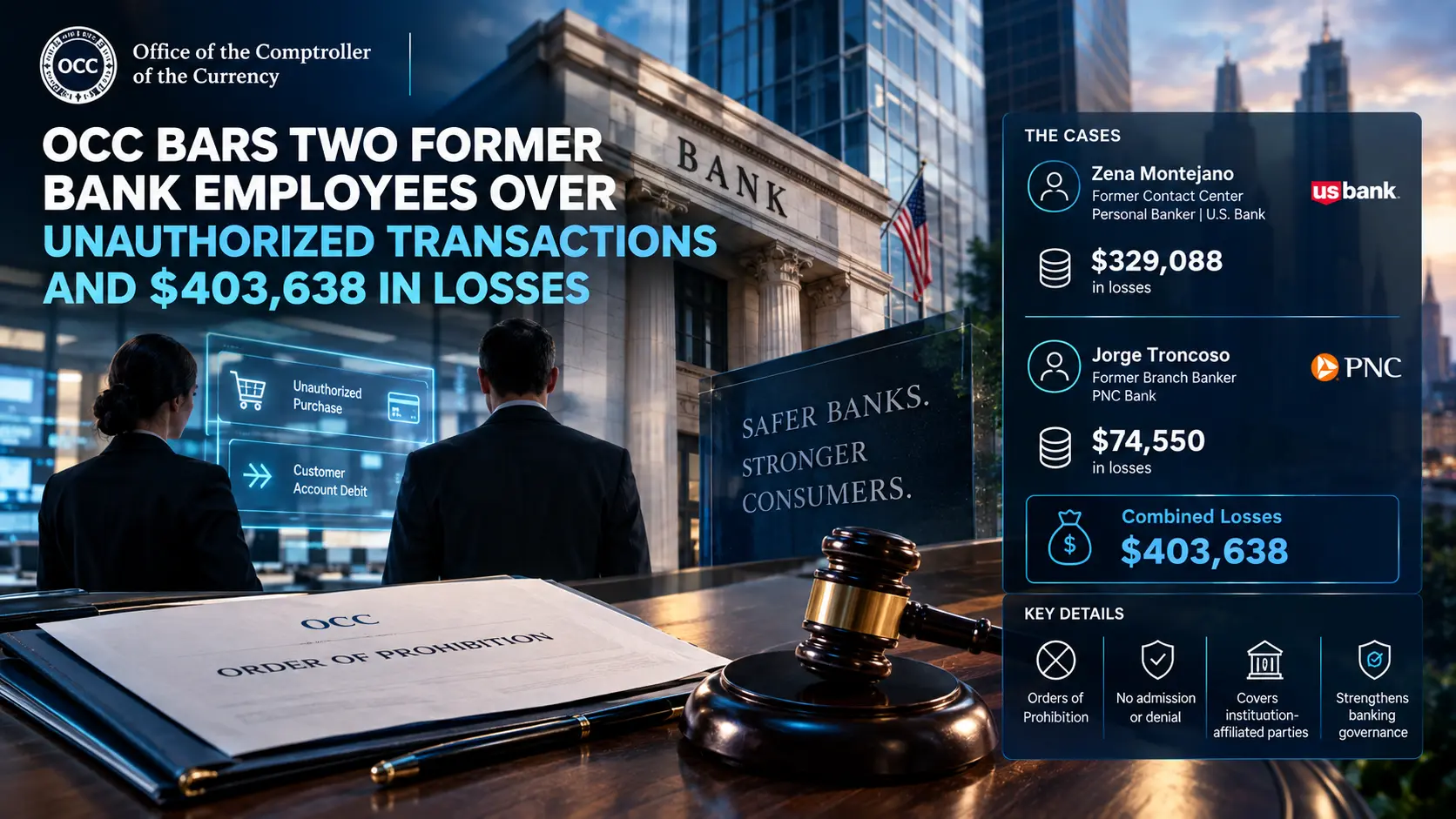
The Office of the Comptroller of the Currency has handed down two separate enforcement actions this month against former bank employees, together accounting for more than $400,000 in losses tied to unauthorized activity.
The federal banking regulator announced the actions on September 17, 2026, issuing Orders of Prohibition against Zena Montejano, a former Contact Center Personal Banker at U.S. Bank, and Jorge Troncoso, a former Branch Banker at PNC Bank. The two cases are unrelated, but both follow a similar pattern: an employee with legitimate access to bank systems allegedly used that access for personal gain.
Montejano was found to have misused her access to bank information and systems to make unauthorized purchases, resulting in roughly $329,088 in losses for U.S. Bank. Troncoso was found to have made unauthorized debits from multiple customer accounts for his own use, costing PNC Bank about $74,550. Both matters were resolved through consent orders, with the respondents neither admitting nor denying the Comptroller’s findings.
What these orders actually are
The OCC’s enforcement authority covers what it calls “institution-affiliated parties,” a category that includes bank directors, officers, employees, and controlling shareholders. The agency uses this authority to deter or address violations, unsafe practices, and breaches of fiduciary duty. An Order of Prohibition is one of its stronger tools: it bars someone from participating in the affairs of a bank or other covered financial institutions altogether.
Worth being precise here, these actions target the individuals, not the banks themselves. U.S. Bank and PNC Bank are named only as the institutions where the conduct took place; neither bank is the subject of the prohibition orders.
The Montejano case: 2,391 unauthorized purchases
Montejano worked as a home-based Contact Center Personal Banker for U.S. Bank out of Corona, California, from December 2021 through September 2023. According to the OCC’s findings, between roughly April 2022 and August 2023, she misused her position and her access to bank information and systems to make purchases without authorization and for non-bank purposes.
The scale is striking: 2,391 different commercial items, including around 515 Apple Watches, along with beds, air-conditioning units, furniture, appliances, household goods, and food, adding up to approximately $329,088. The OCC’s order states she personally benefited from the activity, including by selling off some of what she purchased, and that the conduct violated the law, generated financial gain for her, and involved personal dishonesty.
Montejano signed the consent order on July 30, 2026, and the OCC issued it on August 4, 2026. It’s a final order under the relevant federal banking statute and took effect immediately upon issuance.
The Troncoso case: unauthorized customer debits
The second case involves Jorge Troncoso, a former branch banker at PNC Bank’s Houston branch. Per the OCC’s findings, between July 2024 and May 2025, he made multiple unauthorized debits from several customer accounts for his own personal use, resulting in a $74,550 loss for PNC Bank.
As with the Montejano matter, the OCC concluded the conduct violated the law, generated financial gain for Troncoso, and involved personal dishonesty. He signed his consent order on July 9, 2026, and the case was resolved through that consent rather than a contested administrative hearing again, with no formal admission or denial of the findings.
What being barred actually means
An Order of Prohibition carries real weight. Under these orders, both individuals are barred from participating in the affairs of covered institutions that include institutional activities, certain voting-related actions, and serving in any capacity as an institution-affiliated party going forward. The restrictions apply broadly across insured depository institutions and other entities the order covers.
There is a narrow path back, though: the prohibition against working with a particular institution can be lifted if the individual gets prior written consent from both the OCC and the relevant federal financial regulator. So these aren’t simple employment terminations; they’re regulatory restrictions that follow the person well beyond whatever happened at their original employer.
Two different banks, one common thread
Add the two cases together, and the combined losses come to roughly $403,638 to $329,088 at U.S. Bank and $74,550 at PNC Bank. They’re entirely separate incidents involving different institutions, different employees, and different time periods. What ties them together is simpler: both involved people with legitimate positions inside a bank who allegedly abused access that came with the job, rather than any kind of external hacking or cyber intrusion.
That distinction matters for how banks think about risk. It puts the spotlight squarely on internal controls, transaction monitoring, access governance, and how well banks actually track what employees do with the systems they’re trusted to use.
Why employee access remains such a persistent risk
Banks face an inherent tension here: employees need meaningful access to sensitive systems to actually do their jobs and serve customers, but that same access is exactly what creates the opportunity for misuse when oversight breaks down. In Montejano’s case, it was access to bank systems used to make unauthorized purchases. In Troncoso’s, it was direct access to customer accounts used for unauthorized debits.
The usual layers of defense transaction monitoring, segregation of duties, audit trails, exception reporting, and tighter restrictions on sensitive functions exist precisely to catch this kind of behavior before it accumulates into six-figure losses. The OCC’s enforcement process adds another layer on top of all that: individual accountability once misconduct actually comes to light.
Part of a much longer enforcement record
These September actions aren’t isolated events; they’re part of the OCC’s ongoing public enforcement program, which maintains a searchable database of actions going back to August 1989, covering national banks, federal savings associations, foreign bank branches operating in the U.S., and institution-affiliated parties. The record shows the OCC has continued issuing prohibition orders and other enforcement actions against individuals tied to national banks throughout 2026.
For banks, cases like these serve as a pointed reminder that employee misconduct doesn’t just end with a firing; it can follow someone into a lasting regulatory bar from the industry. And for the sector more broadly, the lesson is straightforward: protecting customers means guarding against risks that originate inside the organization, not just threats coming from outside it. Strong access controls, real transaction oversight, and genuine accountability aren’t optional extras; they’re central to keeping trust in the banking system intact.
OCC Announces Enforcement Actions for September 2026
Comments
No comments yet. Be the first to share your thoughts.
Leave a comment