
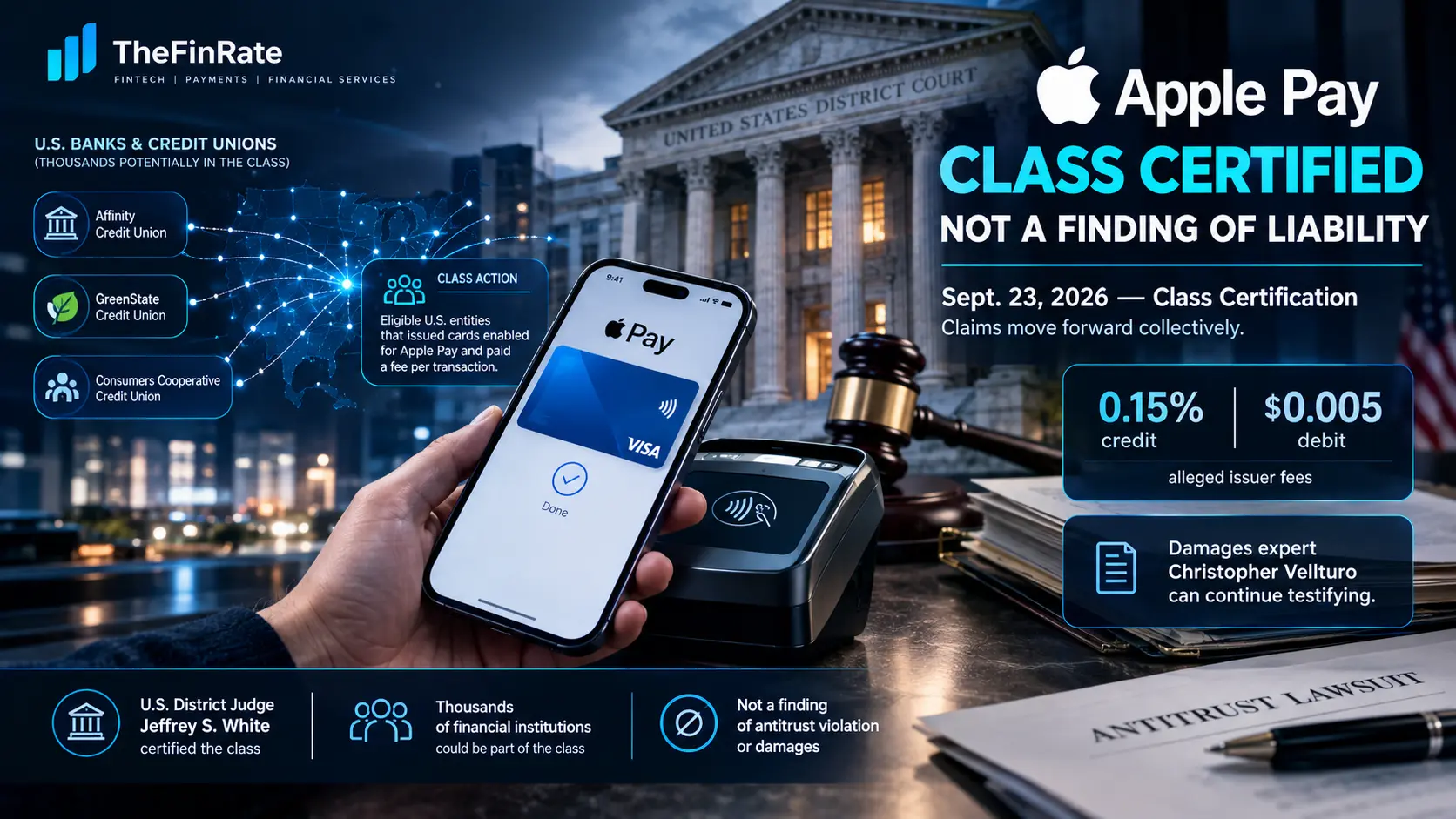
Thousands of U.S. banks and credit unions can now pursue claims against Apple together over fees charged on Apple Pay transactions. A federal judge certified an antitrust lawsuit as a class action, opening the door to collective litigation.
U.S. District Judge Jeffrey White certified the class on September 23, allowing eligible payment-card issuers to pursue the case collectively. The ruling also lets testimony from the plaintiffs’ damages expert remain in the case. However, this decision doesn’t determine whether Apple violated antitrust law or whether the financial institutions are entitled to damages.
The case centers on Apple’s control over contactless payments on the iPhone and the fees card issuers pay when customers use Apple Pay.
According to the lawsuit, Apple charges card issuers 0.15% of the value of credit-card purchases made through Apple Pay, plus $0.005 for each debit transaction. The plaintiffs argue that Apple could impose those fees because competing mobile wallets previously couldn’t access the iPhone’s contactless payment infrastructure on equivalent terms.
This litigation could therefore have implications well beyond the three credit unions that initially filed the case. If the plaintiffs ultimately prevail, the class structure gives eligible U.S. card issuers a mechanism to pursue claims through the same proceeding.
Thousands of card issuers can pursue the claims together.
Affinity Credit Union, GreenState Credit Union, and Consumers Cooperative Credit Union filed the lawsuit in 2022. The certified class covers U.S. entities that issued a payment card enabled for Apple Pay and paid Apple a fee for a transaction involving that card. The plaintiffs estimate that thousands of banks and credit unions could fall within the class.
Judge White found that several central questions could be addressed collectively, rather than requiring separate proceedings for every financial institution. Those questions include whether Apple had monopoly power in the relevant market, whether its conduct harmed competition, and whether card issuers suffered injury from the challenged fees.
The court also found that Apple’s standardized credit and debit fee structure could provide a common framework for calculating potential overcharges if the plaintiffs ultimately prove their claims.
That distinction matters here. The September ruling concerns whether the claims can proceed collectively. It is not a finding that Apple owes the banks money.
What Apple Pay fees are being challenged
This lawsuit challenges fees paid by card issuers when customers use Apple Pay. For a credit-card transaction, the complaint says issuers pay Apple 15 basis points, or 0.15%, of the transaction value. A $100 purchase would therefore result in a 15-cent Apple Pay fee under that rate.
For debit transactions, the lawsuit says Apple charges issuers half a cent per transaction. The plaintiffs argue that comparable mobile-wallet transactions on competing platforms didn’t impose equivalent issuer fees. Their broader argument holds that Apple’s control over contactless payments on iPhones reduced competitive pressure and let the company charge these fees in the first place.
These remain allegations made by the plaintiffs, and they still need to be established in the litigation.
The case is about competition as well as fees.
This lawsuit doesn’t focus only on the amount financial institutions pay Apple. At the center of the dispute sits access to the iPhone’s contactless payment functionality.
The plaintiffs allege that Apple restricted rival wallets from using the iPhone’s NFC capabilities for tap-to-pay transactions. In their view, that left Apple Pay as the dominant option for contactless card payments on iPhones and weakened competition across the board.
The case has evolved since it was first filed. In a 2023 ruling, Judge White let the monopolization claim continue but dismissed a separate allegation that Apple unlawfully tied iOS devices to Apple Pay. The latest ruling now allows the eligible issuers to pursue the remaining claims together as a group.
Apple has since opened more NFC access
One of the most important developments is that Apple’s payment ecosystem has changed since this lawsuit began. Apple introduced APIs supporting secure contactless transactions through compatible third-party iOS apps with iOS 18.1. Eligible applications can support in-store payments and other NFC use cases, while users can select an eligible application as their default contactless app.
Apple’s current developer documentation says developers seeking access to the NFC and SE platforms must enter into an agreement with Apple, meet eligibility requirements, and obtain the relevant entitlement. Apple also states that commercial terms and applicable fees can apply to use of the platform.
That creates an important distinction in this litigation. The expansion of NFC access may affect the future competitive environment for contactless payments on iPhones. But it doesn’t automatically resolve claims concerning fees that issuers allegedly paid in the past. The lawsuit therefore covers a period during which Apple’s rules around iPhone contactless payments have actually changed.
Damages expert can continue testifying.
Judge White also rejected Apple’s effort to exclude the plaintiffs’ damages expert, Christopher Vellturo. His analysis compares Apple’s issuer fees with the zero-dollar issuer fees the plaintiffs attribute to competing mobile wallets. This analysis aims to help estimate potential overcharges for members of the proposed class.
The judge’s decision doesn’t mean the damages calculation has been accepted as correct. Instead, the court found that Apple’s objections went to the strength and assumptions of the analysis, rather than providing a basis to exclude the testimony at this stage. Apple can still continue challenging the expert’s methodology and conclusions as the case proceeds.
That keeps an important part of the plaintiffs’ potential damages case alive for now.
Why class certification matters for banks
Class certification changes the scale of this litigation significantly. Rather than requiring each eligible financial institution to pursue an individual claim, the certified class lets common issues get addressed collectively instead.
For banks and credit unions that qualify, this structure could make it possible to participate in litigation centered on the same alleged conduct, fee structure, and competition questions. The plaintiffs’ lawyers have described the potential class as involving thousands of U.S. payment-card issuers.
Still, the financial impact remains genuinely uncertain. The court hasn’t ruled that Apple overcharged issuers. It hasn’t determined the total damages. It hasn’t found that Apple maintained an unlawful monopoly. Those questions all remain part of the ongoing litigation.
Apple Pay’s business model faces a broader competition question.
This case highlights a recurring issue in digital payments: who controls the infrastructure sitting between a consumer’s device, a wallet, and the financial institution behind the payment card?
Apple Pay sits directly within that chain. For financial institutions, the dispute concerns the cost of reaching customers through a major mobile platform. For Apple, the broader issue involves control over security-sensitive NFC functionality and the commercial terms attached to third-party access.
Apple’s current NFC framework illustrates this complexity well. Third-party applications can now support eligible contactless transactions, but developers must still satisfy Apple’s authorization, security, and commercial requirements. That means the competitive question has moved beyond whether rival wallets can technically access the iPhone’s NFC functionality. It also involves the terms under which that access gets provided.
What comes next for the case?
The September 23 certification lets the case move forward with the eligible issuers grouped into a certified class. The central legal questions remain unresolved for now.
The plaintiffs still need to establish their antitrust claims, demonstrate that Apple’s conduct caused compensable injury, and support any damages they seek. Apple remains able to challenge those claims and the plaintiffs’ economic analysis as the litigation continues forward.
This case could also offer a closer look at how platform-controlled payment infrastructure affects financial institutions that depend on mobile wallets to reach customers. For the payments industry, the most immediate development is therefore procedural but potentially significant: thousands of U.S. card issuers can now pursue the Apple Pay fee claims through one certified antitrust action.
Whether those claims ultimately result in damages, changes to Apple’s practices, or another outcome entirely will depend on the next stages of the litigation ahead.
Comments
No comments yet. Be the first to share your thoughts.
Leave a comment