
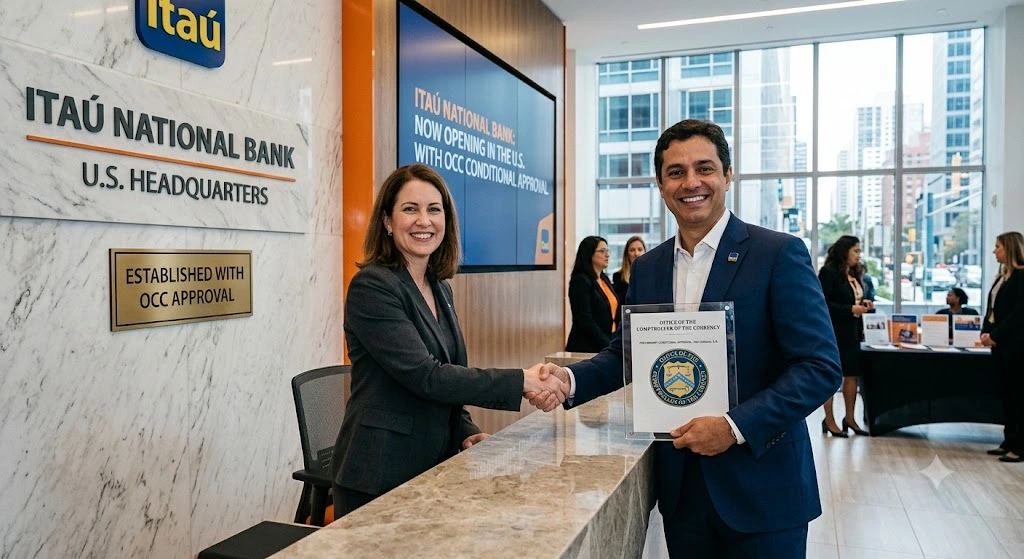
OCC Grants Preliminary Conditional Approval for Itaú to Establish U.S. National Bank
The U.S. Office of the Comptroller of the Currency (OCC) has granted preliminary conditional approval for Itaú Unibanco to establish a new national bank in the United States, marking a significant step in the Brazilian banking group’s expansion of its U.S. banking capabilities.
The proposed institution, Itaú Bank, National Association (IBNA), will be headquartered in Miami, Florida. The OCC issued Corporate Decision #1386 on August 14, 2026, approving the charter application subject to a series of conditions and additional regulatory requirements.
The proposed bank will target high- and ultra-high-net-worth individuals with Brazilian and Latin American connections. It plans to offer deposit accounts, mortgages, other lending products, credit cards and fiduciary services from a single Miami location.
However, the decision does not authorize IBNA to begin operations yet. The OCC made clear that final approval will depend on the completion of pre-opening requirements and favorable action by the Federal Reserve and Federal Deposit Insurance Corporation (FDIC).
OCC Gives Itaú a Conditional Path to a U.S. National Charter
The OCC reviewed Itaú’s application to establish an insured, de novo national banking association with full fiduciary powers under the National Bank Act and related regulations.
In Corporate Decision #1386, the regulator said it granted preliminary conditional approval after evaluating the information submitted by the proposed bank and its representatives. The decision also approves applications concerning fiduciary powers and certain director residency and citizenship waivers.
The proposed institution is sponsored by Itaú Unibanco S.A. and Itaú Unibanco Holding S.A. The OCC identifies the new entity as a full-service bank that would expand the range of products available through Itaú’s U.S. operations.
The development follows Itaú’s formal application for the U.S. charter earlier this year. The bank’s market announcement subsequently confirmed that the OCC approval remains conditional and does not constitute final authorization to commence operations.
What Itaú Bank Plans to Offer
IBNA is designed to serve a relatively specialized customer segment rather than build a broad U.S. retail banking network.
According to the OCC decision, the proposed bank will focus on high- and ultra-high-net-worth customers with Brazilian and Latin American connections. Its planned product range includes:
- Deposit accounts
- Mortgages
- Other loan products
- Credit cards
- Fiduciary products
The bank also expects to enter arrangements with affiliated broker-dealer subsidiaries to maintain and develop existing client relationships.
IBNA will initially operate from one Miami location. The OCC says the bank has no plans for a traditional branch network in the immediate future.
That approach gives Itaú a targeted U.S. strategy. Instead of competing immediately across mass-market retail banking, the proposed bank would focus on cross-border customers who already have financial ties to Brazil and Latin America.
Itaú Plans $507 Million in Initial Capital
Capitalization is another major component of the proposed structure.
The OCC says IBNA’s capital upon opening will be $507 million. The proposed capitalization involves Itaú Bank Holding, Inc., the bank’s planned immediate parent holding company, contributing the ownership interests of Banco Itaú International, Miami (BII) to the new national bank.
The OCC requires the proposed bank to maintain a minimum Tier 1 leverage ratio of 8% during its first three years of operation. Its initial paid-in capital, after organizational and pre-opening expenses, must also remain at no less than $507 million.
The regulator has imposed additional controls around changes to IBNA’s business plan and the appointment of directors and senior executive officers.
For example, significant changes to the proposed business plan will require advance notice and an OCC written determination of no objection. The bank must also obtain OCC clearance before appointing certain senior executives or directors.
These conditions underline that the charter approval represents an important regulatory milestone, but not the end of the licensing process.
Final U.S. Bank Approval Is Still Pending
The distinction between preliminary conditional approval and final approval is central to the development.
The OCC explicitly states that it has granted preliminary conditional approval only. The proposed bank cannot open until it satisfies the regulator’s pre-opening requirements and receives final approval.
The OCC also requires favorable action from both the Federal Reserve and the FDIC before final approval can be granted. Those approvals are particularly relevant to the proposed structure because the bank must obtain Federal Reserve membership and deposit insurance.
In addition, the proposed capitalization through the contribution of Banco Itaú International remains subject to the required regulatory approvals.
The OCC has therefore created a clear sequence for Itaú. The bank must complete its organizational work, secure the required capital, satisfy regulatory conditions and obtain the remaining federal approvals before it can begin banking operations.
OCC Sets Capital and Opening Deadlines
The preliminary approval also comes with specific timing requirements.
Itaú must complete the steps needed to secure the required capital within 12 months of the preliminary conditional approval date. The proposed bank must also open for business within 18 months of that date. Otherwise, the OCC approval will expire, except in the most limited circumstances where the regulator determines that an extension is justified.
That gives Itaú a defined regulatory timetable as it moves toward establishing IBNA.
The OCC also retains the ability to modify, suspend or rescind the preliminary approval if developments during the organizing period warrant such action.
Why Miami Matters to Itaú’s U.S. Strategy
Miami provides a natural base for a bank focused on customers with Latin American connections.
The city has long served as an important financial and commercial gateway between the United States and Latin America. For Itaú, a Miami-based national bank could provide a more direct platform for serving affluent customers whose financial lives span multiple countries.
The proposed structure also gives Itaú room to expand its U.S. banking capabilities beyond products already offered by its existing affiliates.
The OCC specifically notes that IBNA intends to provide products and services that its U.S. affiliates do not currently offer. That includes mortgages, deposit accounts, additional lending products, credit cards and fiduciary services.
The strategy therefore appears focused on deepening existing relationships rather than simply adding another U.S. banking brand.
What the Charter Could Mean for Cross-Border Banking
For Itaú, obtaining a U.S. national charter would strengthen its ability to serve customers across the Brazil-U.S. financial corridor.
A national bank structure can provide a broader regulatory framework for offering banking services in the United States. It could also allow Itaú to integrate additional banking products with its existing international private-banking and investment relationships.
The opportunity is particularly relevant for wealthy customers who need banking, lending, investment and fiduciary services across jurisdictions.
At the same time, the proposed bank will face the same regulatory expectations that apply to other U.S. national banks. Capital, governance, risk management, compliance and consumer protection requirements will remain central to the institution’s operating model.
The OCC’s conditions reflect that regulatory focus.
Itaú Builds on Its Existing U.S. Presence
The proposed national bank would not represent Itaú’s first presence in the United States.
Itaú’s corporate announcement says the Itaú Unibanco group has maintained a U.S. presence since 1979, providing financial products and services in the market. The company said the proposed bank is intended to strengthen that presence by expanding its banking capabilities and product offering.
The new structure would therefore build on an established U.S. footprint rather than represent a completely new market entry.
Itaú remains one of Brazil’s largest financial institutions and operates across multiple international markets. Its corporate profile describes the group as a full-service universal bank with operations and partnerships spanning numerous countries.
What Happens Next
The immediate focus will shift from charter approval to execution.
Itaú must complete the required capitalization process, continue working through its organizational requirements and satisfy the OCC’s pre-opening conditions. The bank must also obtain the necessary favorable actions from the Federal Reserve and FDIC.
The OCC has already identified the proposed leadership team, including Percy Moreira as organizer, director and chief executive officer, alongside other proposed executives and directors. The regulator has also stated that additional appointments will require prior OCC approval or a written determination of no objection where applicable.
The next major milestone will therefore be the completion of the remaining federal regulatory process. Until that occurs, IBNA remains a proposed institution rather than an operating U.S. national bank.
Conclusion
The OCC’s preliminary conditional approval gives Itaú Unibanco a significant regulatory foothold as it moves toward establishing Itaú Bank, National Association in Miami.
The proposed $507 million-capitalized bank would target high- and ultra-high-net-worth customers with Brazilian and Latin American connections while offering deposits, mortgages, lending, credit cards and fiduciary services from a single Miami location.
Still, the approval should not be described as a final U.S. banking authorization. Itaú must meet the OCC’s pre-opening conditions and secure favorable action from the Federal Reserve and FDIC before IBNA can open.
For the broader banking market, the development highlights Itaú’s continued commitment to the U.S. and its strategy of building deeper financial relationships with affluent Latin American customers. The next stage will depend on whether the bank can complete the remaining regulatory and operational requirements within the OCC’s timetable.
OCC Corporate Decision #1386 — Itaú Bank, National Association
Comments
No comments yet. Be the first to share your thoughts.
Leave a comment