
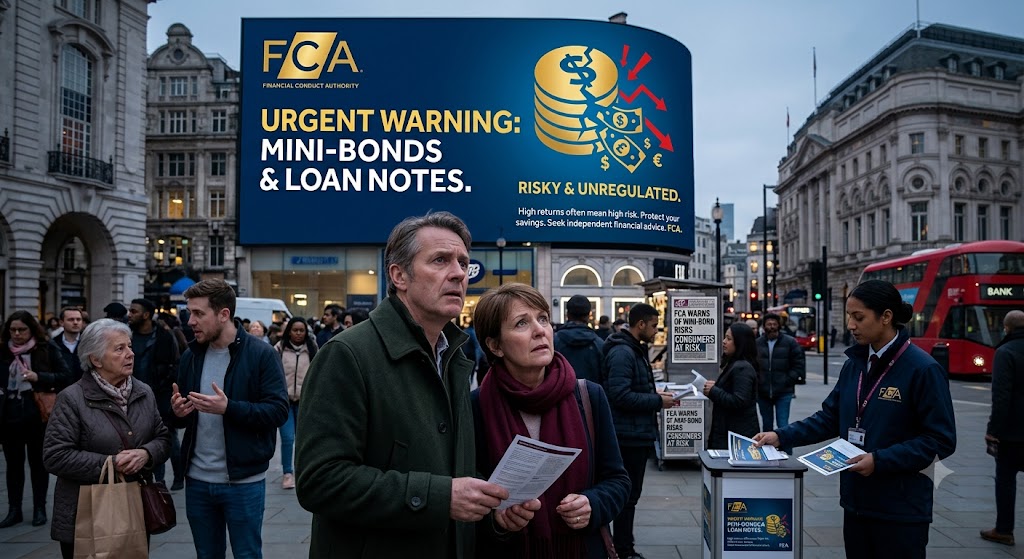
FCA Warns Consumers Over Risky Mini-Bonds and Loan Notes
The UK Financial Conduct Authority (FCA) has warned consumers about the risks of investing in mini-bonds and loan notes from unregulated companies.
The warning follows continued cases of people losing money in these high-risk investments. The recent failure of Woodville Consultants Ltd also highlights the dangers investors can face.
Woodville, a litigation funder, raised money from retail investors through unregulated loan notes. If a company fails, investors could lose some or all of their money.
FCA Warns About High Returns
A loan note or mini-bond usually involves lending money to a company for a fixed period. In return, the company promises to pay interest.
However, these investments carry significant risks. If the company runs into financial trouble, investors may lose every penny.
The FCA permanently banned the marketing of speculative illiquid securities to retail investors on January 1, 2021. The ban includes speculative mini-bonds and loan notes.
Despite the ban, consumers may still see advertisements for these investments. Social media, websites, and online adverts often promote high fixed returns.
The FCA says consumers should not treat high returns as a guarantee. Instead, they should see unusually large returns as a possible warning sign.
Warning Signs Consumers Should Watch For
Some adverts can make risky investments look simple and safe. However, the FCA has highlighted several warning signs.
Consumers should be cautious when they see:
- Pressure to invest quickly
- Poor explanations of how they could lose money
- Claims that an investment is “asset-backed” without clear evidence
- Large fees or commissions paid to introducers
- Encouragement to claim experience or wealth to access an investment
- High-risk investments promoted without the required permission
- Hidden fees or conflicts of interest
- Claims designed to create a false sense of legitimacy
- Complex structures that may try to avoid FCA rules
These practices can make high-risk investments appear safer than they really are.
Investors Could Lose Their Money
Unregulated investments may offer fewer protections than regulated financial products.
Consumers may not be able to take complaints to the Financial Ombudsman Service. They may also lose access to compensation through the Financial Services Compensation Scheme.
The exact protections depend on the investment and the firms involved. However, investors who deal with unauthorised firms may have little or no protection.
The FCA urges consumers to check a firm’s status before investing.
Woodville Failure Highlights the Risks
The FCA pointed to the recent failure of Woodville Consultants Ltd as an example of the risks.
Woodville raised capital from retail investors through unregulated loan notes. The company’s failure shows what can happen when the issuer cannot meet its financial obligations.
Kroll Advisory appointed Robert Goodhew and Andrew Stoneman as joint administrators on July 16, 2026.
The case serves as a reminder that investors can lose money when companies behind high-risk investments fail.
FCA Steps Up Action Against Harmful Promotions
The FCA says it has issued more than 1,200 warnings so far in 2026.
The regulator has also told firms to stop unlawful promotions. In some cases, it has referred matters to law enforcement agencies.
However, the FCA says investment scams remain difficult to stop. Some scammers operate from overseas. Others move quickly or use complex structures to avoid regulation.
The FCA says banks, payment firms, regulators, government bodies, and law enforcement must continue working together.
Consumers Should Check Before Investing
Lucy Castledine, Director of Consumer Investments at the FCA, warned that big fixed returns should raise concerns.
She said mini-bonds, loan notes, and similar investments carry high risks. The FCA also said most ordinary retail investors should avoid these products.
The regulator advises consumers to use the FCA Firm Checker before investing. This tool can help people check whether a firm has the right authorisation.
Consumers should also report suspicious investments to the FCA.
New Securities Rules Change the Regulatory Landscape
A new regime for offers of securities to the public came into force in January 2026.
The FCA has also asked the government to review legal exemptions. These exemptions can allow some high-risk investments to be promoted outside FCA regulation.
The regulator continues to focus on reducing harm from unauthorised and misleading investment promotions.
What Consumers Should Do Before Investing
Before investing, consumers should take time to understand the risks.
They should:
- Check the firm using the FCA Firm Checker.
- Confirm that the firm has the correct FCA permissions.
- Understand exactly how the investment works.
- Ask how they could lose money.
- Check all fees and commissions.
- Avoid pressure to invest quickly.
- Question claims about guaranteed or fixed returns.
- Check what protection applies if the investment fails.
The FCA’s message is clear. High returns often come with high risks. Consumers should stop, check, and understand an investment before handing over their money.
Consumers warned to beware of risky mini-bonds and loan notes
Comments
No comments yet. Be the first to share your thoughts.
Leave a comment