
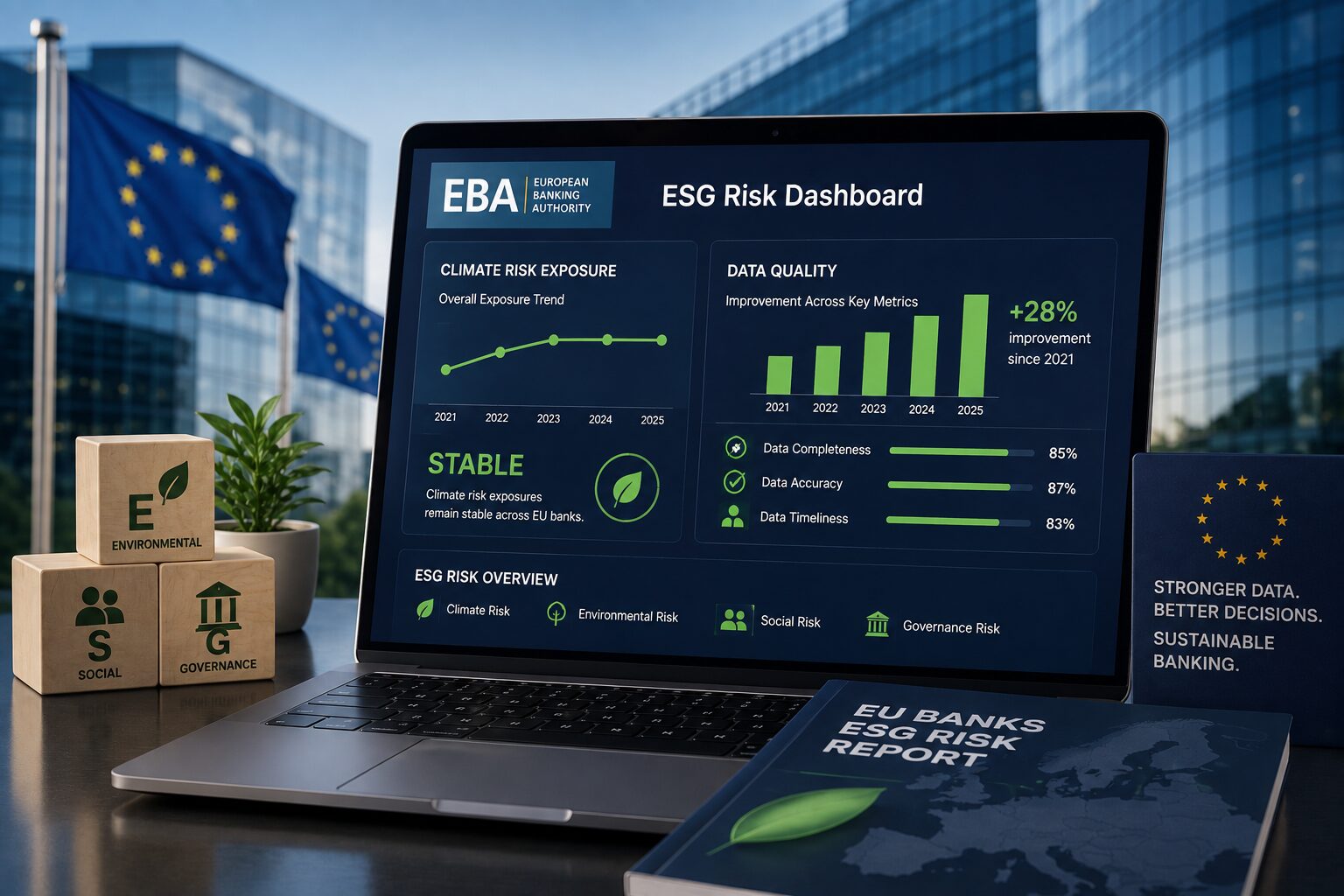
EBA ESG Risk Dashboard Shows Stable Climate Risk Exposures and Better Data Quality Across EU Banks
The European Banking Authority has shared its ESG risk dashboard. This dashboard shows that climate-related risk exposures across the EU and European Economic Area banking sector stayed about the same during the half of 2025.
The report says that banks exposure to both transition climate risk and physical climate risk stayed about the same between June and December 2025. At the time the European Banking Authority found improvements in the availability and quality of climate-related data. This is especially true for the assessment of the energy efficiency of mortgage portfolios.
The findings suggest that European banks are keeping climate risk profiles steady. They are also slowly improving the quality of the data used to watch and handle those risks.
Transition Climate Risk Remains Stable
One of the reports points is that banks exposure to sectors that contribute a lot to climate change stayed the same at 62% across the EU and European Economic Area.
Transition risk is the risks that happen as economies move toward lower-carbon activities. These risks can affect banks through lending to carbon- industries. They can also be affected by rules, changing technologies and shifts in what people want.
Even though some individual countries had changes in exposure levels the overall transition risk picture of the banking sector stayed about the same. The countries and banks with transition risk exposures also stayed much the same as earlier times.
Mortgage Energy Efficiency Data Continues to Improve
The European Banking Authority reported progress in the quality of climate-related mortgage data. The share of energy- mortgage exposures went up a little during the reporting period. At the time the proportion of mortgage exposures without energy performance information went down.
Estimated energy performance scores also went down a bit. This means that banks are using energy performance data more and estimates less.
These improvements matter because energy efficiency data is becoming more important in checking climate-related risks within mortgage portfolios. Better data lets banks and supervisors check climate weaknesses accurately. It also helps make long-term risk management.
Physical Climate Risk Exposures Remain Uneven Across Europe
Even though overall physical climate risk exposures stayed the same the European Banking Authority noticed differences across countries.
Banks exposure to climate risks like floods, storms, droughts, heatwaves and other climate-related events is very different from country to country. Average exposure shares went from under 10% in some countries to than 55% in others.
The European Banking Authority said these differences come from a mix of industry factors. They also come from ways of classifying and checking risks.
Because of this climate risk is still a problem even though the whole European banking sector is stable.
Data Quality Becomes a Key Regulatory Priority
A topic of the report is the improvements in climate-related reporting data. Supervisors have been pointing out the importance of ESG data for proper risk monitoring.
Full energy performance information allows regulators to better check banks exposures to climate risks. It also helps find weaknesses across the system.
The European Banking Authoritys findings suggest that banks are making progress in making their climate reporting better. Although the changes are small they support climate risk checks and supervision.
Why the EBA ESG Dashboard Matters
The EBA ESG risk dashboard has become a way to track climate-related risks across the European banking sector. The dashboard uses ESG disclosure data from banks. It gives regulators a look at both transition and physical climate risk exposures.
By watching changes over time the European Banking Authority can check if climate-related weaknesses are going up down or staying the same. The dashboard also helps leaders see how well climate-related disclosure rules and risk management practices are working across the banking sector.
Climate Risk Remains a Long-Term Banking Issue
Even though the latest report shows things are the same the European Banking Authority still sees climate risk as a term financial stability issue. European banks are still very exposed to sectors that help climate change. Physical climate risks still change a lot between areas.
As climate policies, new technologies and environmental conditions change banks will need data and risk management tools. The slow improvements in data quality could be as important as the exposure levels staying the same.
What Happens Next?
The European Banking Authority is expected to keep sharing updates through its ESG risk dashboard. This is part of its checking process. Future reports might show how banks climate risk exposures change as the European Union moves forward with its goals for sustainability and climate change.
Regulators are also likely to keep pushing for climate-related reports, data quality and ESG risk management methods.
The Bottom Line
The European Banking Authoritys latest ESG risk dashboard shows that EU and EEA banks kept climate risk exposures the same during the half of 2025. Transition risk stayed at 62% of exposures and physical climate risk measures were mostly the same.
Importantly the report points out improvements in climate-related data quality especially, in mortgage energy efficiency checks.
For banks, regulators and investors the results show that Europes banking sector is slowly getting better at reporting climate risks. It is also keeping an overall climate risk picture. The European Banking Authority and EU banks are working together to improve climate risk management. They are doing this by focusing on climate-related data quality and ESG risk management methods.
Comments
No comments yet. Be the first to share your thoughts.
Leave a comment