
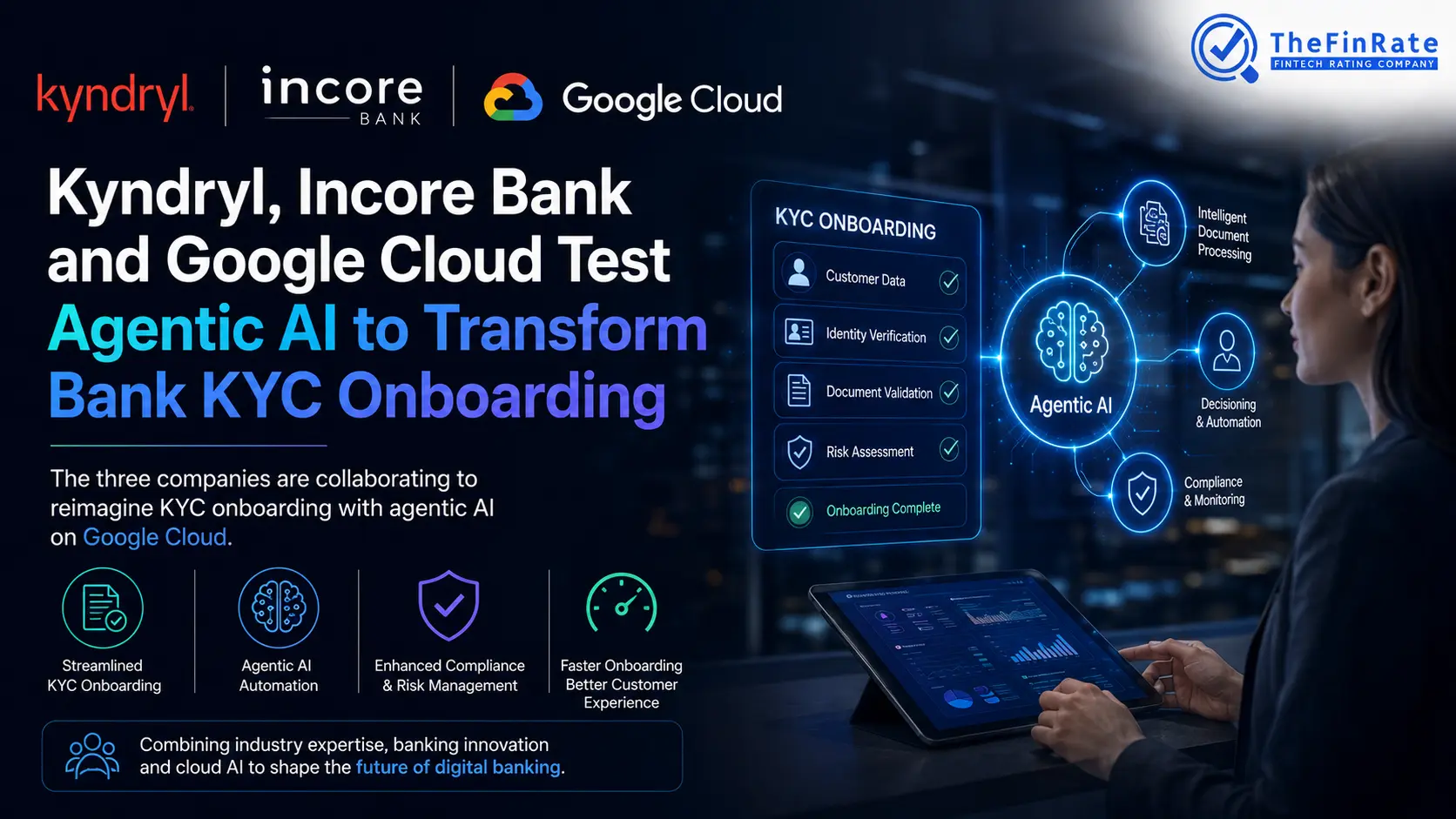
Kyndryl, Incore Bank and Google Cloud Test Agentic AI to Transform Bank KYC Onboarding
Kyndryl, Incore Bank and Google Cloud have completed a proof of concept showing how agentic AI can automate and accelerate bank KYC and customer risk assessment, potentially reducing onboarding timelines from months to days while keeping human oversight at the centre of the process.
The Switzerland-based project combines Kyndryl’s Agentic AI Framework with Google’s Gemini models and agentic AI capabilities to automate tasks across customer onboarding and ongoing risk reviews.
During the proof of concept, the solution achieved up to 99% accuracy in extracting information from customer onboarding documents and demonstrated the potential to significantly reduce the time required for customer risk assessments.
Agentic AI Moves Into Bank KYC
Know Your Customer processes are among the most important — and often most time-consuming — workflows in financial services.
Banks must collect and verify information from customer documents, internal systems and external sources before assessing risk. The process also needs to produce an auditable record that can withstand regulatory scrutiny.
Traditionally, many of these activities involve manual reviews and handoffs between compliance, risk and operations teams.
That creates a difficult balance.
Banks need to complete KYC checks thoroughly, but customers increasingly expect financial services to be delivered quickly.
The Kyndryl, Incore Bank and Google Cloud proof of concept demonstrates how multiple AI agents could help bridge that gap.
How the Agentic AI KYC Solution Works
The solution brings together multiple AI agents that can work across structured and unstructured information.
The agents support several stages of the customer risk-management process, including:
- Extracting information from onboarding documents
- Validating customer information
- Gathering supporting evidence
- Identifying relevant risk factors
- Generating explainable risk assessments
- Monitoring changes in customer circumstances
- Creating auditable decision records
Rather than relying on a single AI model to make an isolated decision, the architecture coordinates multiple agents across different stages of the workflow.
This is important for banking because KYC is not simply a data-extraction problem.
A bank must also be able to explain why a customer received a particular risk assessment and demonstrate how the decision was reached.
Policy as Code Adds a Governance Layer
A central part of the proof of concept is Kyndryl’s use of policy as code alongside its Agentic AI Framework.
The approach introduces a semantic layer and guardrail agents designed to help ensure that AI-driven processes operate within predefined policies and controls.
For regulated financial institutions, this distinction matters.
The goal is not to give an AI agent unrestricted authority over customer onboarding.
Instead, the architecture is designed to automate repetitive processes while maintaining transparency, auditability and human governance over risk decisions.
KYC Onboarding Could Move From Months to Days
One of the most significant findings from the proof of concept was the potential to reduce customer onboarding timelines from months to days.
The system achieved up to 99% accuracy in automated extraction of data from customer onboarding documentation, according to the companies.
If similar results can be achieved in production environments, the impact could extend beyond compliance teams.
Faster onboarding can reduce customer friction, allow banks to activate relationships sooner and free compliance professionals to focus on complex cases requiring human judgment.
That is where agentic AI could become particularly valuable in financial services.
Instead of replacing compliance specialists, AI can potentially remove large amounts of repetitive evidence-gathering and verification work from their workload.
Human Oversight Remains Critical
The banking sector cannot treat agentic AI like a conventional automation tool.
KYC and customer risk assessments have regulatory consequences. Errors can result in financial crime exposure, regulatory action or customers being incorrectly classified.
For that reason, explainability and human oversight are central to the project.
The solution is designed to produce auditable decision records while allowing compliance professionals to concentrate on judgment-intensive cases.
Incore Bank CEO Mark Dambacher said the project demonstrates how cloud-enabled agentic AI can improve efficiency while maintaining the oversight and controls required in a regulated banking environment.
That governance-first approach could become an important model for other financial institutions exploring autonomous AI workflows.
Why Google Gemini Matters
Google Cloud’s Gemini models provide the underlying AI capabilities used within the proof of concept.
Combined with Kyndryl’s framework and Incore Bank’s banking environment, the project demonstrates how generative and agentic AI can be integrated into a highly regulated operational process.
The important development is therefore not simply that a bank is using Gemini.
It is that AI agents are being applied across an end-to-end KYC workflow, from document extraction and evidence gathering through risk-factor identification and the creation of decision records.
That represents a broader shift from AI used as an assistant toward AI that can orchestrate multiple steps in a business process.
The Bigger Trend: Agentic AI in Financial Services
The project comes as banks and financial institutions increasingly explore agentic AI for complex workflows.
Traditional AI applications have generally focused on individual tasks such as classification, fraud detection or customer-service responses.
Agentic AI takes a different approach.
It can coordinate multiple actions toward a defined objective, potentially allowing financial institutions to automate entire workflows rather than individual tasks.
KYC is particularly suitable for this model because it contains many repetitive, rules-driven activities that require information to be gathered from multiple sources.
However, the final risk judgment may still require experienced human professionals.
That makes KYC an important test case for a hybrid model in which AI handles process execution while humans retain decision authority.
What This Means for Banks
If agentic AI can safely automate parts of KYC, banks could potentially gain improvements across several areas:
Faster onboarding: Customers could move through verification processes more quickly.
Lower operational workload: Compliance teams could spend less time on repetitive document processing.
Better monitoring: AI agents could continuously monitor changes in customer circumstances.
Improved consistency: Automated workflows could apply policies more consistently across cases.
Stronger auditability: AI-generated evidence trails could make it easier to reconstruct how decisions were reached.
The key challenge will be proving that these benefits remain reliable at production scale.
From Proof of Concept to Production
The Kyndryl, Incore Bank and Google Cloud project remains a proof of concept.
That distinction matters.
A successful demonstration does not automatically mean the same performance will be achieved across a live banking population with different documents, jurisdictions, risk profiles and regulatory requirements.
Production deployment would require extensive testing, monitoring, security controls and regulatory governance.
Still, the results offer an important signal for the banking industry.
The ability to extract onboarding information with up to 99% accuracy and potentially compress onboarding from months to days shows why financial institutions are taking agentic AI seriously.
The Bottom Line
Kyndryl, Incore Bank and Google Cloud are demonstrating a potentially important next step in the evolution of AI-powered KYC.
The project combines agentic AI, Gemini models, policy controls and human oversight to automate significant parts of customer onboarding and risk assessment.
The headline number is impressive: up to 99% accuracy in automated document-data extraction, alongside the potential to reduce onboarding timelines from months to days.
But the more important development is architectural.
AI is moving from answering questions to coordinating workflows.
For banks, the winning model may not be fully autonomous compliance.
It may be agentic automation with humans firmly in control of the decisions that matter most.
Comments
No comments yet. Be the first to share your thoughts.
Leave a comment