
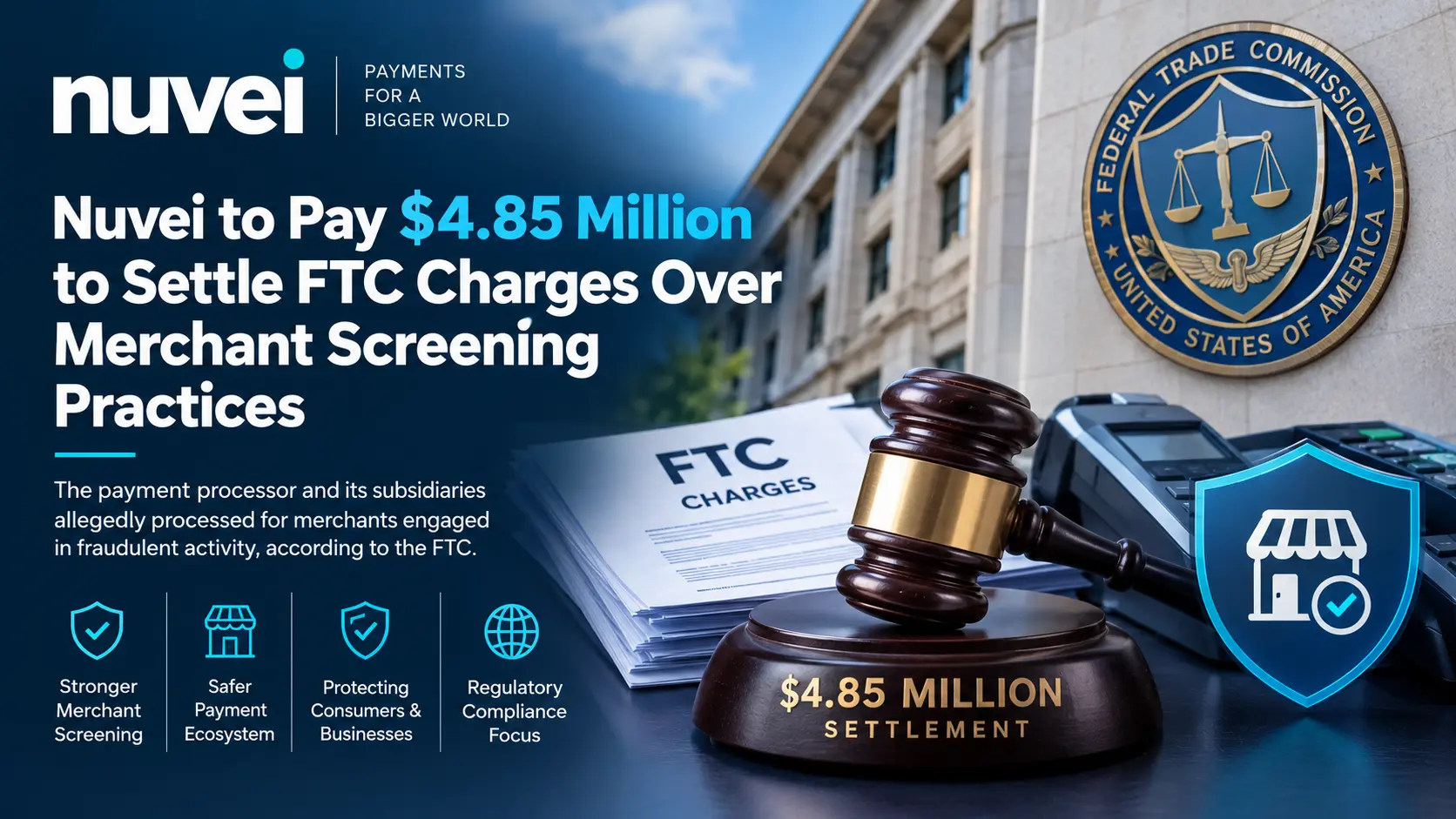
Global payment processor Nuvei will pay $4.85 million to settle Federal Trade Commission (FTC) charges alleging that the company and its subsidiaries opened and maintained payment processing accounts for merchants that the agency says they knew or should have known were engaged in deceptive activity.
The proposed settlement also requires Nuvei to strengthen its merchant screening and monitoring practices, marking a significant development for payment processors facing growing scrutiny over how they identify and manage high-risk merchants.
The FTC announced the action on September 4, 2026, saying the settlement is intended to address allegations involving payment processing for deceptive merchants, including technology support scams that allegedly took millions of dollars from consumers.
What the FTC alleges against Nuvei
According to the FTC’s complaint, Canada-based Nuvei Corporation and several subsidiaries processed payments for merchants allegedly involved in deceptive schemes.
The agency specifically alleges that Nuvei processed more than $30 million in consumer payments for Reimage, an offshore technology support scheme, between 2017 and 2023.
The complaint also alleges that Nuvei’s payment processing infrastructure was used by other merchants accused of deceptive conduct, including businesses allegedly making false earnings claims, impersonating government tax authorities, or having previously been terminated by other payment processors or acquiring banks because of excessive chargebacks or fraud concerns.
The FTC’s allegations extend beyond a single merchant relationship. They focus on the processes payment companies use to identify, onboard and monitor merchants whose activities may expose consumers, banks and card networks to fraud risk.
That makes the case particularly relevant to the wider payments industry.
$4.85 million settlement and new compliance requirements
Under the proposed order, Nuvei will pay $4.85 million, with the money intended to provide consumer redress.
The settlement also places additional restrictions and compliance obligations on the payment processor.
Among other measures, the proposed order would prohibit Nuvei from providing payment services to certain businesses selling technology support products or services through telemarketing or security-related pop-up messages.
It would also prohibit misleading statements used to obtain merchant accounts or payment processing services and restrict tactics designed to circumvent fraud and risk-monitoring programs established by banks or card networks.
Most significantly for the payments industry, Nuvei would be required to strengthen the screening and monitoring of existing and prospective clients.
The order calls for enhanced screening and investigation of certain merchants, including businesses operating in specific high-risk categories such as outbound telemarketing. It also requires additional investigation where existing merchants exceed specified chargeback thresholds.
Why merchant screening is becoming a bigger issue
Payment processors sit at a critical point between merchants, consumers, acquiring banks and card networks.
Their infrastructure makes it possible for businesses to accept digital payments at scale. However, that position also creates significant responsibility around merchant onboarding and ongoing monitoring.
A processor may have to assess a merchant’s business model, ownership structure, products, transaction patterns, geographic exposure and chargeback activity before deciding whether to provide payment services.
The challenge becomes even more complex when merchants operate across multiple jurisdictions or use business models that can change rapidly.
For processors, effective merchant risk management therefore cannot stop at onboarding.
Continuous monitoring is increasingly important.
Changes in transaction volumes, refund patterns, chargebacks, consumer complaints and merchant behaviour can provide signals that a business may require additional investigation.
The FTC’s action against Nuvei highlights this broader shift toward stronger controls throughout the merchant lifecycle.
Reimage and the broader enforcement pattern
The Nuvei case also connects to previous FTC enforcement involving the Reimage technology support scheme.
The FTC took action against Reimage’s operators in 2024. The agency also brought a case against Europe-based payment processor Paddle in 2025, alleging that its merchant-of-record platform facilitated Reimage’s deceptive technology support operation.
The sequence of enforcement actions demonstrates increasing regulatory attention on the role payment intermediaries can play when allegedly deceptive businesses gain access to payment infrastructure.
For the payments ecosystem, the message is increasingly clear: payment processing relationships can attract regulatory scrutiny when merchants allegedly use payment infrastructure to scale deceptive activities.
What the Nuvei case means for payment processors
The case could have implications well beyond Nuvei.
Payment processors, acquirers and payment facilitators are already investing heavily in fraud detection, merchant underwriting and transaction monitoring.
The FTC’s proposed requirements reinforce several areas that are likely to remain important:
- Stronger merchant due diligence
- Continuous merchant monitoring
- Enhanced screening of high-risk businesses
- Chargeback monitoring
- Fraud and risk escalation procedures
- Better documentation of merchant decisions
- Controls against attempts to bypass monitoring systems
- Greater coordination with acquiring banks and card networks
For fintechs and payment companies, this means compliance increasingly has to be embedded into the product and operating model rather than treated as a one-time onboarding exercise.
The growing importance of payment integrity
The payments industry has spent years making transactions faster and more convenient.
Now, the focus is increasingly shifting toward making payment infrastructure more trustworthy.
That means processors need to balance merchant growth with risk controls.
A company that onboards merchants quickly can generate transaction volume, but weak screening can create significant financial, regulatory and reputational exposure.
The challenge is particularly important for payment companies serving international merchants.
Cross-border payment flows can involve multiple currencies, jurisdictions, acquiring relationships and regulatory regimes. A merchant that appears relatively low-risk in one market may present different risks when its transaction activity expands internationally.
Technology is likely to play an increasingly important role in addressing these challenges.
AI-powered transaction monitoring, automated merchant risk scoring, network intelligence and behavioural analytics can help payment companies identify unusual patterns faster.
However, technology alone is unlikely to replace robust governance.
Human investigation, documented controls and clear escalation procedures remain essential when dealing with high-risk merchants.
A stronger compliance standard for fintech
The Nuvei settlement comes at a time when regulators are paying greater attention to the infrastructure behind digital commerce.
Payment processors are no longer simply technical service providers.
They are increasingly part of the broader financial crime and consumer-protection ecosystem.
That means their responsibilities can extend from verifying merchant identities and business models to monitoring transaction behaviour and responding to emerging risk indicators.
For fintech companies, the lesson is straightforward: growth and compliance need to scale together.
As payment volumes increase and digital commerce becomes more complex, merchant screening practices will likely become an even more important competitive and regulatory differentiator.
What happens next?
The FTC filed the complaint and stipulated order in the U.S. District Court for the District of Arizona. The FTC’s case record currently lists the matter as pending.
The agency says the complaint represents its allegation that Nuvei and its subsidiaries engaged in unfair payment-processing practices and assisted or facilitated deceptive telemarketing activity.
That distinction matters.
The FTC itself notes that a complaint is filed when the agency has reason to believe that named defendants are violating or are about to violate the law; the case is to be decided by the court.
For Nuvei and the wider payments industry, however, the proposed settlement already sends a strong compliance signal.
Merchant onboarding cannot simply be about approving businesses and processing transactions. Payment companies increasingly need systems capable of understanding who their merchants are, what they sell, how they operate and whether their transaction behaviour changes over time.
The bigger question is whether stronger merchant screening will become a standard competitive requirement across the global payments industry rather than simply a regulatory obligation.
Comments
No comments yet. Be the first to share your thoughts.
Leave a comment