
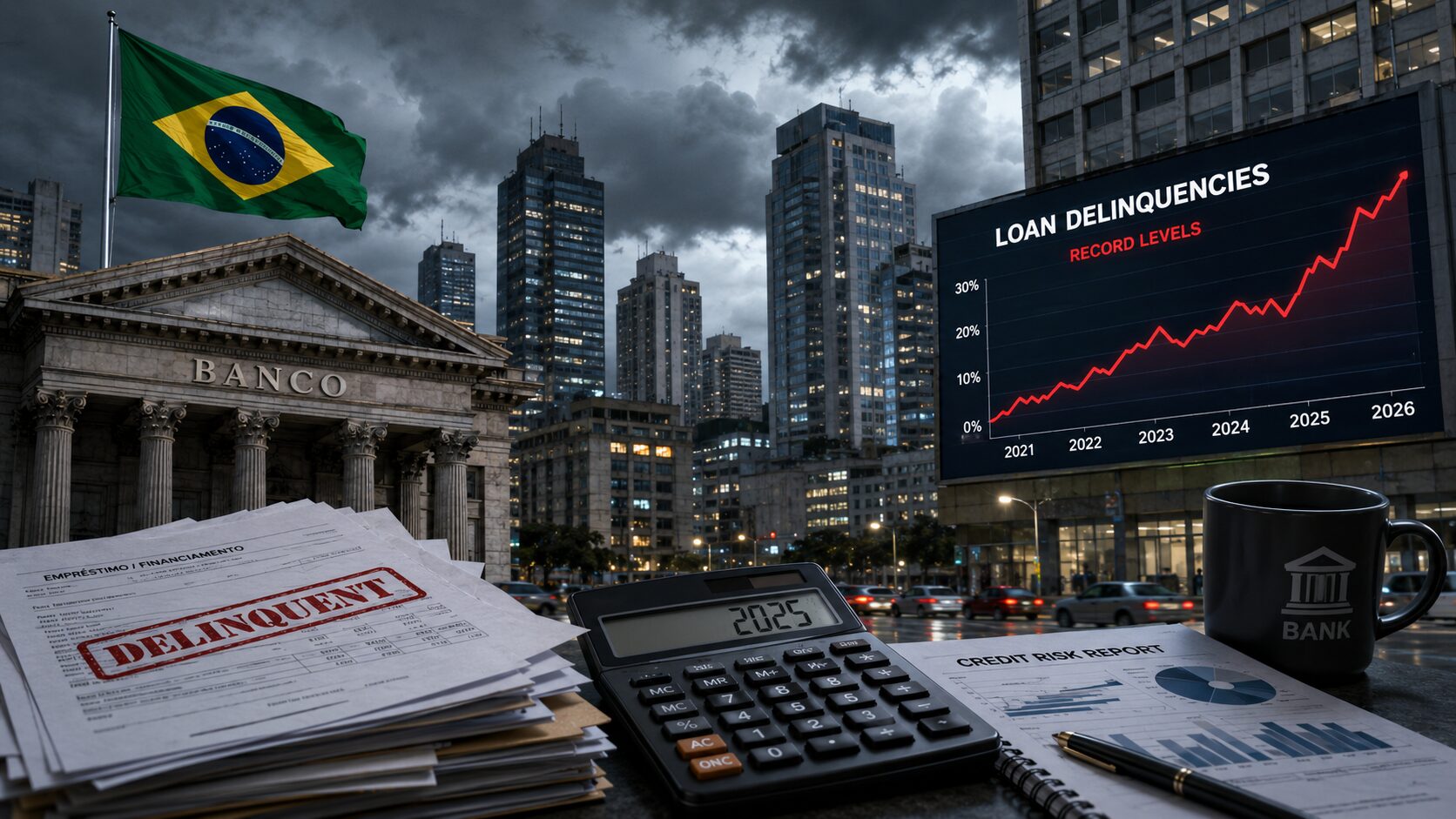
Brazilian Bankers See No End to Record Loan Delinquencies This Year
Brazil’s banking industry is becoming increasingly concerned that record household loan delinquencies could continue through the rest of 2026, despite recent interest-rate cuts by the country’s central bank.
According to market reporting, executives at some of Brazil’s largest banks believe consumer credit stress remains elevated and that delinquency levels are unlikely to improve meaningfully in the near term. The outlook reflects the lingering impact of high borrowing costs, household debt burdens, and weaker repayment capacity among Brazilian consumers.
Although Brazil has begun easing monetary policy, many bankers say the improvement may take time to reach household finances.
Consumer credit pressure remains high
Loan delinquencies have become one of the most important challenges facing Brazil’s financial sector.
Households continue to struggle with loan repayments, particularly after a prolonged period of high interest rates. As a result, banks have faced increased credit risk and greater pressure on consumer lending portfolios.
Brazil’s central bank has previously indicated that household repayment capacity remains under strain, and delinquency trends have continued to weigh on parts of the credit market.
For lenders, the concern is not only the current level of overdue loans but also the pace of any potential recovery.
Interest-rate cuts may not provide immediate relief
Brazil’s central bank has started to lower borrowing costs after maintaining restrictive monetary policy for an extended period.
In August 2026, the benchmark Selic interest rate was reduced to 14%, marking the fourth consecutive rate cut.
Lower interest rates are generally expected to reduce borrowing costs, support consumer spending, and improve loan repayment conditions over time.
However, bankers believe the benefits may emerge gradually rather than immediately.
Many households are still dealing with debt accumulated during the period of higher rates, and refinancing or income improvements may take time to strengthen repayment capacity.
Major banks remain cautious
Executives at leading Brazilian banks, including Bradesco and Itaú, have publicly supported further monetary easing while acknowledging that elevated interest rates have contributed to household indebtedness.
Their comments suggest that the banking sector expects interest-rate reductions to help borrowers eventually.
Nevertheless, the near-term outlook remains cautious.
Banks continue to monitor credit quality closely, particularly in consumer lending segments where repayment pressures remain elevated.
Why delinquencies matter
Persistent loan delinquencies can affect both banks and the broader economy.
For financial institutions, higher delinquency levels may lead to increased loan-loss provisions, tighter lending standards, and more conservative credit expansion.
For households, continued repayment difficulties can limit access to new credit and reduce financial flexibility.
A prolonged period of elevated delinquencies can also slow the transmission of monetary easing because lower policy rates do not immediately translate into stronger consumer borrowing and spending.
The broader economic picture
Brazil’s economy has shown signs of stabilization, and the central bank’s recent rate cuts suggest policymakers believe inflation risks have moderated sufficiently to begin easing financial conditions.
However, the household sector remains a key area of concern.
Consumer credit has been an important driver of economic activity, and sustained repayment problems could affect lending growth, retail spending, and broader economic momentum.
The interaction between lower interest rates and household balance sheets will likely be one of the most closely watched trends in Brazil’s financial system during the remainder of 2026.
What happens next?
Investors and banks will be watching upcoming central bank decisions, consumer credit data, and delinquency trends for signs that household financial conditions are improving.
If rate cuts continue and borrowing costs decline further, pressure on consumers could gradually ease.
However, bankers appear to believe that the adjustment process will take longer than previously expected.
The bottom line
Brazil’s major banks remain concerned that record household loan delinquencies could persist through the rest of 2026, even as the central bank continues cutting interest rates.
The combination of high household debt, elevated borrowing costs, and weak repayment capacity has kept credit stress unusually high.
Although lower rates may eventually improve consumer finances, the banking industry expects the recovery in credit quality to be gradual rather than immediate.
Comments
No comments yet. Be the first to share your thoughts.
Leave a comment