
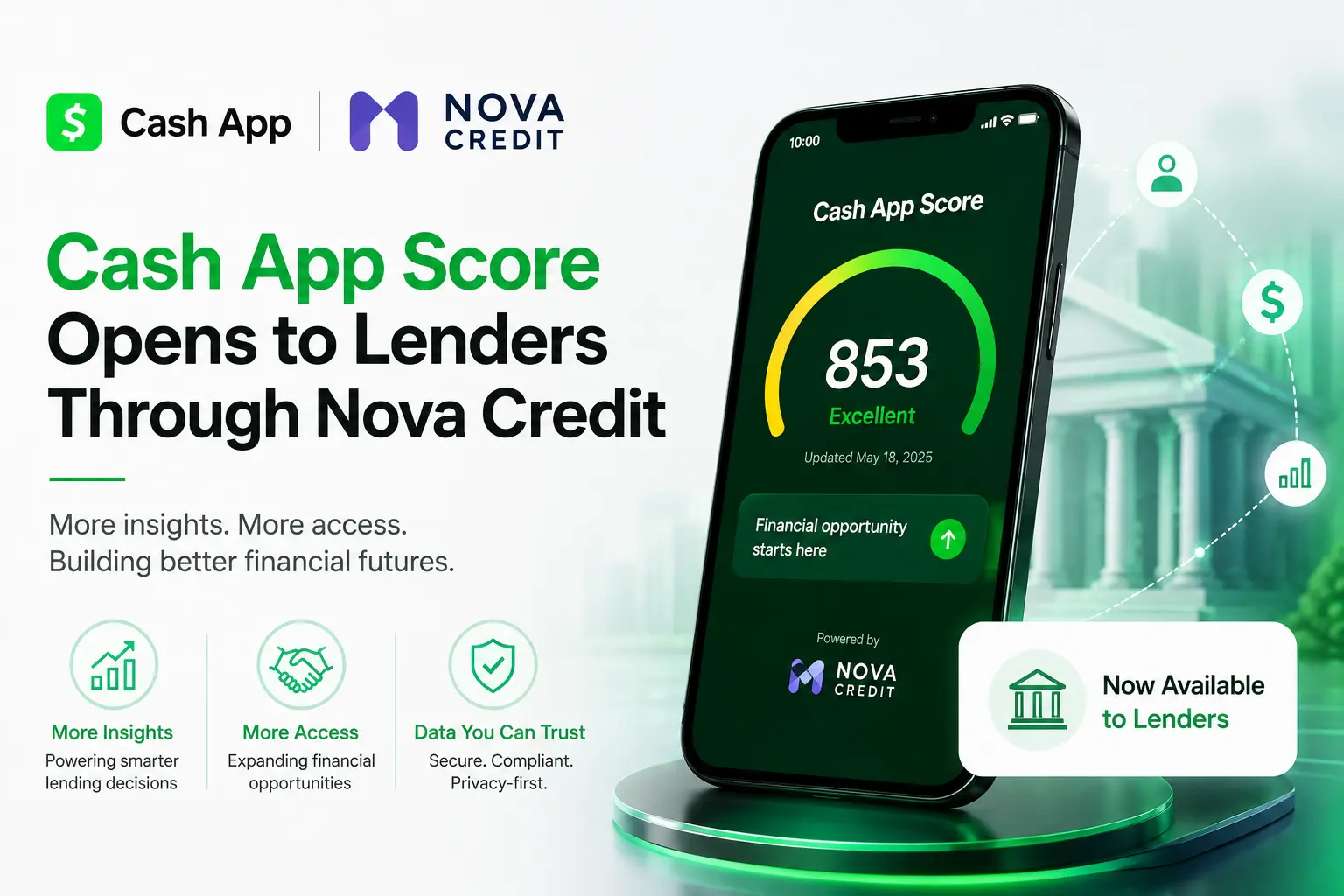
Cash App Score Opens to Lenders Through Nova Credit
Block is taking a major step beyond traditional credit scoring.
The company will make its proprietary Cash App Score available to external lenders for the first time, using Nova Credit’s Cash Flow Intelligence Platform as the distribution channel.
The move could give lenders a more current view of consumer financial health by bringing cash-flow and behavioral data into underwriting workflows they already use.
More importantly, it signals a broader shift in consumer lending: credit decisions are increasingly moving beyond historical credit files toward real-time financial behavior.
Block Opens Cash App Score to External Lenders
Block announced September 1 that it will distribute Cash App Score to external lenders through Nova Credit.
Until now, the technology has primarily supported Block’s own consumer lending business. The score sits at the center of how Block evaluates credit risk across its lending products.
Through the new partnership, Nova Credit will integrate Cash App Score into its Cash Flow Intelligence Platform.
That means lenders can access the signal through existing underwriting infrastructure rather than building a separate connection to Cash App.
Consumers also remain part of the process.
Cash App customers will control whether and how their score is shared with third-party lending partners. Cash App will manage notifications and consent directly, while the process does not require consumers to create additional third-party logins.
That distinction matters as financial institutions increasingly look for alternative data without creating more friction for borrowers.
Cash App Score Looks Beyond Traditional Credit History
Traditional credit scores largely reflect a consumer’s credit history.
Cash App Score takes a different approach.
According to Block, the system uses millions of first-party signals across the Cash App ecosystem. These include spending, saving, repayment behavior, paycheck deposits, and peer-to-peer activity.
The objective is to create a near-real-time picture of financial health.
That can reveal changes that a traditional credit file may take longer to capture.
For example, a consumer’s income may improve, expenses may change, or repayment behavior may strengthen before those developments appear in a conventional credit profile.
Cash flow data can therefore provide another layer of context.
It does not necessarily replace traditional credit scoring. Instead, the model can complement existing information by showing how a consumer manages money today.
That is especially relevant for consumers with limited or weaker traditional credit histories.
Block Says Cash Flow Underwriting Can Expand Approvals
Block’s own lending data provides an indication of why the company wants to expand Cash App Score beyond Cash App.
In Cash App Borrow, where the technology has been used the longest, Block says Cash App Score approves 38% more customers at the same loss rate compared with traditional credit scores.
The company also says roughly 70% of active Borrow customers have FICO scores below 580 while meeting its target repayment criteria.
Those figures point to a significant gap between conventional credit signals and the broader financial behavior of some consumers.
Block’s analysis across other lending categories also estimates that its technology could support 30% more auto-loan approvals and 28% more credit-card applications at comparable loss rates compared with traditional methods.
These are Block’s own analyses rather than independent industry benchmarks, so lenders will ultimately need to evaluate the performance themselves.
Still, the direction is clear.
Cash-flow underwriting is becoming a serious alternative-data strategy for lenders looking to reach consumers that traditional models may underserve.
Nova Credit Adds the Distribution Layer
The partnership becomes particularly important because Block is not building a new lender-facing distribution network from scratch.
Nova Credit already operates infrastructure designed to bring alternative consumer financial data into underwriting.
Its platform supports multiple data sources and cash-flow intelligence, while its Cash Atlas product uses bank transaction data to improve credit-risk assessment.
Nova Credit says it serves more than 7,000 businesses worldwide and operates as a consumer reporting agency under the U.S. Fair Credit Reporting Act.
That existing infrastructure gives Cash App Score a path into established lending workflows.
For lenders, the proposition is relatively simple: access another credit signal through an integration they already understand.
For Block, meanwhile, the partnership creates a new route for its proprietary underwriting technology to reach financial institutions outside its own lending products.
Cash App Score Could Reach Several Lending Markets
The potential applications extend beyond personal loans.
Block and Nova Credit say lenders will be able to incorporate Cash App Score across areas including:
- Credit cards
- Auto lending
- Device financing
- Personal lending
- Tenant screening
There is an important strategic detail here.
Block says these are areas where Cash App does not compete.
That creates room for the company to distribute the underlying credit signal without directly putting Cash App’s own lending products against the external lenders using it.
Nova Credit’s Cash Atlas can also provide additional cash-flow context alongside Cash App Score through a single integration.
Together, the products could give lenders a broader picture of income, spending and repayment capacity.
The Bigger Shift Toward Cash Flow Underwriting
The partnership reflects a wider change in consumer lending.
For decades, credit decisions have depended heavily on historical credit files.
That model remains important. However, it does not always capture the complete financial picture.
Consumers may have limited credit histories. Gig workers can have irregular income. Younger borrowers may have little borrowing experience. New-to-country consumers may lack a domestic credit file.
At the same time, financial apps increasingly see real-time financial activity.
That creates a new source of underwriting information.
The challenge is turning that information into reliable, compliant and explainable credit decisions.
This is where platforms such as Nova Credit become important.
Data alone is not enough. Lenders need consumer permission, reporting infrastructure, compliance controls and analytics that can translate raw financial activity into useful risk signals.
Privacy and Consumer Control Will Matter
The expansion of alternative credit data also creates an important consumer question.
More financial information can produce better underwriting decisions, but consumers need to understand what information lenders can access and how it will be used.
Block says Cash App customers will set their own preferences for sharing Cash App Score with third-party lenders.
That consumer-control layer could become increasingly important as financial institutions use more real-time behavioral data.
Regulation will matter too.
Nova Credit highlights its FCRA-compliance framework and consumer-reporting infrastructure as part of the partnership.
As cash-flow underwriting expands, lenders will need to balance innovation with fair lending, privacy, data accuracy, adverse-action requirements and consumer consent.
The industry cannot simply collect more data and assume better outcomes will follow.
The quality, relevance and governance of that data matter just as much.
Why the Block and Nova Credit Partnership Matters
Block’s decision to open Cash App Score represents more than a new distribution agreement.
It shows how fintech companies can turn proprietary financial data and underwriting technology into infrastructure for the wider lending market.
Cash App generates a large volume of first-party financial signals. Block has used those signals internally to manage credit risk.
Now, Nova Credit gives that capability an external distribution channel.
That could create a new model for fintech lending: consumer platforms develop rich financial intelligence, while specialized infrastructure providers make those signals usable by traditional lenders.
If the model performs well, more lenders could begin incorporating real-time cash-flow indicators alongside traditional credit scores.
That would gradually change how financial institutions define creditworthiness.
What Comes Next for Alternative Credit Scoring
The real test will not be the announcement.
It will be performance.
Lenders will want to know whether Cash App Score consistently improves approval rates without increasing losses. They will also need to evaluate how the signal performs across different borrower groups, loan products and economic conditions.
Block says the technology already helps it monitor consumer financial health and adjust credit policies as conditions change.
That capability could become increasingly valuable when economic conditions shift quickly.
Traditional credit data can be highly useful, but it often reflects what has already happened.
Cash-flow intelligence attempts to show what is happening now.
That difference could become one of the defining themes in consumer lending.
Block is now giving lenders access to that approach through Nova Credit.
If lenders can use real-time financial behavior to responsibly approve more qualified consumers, the partnership could push alternative credit scoring further into the mainstream.
The larger question is no longer whether credit scoring will use alternative data.
It is how much of a consumer’s real financial life should count when deciding whether they deserve credit.
Comments
No comments yet. Be the first to share your thoughts.
Leave a comment