
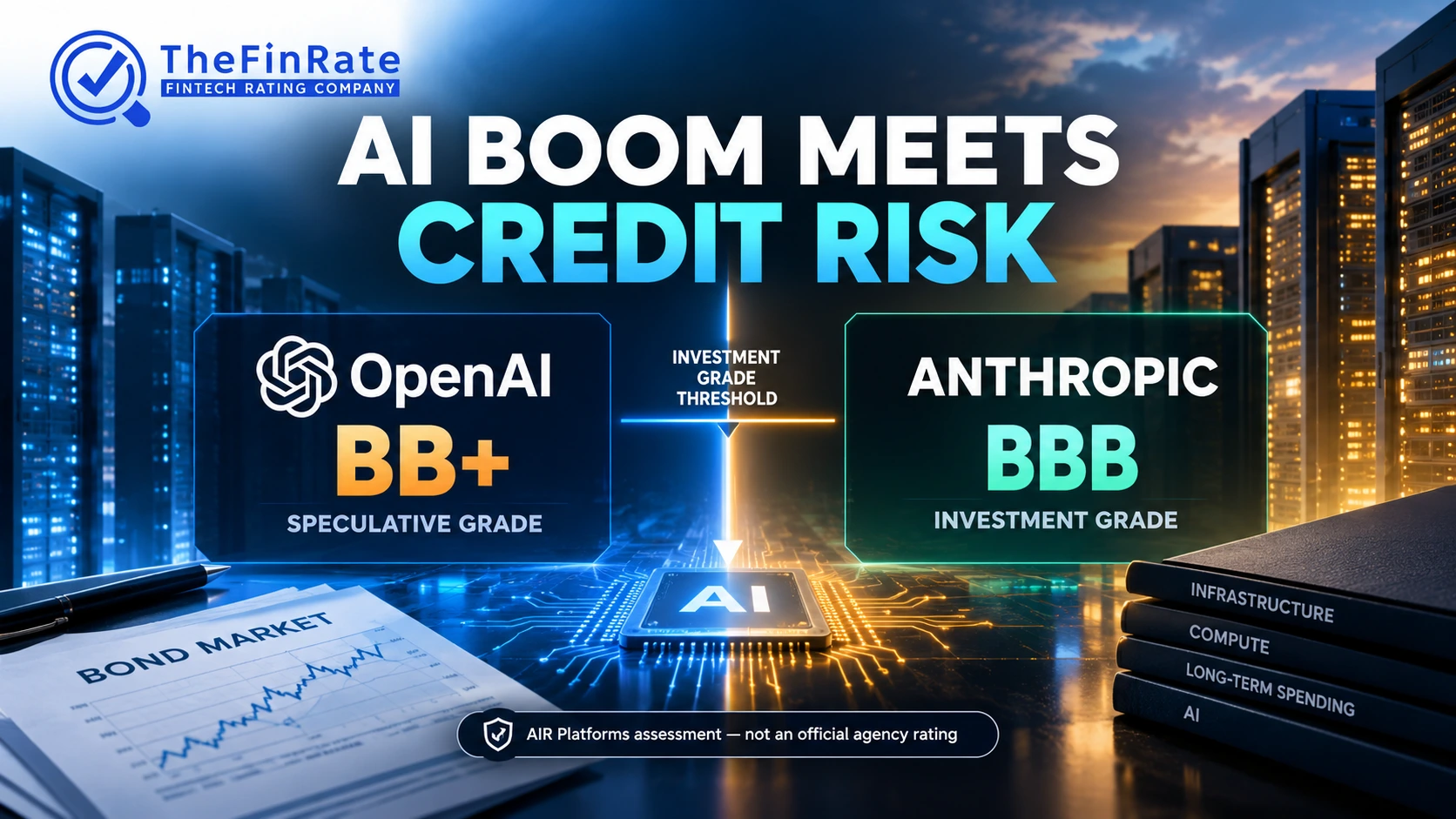
An AI-powered credit rating startup has placed OpenAI below investment grade while rating Anthropic at the lowest investment-grade level, highlighting growing scrutiny of the debt and long-term spending commitments behind the artificial intelligence boom.
The financial risks behind the artificial intelligence boom are becoming harder to ignore. As technology companies commit enormous sums to computing infrastructure, chips, and data centers, investors must assess whether future revenue will be sufficient to support the spending.
A new assessment from AIR Platforms has brought that question into focus. The New York-based credit intelligence startup assigned OpenAI a BB+ rating and Anthropic a BBB rating in an unsolicited credit report published on October 1, according to Forbes.
The distinction is significant. Under the rating scale used by major credit rating agencies, BBB- is generally the lowest investment-grade rating. BB+ sits one notch below that threshold, within speculative grade, often described as junk.
AIR’s assessment therefore places the two AI companies on opposite sides of the investment-grade boundary. However, the ratings are the startup’s own analytical judgments, not official public ratings from established agencies such as S&P Global Ratings, Moody's, or Fitch.
The report arrives as AI developers and infrastructure providers pursue increasingly capital-intensive expansion plans. The industry’s next phase may depend not only on technological progress and customer demand but also on access to financing at a sustainable cost.
AIR Platforms Give OpenAI BB+ and Anthropic BBB
AIR Platforms’ assessment centers on the creditworthiness of two of the most prominent companies in generative AI.
The startup assigned OpenAI a BB+ rating, placing it in speculative-grade territory. Anthropic received BBB, which is within investment grade but remains relatively close to the boundary separating investment-grade and speculative-grade borrowers.
The difference does not mean that OpenAI has defaulted or that Anthropic is financially secure. Credit ratings express an assessment of credit risk, not a guarantee about a company’s future performance. They also depend on the information available, the methodology used, and the obligations included in the analysis.
AIR published its report without being hired by either company, according to Forbes. The startup did not receive complete financial statements from OpenAI or Anthropic, meaning it had to estimate some missing financial information using publicly available data and its own analytical tools.
That limitation is central to interpreting the result. Private companies can disclose less information than listed companies, making it difficult for outside analysts to construct a complete picture of profitability, leverage, cash flow, and contractual commitments.
AIR’s ratings should therefore be treated as an independent, model-based assessment rather than a definitive verdict on either company’s financial condition.
Why the Investment-Grade Boundary Matters
The distinction between investment grade and speculative grade can affect how companies access debt markets.
Institutional investors, including some pension funds and bond funds, operate under mandates that restrict how much speculative-grade debt they can hold. A rating below investment grade can consequently reduce the number of eligible investors for a bond issue.
Borrowers may also face higher financing costs when investors perceive greater credit risk. The actual cost depends on market conditions, maturity, security, contractual terms, liquidity, and the borrower’s broader financial position.
For companies financing expensive AI infrastructure, these differences can become important. Building and operating large-scale AI systems requires substantial investment in computing capacity, data centers, energy, and related infrastructure. Those commitments may arise well before the revenue expected to justify them is fully realized.
If investors demand higher returns to compensate for risk, financing new projects can become more expensive. If access to capital narrows, companies may need to adjust spending plans, negotiate different financing arrangements, or rely more heavily on strategic partners.
The implications extend beyond AI developers themselves. Data center operators, chip suppliers, cloud providers, utilities, and infrastructure financiers are all connected to the investment cycle.
The question is not simply whether AI demand will grow. It is whether future cash generation will be sufficient to support the costs and commitments created during the race to expand capacity.
AIR Platforms’ Credit Assessment Uses Estimated Financial Data
AIR Platforms is an AI-powered credit intelligence startup that aims to assess public and private companies using financial information, market data, and other signals.
According to Forbes, the company has raised $6.1 million and has a team of around 10 people. Its co-founder and CEO, Glenn Carvajal, previously spent 12 years at Moody’s.
The company’s approach combines machine-learning models with AI-generated analysis to evaluate credit risk. Its stated product strategy includes financial analysis, scenario modelling, and monitoring changes that could affect a company’s credit profile.
In the OpenAI and Anthropic assessment, AIR used publicly available information and estimated missing financial data before running its analysis through its credit model.
Forbes reported that AIR’s estimates placed Anthropic’s EBITDA margin at 5.4%, compared with negative 33.3% for OpenAI. EBITDA is a measure of operating performance before interest, taxes, depreciation, and amortization. It is often used in credit analysis, although it does not capture every cost or cash requirement.
These figures are model-derived estimates, not necessarily company-reported financial results. They should not be interpreted as audited measures of profitability.
AIR co-founder and Chief AI Officer Joe Burdis told Forbes that incomplete public information was a major limitation. He also noted that relatively small changes in the underlying numbers could alter the credit picture for rapidly growing companies.
This uncertainty matters because a credit rating is only as useful as the data, assumptions, and methodology behind it. AI may help analysts process large volumes of information, but it cannot automatically eliminate the uncertainty created by limited disclosures.
Why OpenAI’s Credit Profile Is Under Scrutiny
OpenAI’s BB+ assessment raises questions about the relationship between rapid growth, operating economics, and future financial commitments.
The company is at the center of an expanding market for AI models and services. Yet building the infrastructure required to support that demand can require large, long-term commitments before the resulting cash flows become clear.
Forbes reported that OpenAI had no balance-sheet debt as of March 31, based on financial statements reviewed by The Information. It also reported that OpenAI had access to more than $5 billion in revolving credit lines.
Those details illustrate why conventional balance-sheet debt is not the only measure of financial exposure.
A company can have limited conventional borrowing while still agreeing to substantial future spending through computing contracts, leases, minimum-purchase commitments, or other arrangements. Such obligations may create significant demands on future cash flow even when they do not appear as ordinary corporate debt.
AIR’s assessment did not directly incorporate some of these future infrastructure commitments, according to Forbes. This is an important qualification: the rating reflects a particular model and data set, not a complete assessment of every possible financial obligation.
A broader credit analysis would need to consider not only recorded debt but also the timing, flexibility, and enforceability of long-term contracts. It would also examine how revenue, margins, and funding needs could change under different demand scenarios.
The result is not proof that OpenAI cannot meet its obligations. Instead, it highlights the challenge of evaluating a company whose infrastructure requirements and future commercial opportunities are evolving rapidly.
Anthropic’s BBB Rating Still Comes With Risks
Anthropic received a BBB rating from AIR, placing it just above the lowest investment-grade threshold used by major agencies.
The startup’s assessment appears to reflect a stronger recent operating picture than the one estimated for OpenAI. Forbes reported that Anthropic generated $4.6 billion in revenue during 2025 while recording an operating loss exceeding $8 billion, citing its IPO prospectus. AIR’s higher rating relies on more recent results suggesting that the gap has narrowed.
Even so, a BBB rating does not mean that Anthropic faces no financial pressure. Investment grade covers a range of credit profiles, and a rating close to the lower boundary can still signal meaningful sensitivity to changes in business performance or funding conditions.
Anthropic’s infrastructure plans also demonstrate the scale of the commitments associated with the AI race. Forbes reported that the company had at least $518 billion in future infrastructure commitments, including substantial Broadcom-related equipment lease obligations.
It also reported that Broadcom had agreed to provide up to $42 billion through convertible debt linked to chip leases, while Amazon had purchased $8 billion in Anthropic convertible notes. Some of those notes had reportedly already converted into preferred shares, with the remainder expected to convert when Anthropic goes public.
Convertible debt differs from a conventional loan because it can turn into equity. That possibility can change how analysts assess repayment obligations and future capital structure.
Nevertheless, the broader point remains: credit analysis must look beyond a single rating or headline revenue figure. Investors need to understand the timing of cash flows, the structure of financing, the nature of contractual commitments, and the possibility that technology demand or pricing could change.
Anthropic’s BBB assessment is AIR’s opinion based on its available information and assumptions, not a guarantee that its future obligations will be easy to finance.
AI Infrastructure Spending Is Changing Credit Analysis
The debate over OpenAI and Anthropic reflects a broader challenge facing financial markets: how to evaluate companies investing heavily in infrastructure ahead of future demand.
AI developers need computing capacity to train and operate models, serve customers and compete on performance. Infrastructure providers need to invest in facilities, power systems and equipment to support that demand.
These investments can create long-term obligations. Companies may commit to leases, reserve computing capacity or enter minimum-purchase agreements that limit their flexibility if demand disappoints.
Some arrangements may be recorded as debt, while others appear as leases, contractual commitments or obligations held by separate financing entities. The accounting treatment differs, but lenders and investors still need to understand the economic exposure.
That is why credit analysis cannot rely on headline balance-sheet debt alone. Analysts must examine what a company has promised to pay, how long those commitments last, whether they can be cancelled and how much revenue or cash flow is required to support them.
The challenge is particularly acute for fast-growing AI companies. Their future revenue may rise quickly, but the industry is also exposed to competition, changing model economics, pricing pressure, technology shifts and the risk that capacity is built faster than demand develops.
A strong growth outlook can support borrowing capacity, but it does not remove the need for a careful assessment of fixed costs and downside scenarios.
Traditional Rating Agencies Face Pressure to Assess AI Giants
AIR’s report also arrives as the financial industry considers how established rating agencies should evaluate AI companies preparing for larger capital-market transactions.
Forbes reported that Morgan Stanley and Goldman Sachs had been in discussions with S&P, Moody’s and Fitch regarding investment-grade ratings for AI companies ahead of potential public listings.
Such discussions are part of the broader process through which companies and their advisers prepare for access to public markets. Formal ratings from established agencies can influence investor eligibility, financing terms and how debt securities are assessed.
However, AIR’s unsolicited ratings are not directly comparable with a formal rating process in every respect. The companies did not commission the AIR assessments, provide complete private financial information or control whether the ratings were published.
A commissioned rating process may incorporate additional company disclosures and direct engagement with management. An outside assessment must work with the information it can access and make assumptions where data is missing.
This difference does not automatically make one assessment correct and another incorrect. It means investors must understand the basis of each opinion before using it to make decisions.
The emergence of AI-powered credit tools could broaden the range of perspectives available to investors. But it also increases the importance of transparent assumptions, clear limitations and careful validation.
Can AI Improve Credit Ratings?
AIR’s analysis highlights the potential for AI to help assess companies whose financial information is incomplete or changes rapidly.
Credit professionals must evaluate financial statements, market developments, contractual exposures and industry conditions. AI tools can help organise this information, identify patterns and produce scenarios more quickly.
AIR says its platform is designed to combine machine-learning credit models with AI-supported analysis. Its approach reflects a wider effort to use technology to make credit intelligence more continuous and accessible across public and private markets.
However, generating a rating is not the same as proving that a rating is accurate.
Models can be sensitive to missing information, assumptions, training data and the choice of factors included in an analysis. AI-generated estimates may help fill gaps, but they can also create false precision if readers mistake estimates for verified company disclosures.
A credible assessment therefore needs more than a numerical score. Investors should be able to understand the principal drivers of a rating, the data used, the assumptions made and how the conclusion changes under different scenarios.
For complex businesses, analysts must also consider risks that may not be captured cleanly in a single model, including contractual flexibility, reliance on strategic partners and the possibility of sudden changes in market conditions.
AI can support credit professionals, but its value depends on the quality and transparency of the analysis it produces.
What the Ratings Mean for AI Financing
The AIR report does not establish that OpenAI or Anthropic will struggle to raise capital. Both companies operate in a rapidly developing market, and their access to financing will depend on factors beyond one startup’s assessment.
These include investor demand, future revenue, available liquidity, contractual obligations, strategic partnerships, financing structure and the conditions prevailing in debt and equity markets.
Still, the ratings illustrate why the economics of AI infrastructure are receiving more attention. As spending expands, investors need to distinguish between growth potential and the capacity to fund that growth.
A company can have strong demand for its products while also facing significant cash requirements. Likewise, a large infrastructure commitment may support future growth but reduce flexibility if business conditions change.
The ability to finance AI expansion will therefore depend on how convincingly companies demonstrate that their long-term commitments can be supported by sustainable cash generation.
For investors, lenders and infrastructure providers, the central issue is not whether AI will remain important. It is how much capital the industry can deploy, at what cost and with what level of financial risk.
What Happens Next for OpenAI, Anthropic and AIR Platforms?
The next stage will depend on company disclosures, future financing arrangements and the evolution of AI demand.
For OpenAI and Anthropic, greater transparency around revenue, operating costs, financing structures and infrastructure commitments could help investors assess their financial positions more clearly.
For rating agencies and credit investors, the challenge will be to evaluate both conventional debt and the economic impact of long-term contractual obligations. Ratings may change as new information becomes available or as the companies’ operating performance develops.
For AIR Platforms, the report offers an example of how AI-powered credit analysis can challenge prevailing assumptions and provide an additional perspective on private companies. Its credibility will depend on the quality of its methodology, the transparency of its estimates and how well its assessments hold up as more information becomes available.
The distinction between OpenAI’s BB+ and Anthropic’s BBB rating is therefore less a definitive ranking of the two businesses than a window into the uncertainty surrounding the financing of AI infrastructure.
The wider message is clear: the AI boom is no longer only a story about models, chips and customer adoption. It is also a story about debt, long-term commitments and whether future cash flows can justify today’s spending.
Comments
No comments yet. Be the first to share your thoughts.
Leave a comment