
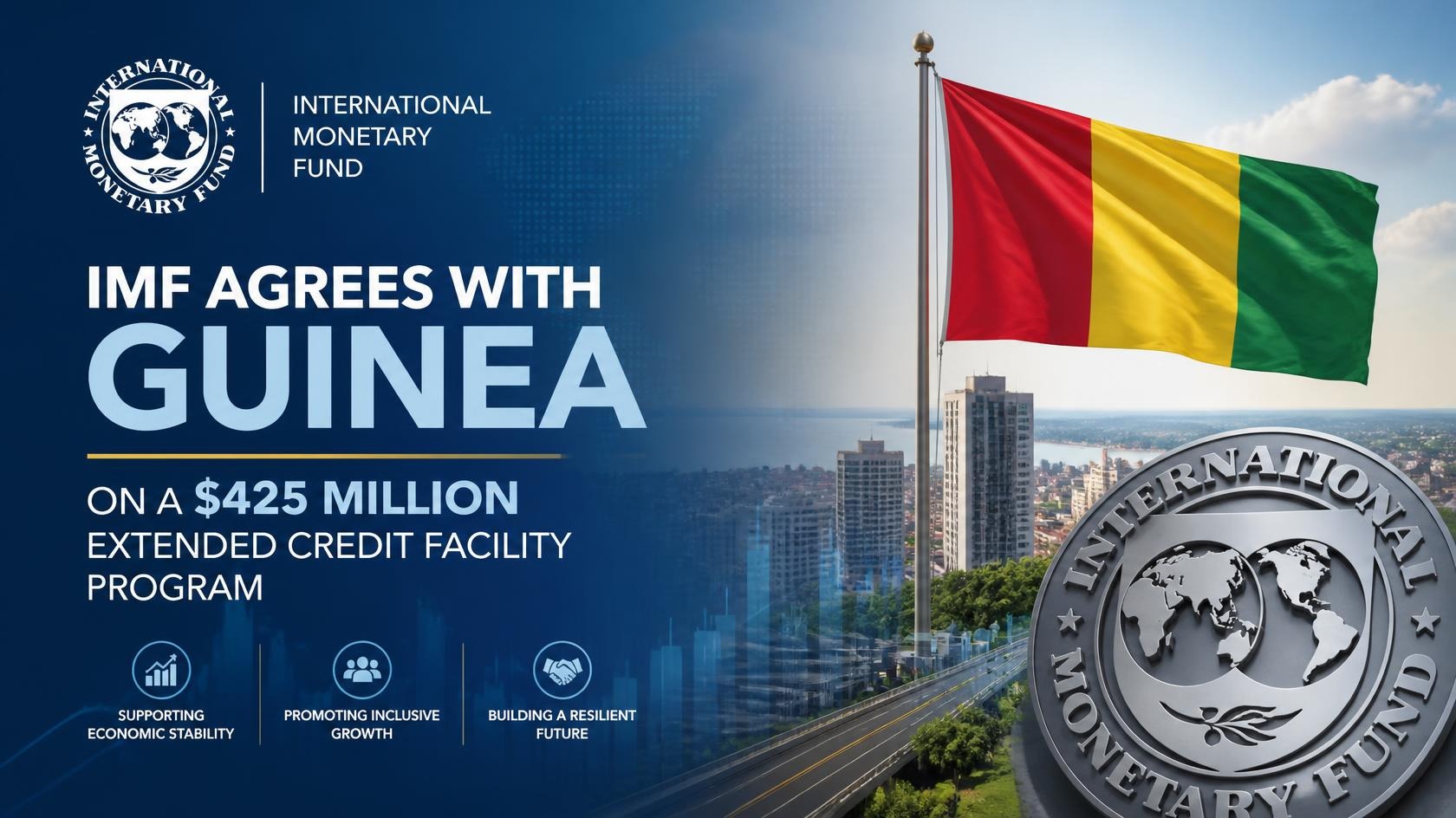
IMF Reaches Staff-Level Agreement With Guinea on $425 Million Extended Credit Facility Program
The International Monetary Fund (IMF) has reached a staff-level agreement with Guinea on a 41-month Extended Credit Facility (ECF) arrangement worth SDR 310.59 million (about $425 million). The agreement marks a significant step in the country’s effort to strengthen public finances, improve economic governance, and prepare for a major expansion in mining production.
The agreement follows the IMF’s 2026 Article IV mission. IMF management and the IMF Executive Board must still approve it. The Executive Board is expected to consider the program in September 2026.
The proposed financing package aims to help Guinea transform its growing resource wealth into sustainable and inclusive economic growth. It also aims to strengthen fiscal discipline, monetary policy, governance, and transparency.
A turning point for Guinea’s economy
The agreement comes at an important moment for Guinea as the Simandou iron ore project enters production and mining activity accelerates.
The IMF believes the expansion of the mining sector could significantly increase economic growth and government revenue. However, the Fund emphasized that stronger institutions and better fiscal management will be essential. These reforms can help Guinea turn resource wealth into long-term development gains.
The proposed program aims to help the government invest mining revenues in infrastructure, human capital, and economic diversification.
Growth outlook remains strong
According to the IMF, Guinea’s economy has remained resilient despite repeated domestic and external shocks.
Growth is expected to accelerate over the medium term as mining production expands. At the same time, the IMF warned that inflationary pressures have increased. Fiscal and external buffers also remain below desired levels.
As a result, the program includes measures to support growth-friendly fiscal consolidation. It also aims to contain inflation, rebuild foreign exchange reserves, and strengthen macroeconomic stability.
Four priorities of the IMF program
The proposed ECF arrangement focuses on four core policy priorities.
The first priority is revenue mobilization, especially from the mining sector, to finance priority public spending while preserving debt sustainability.
The second focuses on strengthening liquidity management and improving preparedness for economic shocks.
The third aims to rebuild external reserves, supported by greater exchange rate flexibility.
The fourth priority centers on governance and transparency reforms, including improvements in central bank governance, gold operations, and anti-corruption and integrity frameworks.
Simandou could reshape Guinea’s finances
The Simandou project is one of the world’s largest undeveloped iron ore deposits and is widely expected to transform Guinea’s economic landscape.
The IMF said the country is at an important economic juncture because mining expansion could create significant opportunities for revenue generation and long-term development.
However, it also stressed that commodity-dependent economies face substantial risks if resource revenues are not managed effectively.
Discussions during the Article IV consultation included the possibility of a rules-based fiscal framework and a potential sovereign wealth fund to manage mining revenues more effectively.
Risks remain significant
Despite the favorable medium-term outlook, the IMF highlighted several downside risks.
These include commodity price volatility, financing shocks, regional geopolitical spillovers, prolonged cash shortages, and slower implementation of economic reforms.
On the other hand, the outlook could improve further if mining production expands faster than expected and non-mining sectors gain momentum.
Governance and transparency in focus
A notable aspect of the proposed program is its emphasis on institutional reform.
The IMF is encouraging Guinea to strengthen transparency in the management of natural resource revenues, improve public financial management, and reinforce anti-corruption frameworks.
These reforms are intended to improve investor confidence and ensure that mining wealth supports long-term economic development rather than short-term fiscal pressures.
What happens next?
The staff-level agreement is an important milestone, but it is not yet final.
The program will now undergo review by IMF management before being presented to the Executive Board in September 2026.
If approved, the 41-month arrangement will provide Guinea with a policy framework and financial support to strengthen macroeconomic stability and implement structural reforms.
The bottom line
The IMF’s staff-level agreement with Guinea on a 41-month Extended Credit Facility worth about $425 million represents a major step toward supporting the country’s next phase of economic development.
With Simandou iron ore production approaching a new growth phase, the program aims to strengthen fiscal management, improve governance, rebuild external buffers, and ensure that Guinea’s mining wealth contributes to sustainable and inclusive growth.
Comments
No comments yet. Be the first to share your thoughts.
Leave a comment