
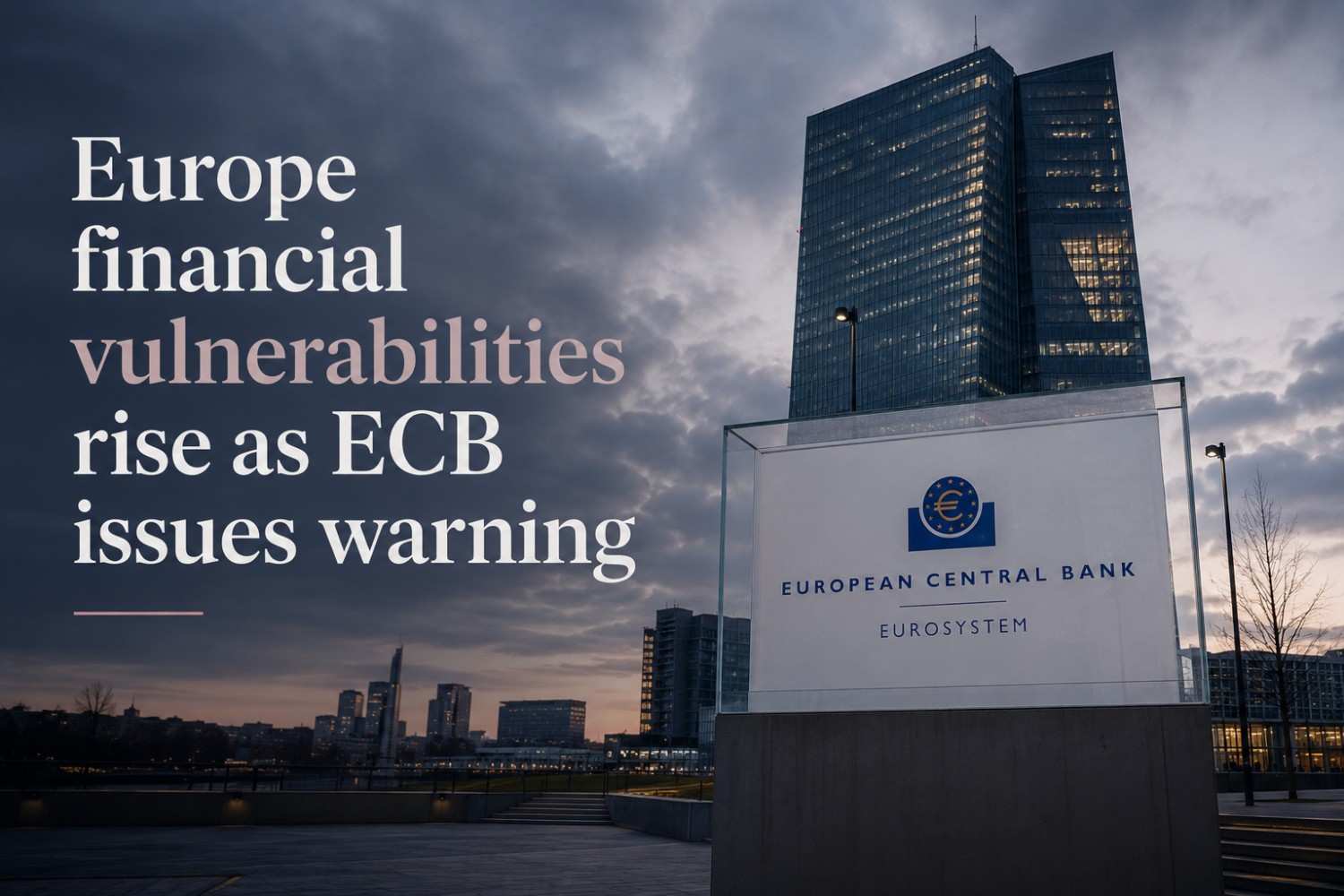
Europe finance is facing increasing pressure after the European Central Bank warned that geopolitical tensions and energy market instability are amplifying risks across the eurozone economy. The ECB said inflation, weaker growth, and rising borrowing costs are creating fresh uncertainty for financial markets and governments across Europe.
Moreover, policymakers are becoming more concerned about investor confidence as global tensions continue affecting economic conditions.
As a result, Europe finance remains vulnerable to inflation shocks, debt risks, and market volatility.
Furthermore, rising energy prices are increasing pressure on businesses, consumers, and public finances.
Why Europe finance is becoming more vulnerable
The growing pressure on Europe finance is linked to multiple economic and geopolitical challenges.
Key concerns include:
- Higher energy costs
- Rising inflation
- Slower economic growth
- Increasing debt pressure
Because Europe relies heavily on imported energy, geopolitical disruptions continue affecting industrial activity and household spending.
Consequently, businesses are facing tighter operating conditions and weaker consumer demand.
Moreover, governments may face additional fiscal pressure if economic growth slows further.
ECB financial warning highlights Europe finance risks
The latest ECB financial warning highlighted several risks affecting Europe finance and broader eurozone stability.
Important areas under monitoring include:
- Sovereign debt markets
- Corporate borrowing
- Investment fund leverage
- Market volatility
Because investors may underestimate geopolitical risks, regulators fear sudden market corrections could impact financial stability.
As a result, banks and financial institutions are strengthening liquidity management and operational resilience.
Furthermore, uncertainty surrounding global conflicts continues affecting market sentiment.
Europe finance affected by energy market instability
Energy market disruptions remain a major threat to Europe finance and economic recovery.
Several energy-related concerns continue affecting the region:
- Oil price volatility
- Gas supply uncertainty
- Higher electricity costs
- Industrial energy pressure
Because energy costs influence transportation, manufacturing, and household spending, prolonged instability may weaken economic growth.
Consequently, inflationary pressure remains elevated across the eurozone.
Moreover, businesses dependent on energy-intensive operations are facing rising operational costs.
Eurozone market pressure continues rising
The increase in eurozone market pressure is creating broader concerns around debt sustainability and investor confidence.
Several financial risks remain important:
- Government borrowing costs
- Corporate refinancing pressure
- Weak investment activity
- Slower trade growth
Because interest rates remain elevated, heavily indebted sectors may struggle with refinancing obligations.
As a result, financial institutions are becoming more cautious about lending and investment exposure.
Furthermore, market volatility could increase if geopolitical tensions worsen further.
Comparison between stable and high-risk Europe finance conditions
| Feature | Stable Europe Finance Environment | High-Risk Europe Finance Environment |
|---|---|---|
| Inflation | Controlled | Elevated |
| Borrowing costs | Moderate | Higher |
| Investor confidence | Strong | Fragile |
| Market volatility | Lower | Increased |
| Economic growth | Stable | Slowing |
This comparison explains why regulators remain concerned about Europe finance stability.
European economic instability impacts businesses
The broader issue of European economic instability is affecting businesses and consumers across multiple sectors.
Several industries are under pressure:
- Manufacturing
- Transportation
- Retail
- Energy-intensive industries
Because financing and operating costs are increasing, businesses are delaying expansion and investment decisions.
Consequently, consumer confidence and spending activity may weaken further.
Moreover, higher living costs continue affecting households across Europe.
Geopolitical market risks influence investor sentiment
The rise in geopolitical market risks is influencing investment activity and financial market behavior across Europe.
Several factors continue affecting confidence:
- Global conflicts
- Trade uncertainty
- Energy supply concerns
- Inflation pressure
Because financial markets react quickly to geopolitical events, volatility may remain elevated in the near term.
As a result, investors are closely monitoring central bank policies and economic data.
Furthermore, uncertainty surrounding global trade and energy markets continues affecting risk pricing.
Europe finance institutions strengthen resilience
Banks and financial institutions across Europe are responding to pressure on Europe finance by improving operational resilience and risk management.
Key focus areas include:
- Liquidity protection
- Capital resilience
- Stress testing
- Credit risk assessment
Because financial instability can spread rapidly through interconnected markets, institutions are strengthening contingency planning.
Consequently, regulators are encouraging stronger oversight and financial safeguards.
Moreover, maintaining confidence within banking systems remains a key priority.
Future outlook for Europe finance
The future outlook for Europe finance will depend on geopolitical developments, inflation trends, and energy market conditions.
Several factors may shape future risks:
- Interest rate decisions
- Oil and gas prices
- Economic growth trends
- Investor confidence
Additionally, central banks and governments are expected to remain cautious regarding economic policy decisions.
As a result, Europe finance may continue facing elevated uncertainty over the coming months.
However, improvements in energy markets and inflation conditions could eventually reduce some economic pressure.
Final Thoughts on Europe finance risks
The ECB’s latest warning shows that Europe finance is increasingly vulnerable to geopolitical tensions, inflation pressure, and energy market instability.
As financial risks continue rising, regulators and financial institutions are strengthening resilience planning and market oversight.
Moreover, the situation demonstrates how interconnected global conflicts, energy markets, and financial systems have become.
Ultimately, Europe finance stability will depend on how effectively governments, businesses, and central banks manage prolonged economic and geopolitical uncertainty.
Comments
No comments yet. Be the first to share your thoughts.
Leave a comment