
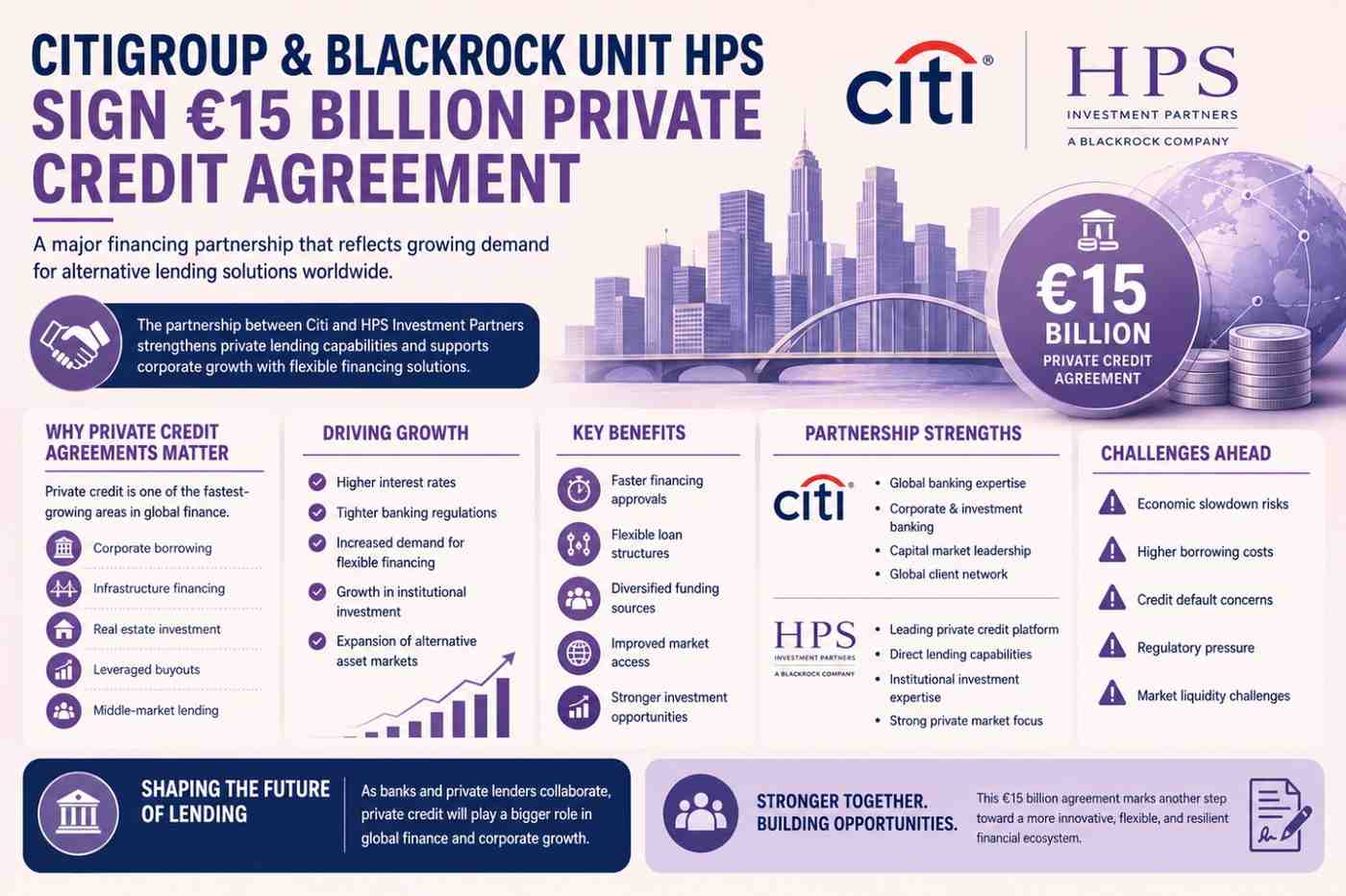
Citigroup and BlackRock unit HPS Investment Partners have signed a major financing deal involving a private credit agreement worth €15 billion. Moreover, the partnership highlights growing demand for alternative lending solutions as private credit markets continue expanding worldwide.
The latest agreement reflects increasing cooperation between major banks and private investment firms in corporate financing. Consequently, private credit continues gaining importance as businesses search for flexible funding options outside traditional banking channels.
Additionally, the deal comes as global investors show stronger interest in private lending markets amid changing economic conditions and tighter banking regulations.
Private credit agreement highlights market growth.
The new private credit agreement between Citi and HPS demonstrates how alternative lending continues to become a larger part of global finance.
In particular, the agreement may support:
- Corporate lending activities
- Large-scale financing deals
- Alternative credit solutions
- Institutional investment growth
- Expanded private market funding
As a result, companies may gain additional funding sources beyond traditional bank loans.
Furthermore, private credit firms increasingly partner with major banks to expand financing capabilities and improve market access. Meanwhile, institutional investors continue seeking higher returns through alternative asset classes.
Why private credit agreement deals matter
Private credit has become one of the fastest-growing areas within global financial markets.
Today, private credit markets support:
- Corporate borrowing
- Infrastructure financing
- Real estate investment
- Leveraged buyouts
- Middle-market lending
Therefore, large financing partnerships like this private credit agreement may strengthen alternative lending activity across international markets.
Additionally, businesses often turn to private lenders for faster approvals and more flexible financing structures. Consequently, private credit providers continue attracting major institutional investors and financial firms.
At the same time, traditional banks remain active partners in many large lending transactions.
Citi expands alternative finance partnerships.
Citigroup continues to increase its involvement in private market and institutional finance activities.
The bank remains focused on:
- Corporate banking services
- Investment banking operations
- Alternative financing solutions
- Global lending partnerships
- Capital market growth
Consequently, partnerships involving private credit firms may help Citi expand financing opportunities for large corporate clients.
Furthermore, global banks increasingly collaborate with investment managers and private lenders as financial markets evolve. Meanwhile, competition within corporate lending continues to intensify worldwide.
BlackRock and HPS strengthen private credit presence
BlackRock’s HPS Investment Partners has become an important player in private credit and alternative investments.
The firm focuses on:
- Direct lending
- Credit investments
- Institutional financing
- Alternative asset management
- Private market opportunities
As a result, HPS continues expanding its role within global private lending markets.
Moreover, institutional investors increasingly allocate capital toward private credit assets because of income opportunities and portfolio diversification benefits. Consequently, alternative lending platforms continue growing rapidly across financial markets.
Private lending continues to gain momentum.
The private credit industry has expanded significantly over the past decade.
Currently, several trends are driving growth:
- Higher interest rates
- Tighter banking regulations
- Increased demand for flexible financing
- Growth in institutional investment
- Expansion of alternative asset markets
As a result, private lenders are handling larger and more complex financing transactions.
Additionally, businesses increasingly explore funding sources outside traditional banking systems. Therefore, private credit agreements may continue becoming more common in global finance.
Benefits of private credit agreements
Large private lending partnerships may provide several important benefits for businesses and investors.
Possible advantages include:
- Faster financing approvals
- Flexible loan structures
- Diversified funding sources
- Improved market access
- Stronger investment opportunities
Consequently, private credit markets may continue supporting corporate growth and investment activity.
Furthermore, partnerships between banks and private lenders may improve financing capacity during periods of economic uncertainty. Meanwhile, institutional demand for alternative investments remains strong.
Challenges facing private credit markets
Despite rapid growth, private credit markets still face several important challenges.
These include:
- Economic slowdown risks
- Higher borrowing costs
- Credit default concerns
- Regulatory pressure
- Market liquidity challenges
Consequently, investors and lenders must carefully manage risk within expanding private lending markets.
Furthermore, rising interest rates may affect borrower repayment conditions and financing activity. Meanwhile, regulators continue monitoring growth within alternative credit markets.
Future outlook for private credit agreement activity
Looking ahead, large-scale private credit agreement deals may continue increasing as global finance evolves.
Several trends may shape future growth:
- Expansion of institutional lending
- Greater demand for flexible financing
- Growth in alternative asset management
- Increased bank-investor partnerships
- Rising private market investment
Consequently, private credit may continue becoming a larger part of international corporate finance.
Additionally, financial institutions that successfully combine banking expertise with private lending capabilities may strengthen their positions within future credit markets.
Conclusion
The €15 billion financing partnership between Citi and BlackRock’s HPS highlights the growing importance of alternative lending within global finance. Moreover, the latest private credit agreement reflects increasing institutional demand for flexible financing and private market investment opportunities.
Ultimately, as traditional banking and alternative finance continue converging, private credit markets may play an even larger role in shaping the future of corporate lending and global investment activity.
Comments
No comments yet. Be the first to share your thoughts.
Leave a comment