
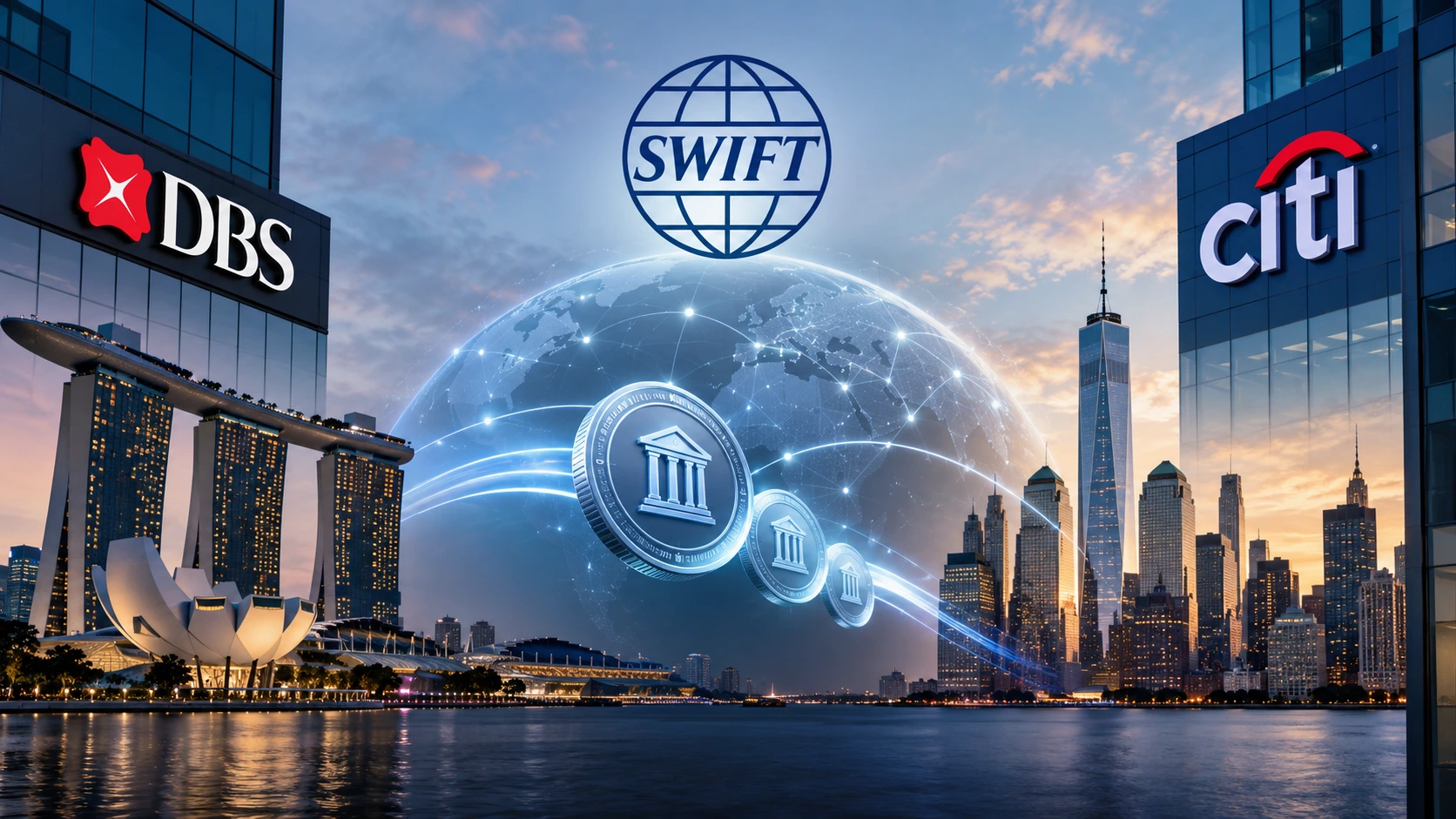
ANZ has completed a live cross-border corporate treasury transaction using tokenized deposits and SWIFT's blockchain-based ledger in a pilot involving BHP and Citi that shows how digital payment infrastructure could operate quietly behind existing banking channels. The transaction moved US dollar payments between Melbourne and New York, and it made ANZ the first Australian bank to use Swift's ledger, according to the bank's September 30 announcement.
What makes this pilot notable is what BHP didn't have to change. The mining company used its existing ANZ account and banking channel throughout, while tokenized deposits and distributed-ledger infrastructure operated behind the scenes without disrupting that relationship. The whole approach is designed to reduce customer friction while testing whether shared blockchain infrastructure can support faster, more continuous cross-border payments between financial institutions.
ANZ Uses Swift's Ledger for Tokenized Deposit Payments
The transaction brought together ANZ, BHP, Swift, and Citi to test how tokenized deposits could move across banks through shared industry infrastructure. Tokenized deposits represent deposits held with banks in digital form, transferable through blockchain or distributed-ledger infrastructure rather than traditional rails alone.
In this pilot, the technology wasn't presented as a replacement for conventional banking relationships. Instead, the transaction was built to work through existing banking arrangements while using tokenized deposits and Swift's ledger to support the actual movement of funds. ANZ said the successful payments demonstrated how shared ledger technology could help evolve cross-border payments toward faster, seven-day-a-week processing. The transaction also tested whether Swift's ledger can connect banks so that tokenized deposits issued by different institutions can interact with one another.
BHP Kept Its Existing Banking Channel Throughout
One of the most important aspects of this transaction is what the corporate customer did not have to change. BHP used its existing ANZ account and banking channel for the entire transaction, while the tokenized deposit and digital ledger infrastructure operated behind that existing relationship.
That approach addresses one of the central challenges facing new payment technologies. Customers may well benefit from faster settlement, but they're unlikely to want to rebuild their treasury operations around entirely new infrastructure just to get there. ANZ Executive General Manager for Payments Services Nigel Dobson said the transaction was designed specifically to test how new digital ledger technology could deliver benefits through the existing accounts, channels, and operational processes institutional customers already use. The goal, therefore, isn't simply to prove that blockchain can move money. It's to determine whether blockchain-based infrastructure can deliver new capabilities without forcing corporate customers to change how they interact with their banks.
How Tokenized Deposits Could Improve Cross-Border Liquidity
Large multinational companies regularly move funds between countries, currencies, banks, and time zones, and traditional payment infrastructure can create real delays in that process. Settlement often depends on banking hours, local payment systems, and correspondent banking arrangements, all of which add friction.
Tokenized deposits could potentially ease some of those constraints by representing bank deposits on digital ledger infrastructure instead. In the ANZ transaction, participants tested whether those deposits could move between banks through a shared ledger. For corporate treasurers, the potential benefit goes well beyond raw transaction speed. Faster movement of funds could improve liquidity management overall, letting companies reposition capital across operations exactly when it's needed, rather than waiting for conventional settlement windows to open.
BHP Manager for Treasury Marlon Singh said the company sees a real opportunity to move funds across borders in real time rather than waiting for banking systems to open. However, Singh also stressed that the initiative remains at an early stage. That distinction matters. The transaction demonstrates this technology working in a live corporate treasury setting, but it doesn't mean always-on cross-border tokenized payments are already available as a standard service across global banking networks.
Swift's Blockchain Ledger Connects Different Banks
Swift's role here is particularly important because the organization is positioning its ledger as an interoperability layer between financial institutions. Rather than requiring each bank to build its own separate blockchain network and establish individual connections with every other institution, a shared industry ledger could instead provide common infrastructure through which different financial institutions interact.
The ANZ transaction tested exactly that concept using tokenized deposits issued by different institutions. Swift Head of Oceania Suresh Rajalingam said interoperability sits at the center of the organization's approach to its blockchain-based ledger. The transaction therefore goes beyond simply testing a digital representation of deposits. It tests whether those digital deposits can operate across institutional boundaries while still maintaining the security and resilience associated with existing financial infrastructure.
Citi Brings Deep Cross-Border Banking Experience
Citi's participation adds another major international banking institution into the mix. Kanika Thakur, Citi's Head of Services for Japan, Asia North, and Australia, said financial markets are moving toward real-time payments and settlement, with customers increasingly expecting always-on capabilities across time zones and asset classes.
For Citi, this transaction forms part of a broader effort to develop digital cash and securities capabilities within its Services business. The bank described the ANZ transaction as an example of how shared blockchain infrastructure could connect traditional finance with digital networks. That kind of interoperability could become increasingly important as banks continue developing tokenized deposits, digital currencies, and other forms of blockchain-based financial infrastructure.
The Move Toward Always-On Corporate Payments
The strongest potential use case demonstrated by this pilot is always-on corporate treasury. A multinational business doesn't necessarily operate according to the opening hours of just one country's banking system. Its subsidiaries, suppliers, customers, and treasury operations can span several time zones at once.
Payment infrastructure that operates continuously could allow businesses to move liquidity whenever it's actually needed, rather than waiting for the next available banking window. That could be particularly valuable for large companies managing working capital across multiple jurisdictions simultaneously. That said, moving toward always-on payments involves more than simply increasing transaction speed. Banks still need to address compliance, settlement finality, liquidity management, interoperability, security, and regulatory requirements along the way. The ANZ-Swift transaction is therefore as much an infrastructure test as it is a payment-speed demonstration.
ANZ Becomes First Australian Bank on Swift's Ledger
ANZ said it is the first Australian bank to use Swift's ledger, a development that builds on the bank's broader focus on institutional payments, cash management, and financial markets. ANZ Institutional operates across almost 30 markets, providing services spanning cash management, trade finance, financial markets, and corporate finance.
For ANZ, participating in Swift's ledger gives the bank a genuine opportunity to test how emerging digital infrastructure could integrate with the services large corporate customers already use. That matters because the success of tokenized deposits may depend less on creating entirely new payment networks and more on connecting digital assets with the existing financial system that's already in place.
What the ANZ, BHP, Citi, and Swift Transactions Show
This transaction demonstrates several important developments in financial infrastructure at once. First, tokenized deposits can be used in a live corporate treasury transaction across borders. Second, the transaction shows how a shared ledger can potentially connect banks using tokenized deposits issued by different institutions. Third, the pilot demonstrates a model where the customer doesn't necessarily need to interact directly with the blockchain infrastructure at all.
BHP continued using its existing ANZ account and banking channel while the digital infrastructure operated underneath that customer experience, invisible to the day-to-day workflow. That model could prove important for wider adoption going forward. Corporate customers generally care about whether money arrives quickly, securely, and predictably. They don't necessarily need to manage the underlying distributed-ledger technology themselves.
Tokenized Deposits Could Become Part of Traditional Banking
This ANZ transaction points toward a potential future where blockchain infrastructure becomes part of conventional banking rather than operating separately from it. Tokenized deposits could provide a digital representation of bank money, while institutions such as Swift provide the connectivity between financial networks.
In that model, customers continue relying on regulated banks, existing accounts, and familiar banking channels, exactly as before. The infrastructure underneath those services simply becomes more programmable and capable of operating continuously. That combination could allow banks to pair the trust and regulatory oversight of traditional financial institutions with some of the speed and flexibility associated with distributed-ledger technology. Still, the technology remains at an early stage, and broader adoption will depend on interoperability, regulatory frameworks, and whether banks can deliver these capabilities at genuine commercial scale.
What Comes Next for Tokenised Cross-Border Payments
The ANZ, BHP, Citi, and Swift transaction offers a live demonstration of how tokenised deposits could support cross-border corporate payments. It doesn't mean traditional cross-border payments are being replaced overnight. Instead, it shows how banks can experiment with blockchain-based infrastructure while still maintaining the existing customer relationships and banking channels that businesses already rely on.
For corporate treasurers, the potential prize is greater control over liquidity across borders and time zones. For banks, the challenge is building interoperable infrastructure that can connect tokenised deposits while maintaining security, compliance, and operational resilience throughout.
The most important part of the ANZ transaction may therefore be what happened behind the scenes: BHP used its existing banking relationship while tokenised deposits and Swift's ledger tested a new way for banks to move money across borders. If that model can scale, blockchain infrastructure could become less visible to customers while becoming increasingly important underneath the global payments system.
ANZ Completes Cross-Border Tokenised Deposit Payment With Swift, BHP and Citi
Comments
No comments yet. Be the first to share your thoughts.
Leave a comment