
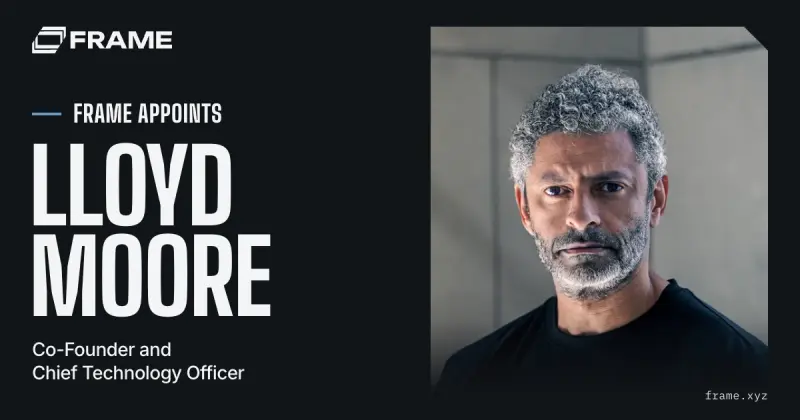
Frame has appointed Lloyd Moore as co-founder and chief technology officer, bringing a former Blockdaemon engineering leader into the startup as it develops infrastructure for settlement across traditional financial rails, stablecoins, and tokenized deposits.
The New York-based company describes itself as a provable settlement layer for global finance. Its platform is designed to let banks, fintechs, payment companies, exchanges, and enterprises orchestrate transactions across different forms of value through a single programmable integration. The appointment puts Moore in charge of the technical architecture behind that system as Frame works to build settlement infrastructure that can operate across existing financial networks while giving institutions greater control and verification capabilities.
Moore joins Frame with experience spanning distributed systems, cloud architecture, security, and digital-asset infrastructure. Before joining the company, he served as Acting Chief Technology Officer and Vice President of Engineering at Blockdaemon, where he helped scale its engineering organization from 10 to 187 people across 14 countries, according to Frame. The company also says the infrastructure Moore helped build processed more than $500 billion in digital-asset transactions and maintained 99.98% uptime while handling more than two million API calls per day.
Lloyd Moore Takes Technical Lead at Frame
At Frame, Moore will lead the company’s technical vision and oversee the development of the infrastructure that sits at the center of its settlement model.
Frame is building a system designed to connect multiple forms of money and payment infrastructure rather than create another isolated financial rail. The platform is intended to work alongside existing systems and allow institutions to orchestrate transactions involving fiat currencies, stablecoins, and tokenized deposits through programmable rules.
That approach is increasingly relevant as financial institutions experiment with stablecoins and tokenization while continuing to rely on established banking and payment infrastructure.
Instead of requiring institutions to move entirely onto a new network, Frame is positioning its technology as a layer that can sit between existing systems and newer forms of digital settlement.
Alexander Taskey, Frame’s founder and CEO, said Moore brings a combination of technical depth, security discipline, and experience scaling critical infrastructure. He added that Moore’s leadership will be central to Frame’s effort to make interoperable and provable settlement practical for institutions.
Frame Focuses on Fiat, Stablecoins, and Tokenized Deposits
The core idea behind Frame is interoperability.
Financial institutions currently operate across multiple payment systems, banking platforms, and digital-asset networks. Fiat payments, stablecoin transfers, and tokenized deposits can each involve different infrastructure, operational requirements, and compliance processes.
Frame is attempting to provide one programmable layer across those environments.
Its platform is designed for institutions that want to move value across different rails while maintaining control over their own systems, keys, and regulated responsibilities. Frame says it does not act as a bank, custody customer funds, or issue stablecoins. Those regulated functions remain with licensed partners.
That distinction is central to the company’s business model.
Rather than becoming another financial intermediary, Frame is positioning itself as infrastructure that institutions can use to coordinate settlement while continuing to operate their own regulated financial businesses.
The company says transactions can be orchestrated in seconds rather than taking days, while settlement policies can be applied before value is released.
Settlement Engine, Rules Engine, and SecLog
Moore’s responsibilities will include architecting several of Frame’s core systems.
The company’s Settlement Engine is designed to coordinate the movement and settlement of transactions across supported financial rails.
The Rules Engine provides the policy layer, allowing institutions to apply rules and controls during the settlement process rather than relying only on checks that occur before or after a transaction.
Frame is also developing SecLog, which it describes as a high-speed encrypted log that records settlement decisions and their proofs for later verification.
Together, those components reflect the company’s broader focus on what it calls provable settlement.
The idea is that institutions should not only be able to execute transactions but also maintain independently verifiable records showing how settlement decisions were made.
For banks and regulated financial companies, that combination of execution, policy enforcement, and auditability could be important as digital assets become more integrated with traditional financial infrastructure.
Moore Brings Distributed Systems and Security Experience
Moore’s background extends beyond Blockdaemon.
Before Frame, he served as Chief Technology Officer at Valence, where he worked on a privacy-focused federated learning platform for enterprise customers. Frame says he also helped the company achieve ISO 27001 and SOC 2 Type I certification within four months.
His experience includes distributed systems, cloud architecture, cybersecurity, and financial infrastructure. He also spent 12 years as a Royal Marines Commando, a background he has described as influencing his focus on operational discipline, resilience, and engineering-team performance.
Frame’s own site describes Moore as its CTO and highlights his previous experience at Blockdaemon, Valence, and other technology businesses.
For an infrastructure company focused on financial settlement, that combination is relevant because reliability and security are as important as transaction speed.
A settlement platform cannot simply move money quickly. It must also handle permissions, controls, records, and operational edge cases without compromising institutional requirements.
Why Settlement Infrastructure Is Becoming More Important
The financial system is gradually moving toward a model in which multiple forms of money can coexist.
Traditional bank deposits remain central, but stablecoins have become an increasingly important part of digital payments and onchain finance. Banks and financial institutions are also exploring tokenized deposits and other forms of blockchain-based settlement.
That creates a new infrastructure challenge.
A financial institution may want to accept or send a stablecoin payment while maintaining its existing banking relationships. Another may want to use tokenized deposits for certain transactions while retaining traditional fiat rails for others.
Frame is targeting that connectivity problem.
Its pitch is not to replace those systems but to provide a programmable settlement layer that allows institutions to work across them. FinTech Futures similarly describes the company as a consolidated settlement layer for fiat, stablecoins, and tokenized deposits.
This approach also places compliance closer to the point of settlement.
Rather than treating compliance as a separate administrative workflow, Frame says its architecture can enforce policies as transactions are settled and create verifiable records of the decisions involved.
For institutions experimenting with digital money, that could become an important requirement as transaction volumes grow.
A CTO Appointment Tied to Frame’s Next Stage
Moore’s appointment gives Frame a technology leader with experience scaling large engineering organizations and building infrastructure for digital asset transactions.
His Blockdaemon background is particularly relevant to Frame’s ambitions because the company is attempting to solve a problem that sits between traditional financial infrastructure and digital-asset networks.
The challenge is not simply technical throughput.
Frame needs its infrastructure to work with the systems institutions already use, while preserving their control over keys, operations, and regulatory obligations. At the same time, the platform needs to provide clear records that can be independently verified.
That combination could determine how useful the technology becomes for banks and other regulated institutions.
Moore said institutions do not need another isolated rail. Instead, he argued that they need infrastructure that can work across their existing systems while preserving institutional control and making settlement independently verifiable.
His comments closely reflect the problem Frame is trying to solve.
The Road Ahead for Frame
Frame remains an infrastructure company rather than a regulated bank or payments institution. Its model depends on connecting with licensed partners that perform regulated functions such as holding customer funds or issuing stablecoins.
That allows Frame to focus its product development on orchestration, policy enforcement, and settlement technology.
The company is now building around a market where institutions increasingly need to bridge legacy payment systems with blockchain-based forms of value. As those worlds converge, the infrastructure connecting them may become as important as the individual payment products built on top.
Moore’s appointment suggests Frame is putting additional engineering weight behind that goal.
With its focus on programmable settlement, policy controls, and independently verifiable transaction records, the company is targeting a part of financial infrastructure that is likely to become more complex as digital assets move further into mainstream institutional use.
TheFinRate Take
Frame’s appointment of Lloyd Moore comes at a time when the financial industry is looking for ways to connect fiat payments, stablecoins, and tokenized deposits without forcing institutions to abandon the systems they already operate.
Moore brings experience scaling engineering teams and digital-asset infrastructure, while Frame is building a settlement layer focused on policy enforcement, interoperability, and verification.
The immediate story is a leadership appointment. The larger one is the infrastructure challenge underneath it: how financial institutions can move different forms of value across different rails while keeping control, compliance, and auditability intact.
That is the problem Frame is now building around, with Moore taking responsibility for the technology needed to make it work.
Comments
No comments yet. Be the first to share your thoughts.
Leave a comment