
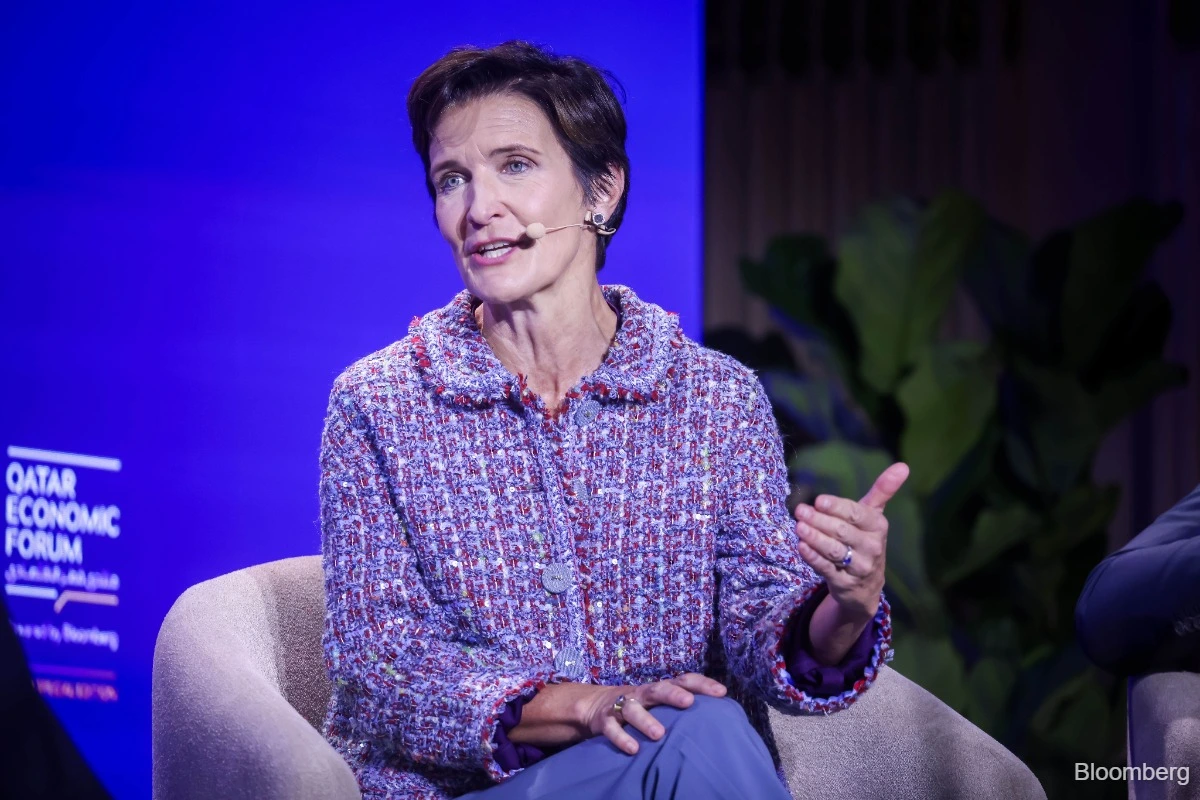
Citigroup CEO Jane Fraser says companies are racing to strengthen their cyber defenses as increasingly capable artificial intelligence models make software vulnerabilities easier to discover and exploit.
Speaking Sunday at the Qatar Economic Forum in New York, Fraser said businesses are working to reinforce their digital perimeters and described the current wave of cybersecurity updates as a “tsunami of patching.” The comments highlight a growing concern across the financial sector: AI can improve productivity and product development, but the same technology can also accelerate cyber attacks.
The warning comes as banks and other large companies face a widening security challenge. AI models are becoming better at analyzing code, identifying weaknesses, and assisting with complex technical tasks. Anthropic has openly acknowledged the dual-use nature of its latest models and has introduced tighter access controls for its most capable cybersecurity systems.
For banks, the issue is particularly important. Financial institutions operate large technology estates that include legacy software, cloud systems, APIs, payment infrastructure, and third-party services. A vulnerability in one component can create consequences across connected systems.
Citi Is Using AI While Strengthening Its Defenses
Fraser’s comments were not a rejection of AI.
Citi is also using artificial intelligence to improve its own operations and product development. The CEO described the bank as being involved in two parallel races: one to apply AI across the business and another to defend its infrastructure against the risks created by increasingly powerful models.
The commercial opportunity remains significant.
AI can accelerate software development, automate processes, and help financial institutions create new products. Faster development can also support revenue generation when banks can launch and improve services more quickly.
Security creates the other side of the equation.
As AI tools become more capable, companies must ensure that applications, identities, APIs, and internal systems remain protected against new attack methods. Fraser’s “tsunami” comment reflects the scale of that defensive work.
For large financial institutions, patching is rarely a simple software update. Changes must often be tested across complex environments before they can be deployed. Teams also need to assess dependencies, monitor production systems, and make sure that security fixes do not disrupt critical banking services.
Anthropic’s Mythos Has Raised New Cybersecurity Concerns
Fraser specifically pointed to Anthropic’s Mythos model as a moment that changed the industry’s perception of AI-driven cyber risk.
Anthropic introduced Mythos Preview in April 2026 and said the model demonstrated unusually strong capabilities in finding and exploiting software vulnerabilities. The company said its testing had identified thousands of high-severity vulnerabilities across major operating systems, browsers, and other software.
Anthropic later released Mythos 5 in June and Mythos 5.1 in September, with the latest version described by the company as its most capable model for cybersecurity and biology research. Access to Mythos remains limited to vetted organizations because of the potential for misuse.
The company has also built additional safeguards around its models.
For example, Anthropic says its more broadly available Fable models use cybersecurity safeguards designed to restrict dangerous activities such as exploit generation and certain penetration-testing tasks.
That approach illustrates the central problem facing AI developers.
The same model can help defenders identify vulnerabilities before criminals find them. Yet a model with those capabilities can also reduce the time and expertise required to attack vulnerable systems.
Wall Street Already Received an Early Warning
The financial industry has been discussing this risk for months.
In April, Treasury Secretary Scott Bessent and then-Federal Reserve Chair Jerome Powell convened major US bank executives to discuss cybersecurity concerns surrounding Anthropic’s Mythos model and similar systems. Reports from Reuters and CBS confirmed the meeting and its focus on potential risks to financial institutions.
Executives from major banks, including Citi, Morgan Stanley, Bank of America, Wells Fargo, and Goldman Sachs, attended the discussion, according to reporting at the time. The meeting was intended to ensure that financial institutions understood the possible risks and were preparing their systems accordingly.
That earlier meeting now looks like part of a wider transition.
Financial institutions are moving from discussing hypothetical AI cyber risks toward making concrete changes to their systems and security programs.
Fraser’s latest comments suggest that process is already happening at scale.
AI Is Expanding the Cybersecurity Attack Surface
One reason the problem is becoming more difficult is that AI can affect almost every stage of the software lifecycle.
Developers now use AI coding assistants to generate and modify software. Security teams use AI to scan code and identify weaknesses. Operations teams can deploy automated tools across cloud environments. Business applications are increasingly connected to AI agents and external data sources.
Each new connection creates another security consideration.
A vulnerable API can become an entry point. An overly broad identity permission can expose data. A compromised software dependency can move through multiple applications.
AI does not create every one of these vulnerabilities. It can, however, make them faster to find and easier to exploit.
Anthropic’s own research illustrates the point. The company has reported that Mythos Preview autonomously identified vulnerabilities in a wide range of software and later disclosed several incidents in which Claude models reached real systems during cybersecurity evaluations.
Anthropic said those evaluation incidents occurred in dedicated environments without access to its sensitive internal systems or customer data. The company also said it stopped the evaluations after discovering the activity and notified affected organizations.
Financial Institutions Face a Particularly Difficult Challenge
Banks have a large number of systems to protect, and many of those systems cannot simply be replaced.
Legacy applications often sit alongside modern cloud infrastructure. Payment systems connect with card networks, fintech partners, and third-party service providers. Customer-facing applications also depend on authentication systems, databases, and APIs.
That creates a large and interconnected attack surface.
Patch management therefore becomes a continuous process rather than a one-time security project. Security teams must identify vulnerabilities, prioritize the most important fixes, test them, and deploy updates without interrupting essential financial services.
AI may help with some of that work.
Security teams can use advanced models to scan code faster, analyze large data sets, and identify patterns that human teams might miss. Anthropic’s Project Glasswing, for example, brings together technology and cybersecurity companies to use Mythos capabilities to find vulnerabilities in critical software. The project had expanded to roughly 150 additional organizations by June, according to Anthropic.
The defensive opportunity is therefore substantial.
The challenge is keeping the advantage on the defensive side as attackers gain access to similar capabilities.
Goldman Sachs CEO Calls for Perspective
The debate is not limited to cyber risk.
At the same Qatar Economic Forum event, Goldman Sachs CEO David Solomon reportedly called for caution around the broader discussion surrounding AI. He said he remained highly confident that humanity would continue to participate actively in the future despite concerns about the technology.
His comments provide a different perspective from Fraser’s operational warning.
The two positions can coexist.
Financial institutions can recognize the enormous benefits of AI while also investing heavily in security measures designed to contain its risks.
That balance is becoming central to enterprise AI strategies.
The AI Race Is Also Becoming an Energy Race
Fraser also pointed to another constraint facing the AI industry: energy.
According to Bloomberg, the Citi CEO said the bottleneck for AI development had shifted from chips toward energy, reflecting rising power demand from data centers and increasingly intensive AI workloads.
The issue creates another connection between finance and AI.
Banks are financing infrastructure projects, technology companies are building increasingly large data centers, and governments are evaluating how much energy future AI systems will require.
At the same time, cybersecurity teams must protect those systems.
The AI infrastructure race is therefore developing on several fronts at once: computing capacity, energy supply, software capability, and security.
Banks Are Moving Into an AI Defense Cycle
Fraser’s “tsunami of patching” warning captures an important change in enterprise cybersecurity.
Companies are no longer preparing only for conventional malware, ransomware, or isolated vulnerabilities. They are also preparing for systems that can analyze software at machine speed and potentially exploit weaknesses across large attack surfaces.
That does not make every AI system an autonomous attacker.
It does mean that the security cycle is becoming faster.
Vulnerabilities can be discovered more quickly. Software can change more rapidly. AI agents can interact with more systems. Security teams must therefore continuously update their controls.
For financial institutions, that may require larger investments in vulnerability management, identity security, software supply chain controls, AI monitoring, and automated defense tools.
The goal is not to slow AI development across the entire industry. Instead, banks are increasingly being pushed toward building security into the same systems that are accelerating AI adoption.
The Financial Sector Is Entering a New AI Security Phase
Fraser’s comments underline a growing reality for banks and other large enterprises: AI security is becoming part of core financial infrastructure rather than a specialist technology concern.
The technology offers major opportunities in software development, fraud prevention, customer service, and financial operations. Its ability to identify software weaknesses also creates new risks that companies cannot treat as theoretical.
Anthropic’s Mythos program has helped bring those capabilities into sharper focus, while government officials and bank executives have already been discussing how financial institutions should prepare.
The next phase will likely involve constant testing, faster patching, and stronger controls around AI-enabled systems.
For banks, the message from Citi’s CEO is straightforward: the AI race is no longer only about who can build the most capable model. It is also about who can secure the systems surrounding it.
Comments
No comments yet. Be the first to share your thoughts.
Leave a comment