
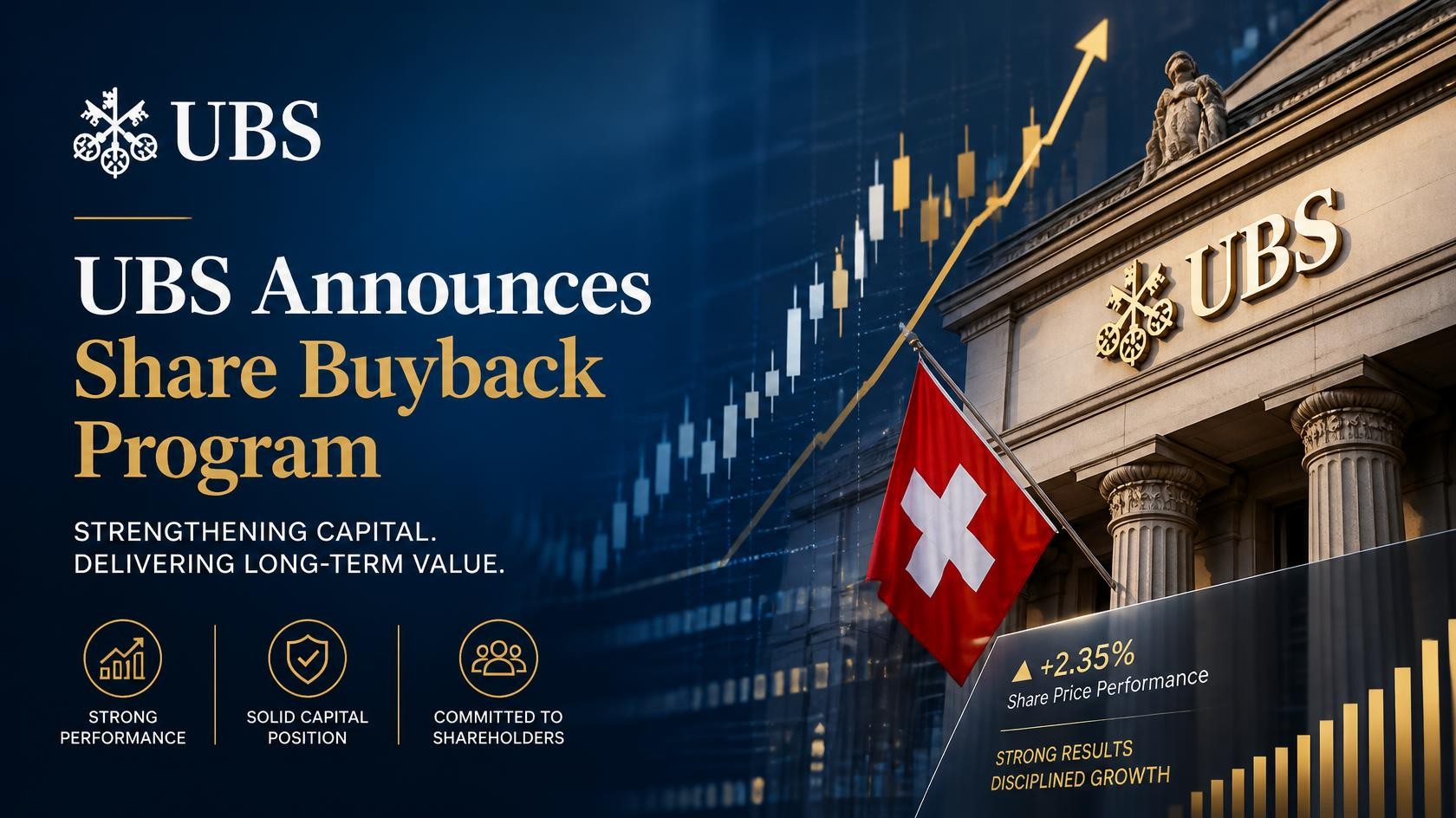
UBS Launches $3 Billion Share Buyback After Profit Beats Expectations and Trading Revenue Hits Record
UBS reported a stronger-than-expected second quarter, announcing a new $3 billion share buyback program as wealth management inflows surged and investment banking delivered record trading revenue.
UBS beats profit forecasts and unveils fresh buyback plan
UBS has announced a new $3 billion share buyback program after reporting second-quarter earnings that exceeded analyst expectations, reinforcing investor confidence in the Swiss banking giant’s capital strength and earnings momentum.
The bank posted net profit of $2.8 billion for the second quarter of 2026, representing a 17% increase from a year earlier and comfortably surpassing the $2.39 billion consensus estimate compiled by analysts. The stronger performance was driven by broad-based growth across wealth management and investment banking, with the trading division generating record second-quarter revenue.
Following the earnings release, UBS shares rose sharply as investors welcomed both the profit beat and the renewed commitment to shareholder returns.
New $3 billion share repurchase program
UBS said it plans to repurchase up to $3 billion of shares by mid-2027 at the latest, with at least $1 billion expected to be completed during the next three months.
The announcement comes shortly after the bank completed a previous $3 billion buyback program, underscoring management’s confidence in the group’s capital position despite ongoing regulatory uncertainty in Switzerland.
However, UBS emphasized that the timing and pace of future buybacks will depend on financial performance, capital ratios, and the outcome of upcoming Swiss banking regulations linked to its acquisition of Credit Suisse.
Wealth management attracts $36 billion in new assets
One of the strongest highlights of the quarter came from UBS’s core Global Wealth Management business, which attracted $36 billion in net new assets.
The inflows reflected continued demand from wealthy clients seeking portfolio diversification and professional investment management amid global market volatility.
The Swiss business contributed $14.3 billion in net new assets, while the Americas operation returned to positive territory with additional inflows.
The strong asset gathering performance reinforces UBS’s position as one of the world’s largest wealth managers and provides a stable source of recurring fee income.
Investment banking delivers record trading revenue
UBS’s investment bank produced one of its strongest quarters in years, benefiting from elevated market activity and client trading volumes.
Revenue in the division rose significantly, with the trading business delivering record second-quarter revenue, supported by strong performance across equities and other trading operations.
The results echoed a broader trend seen across major global investment banks, many of which benefited from increased market volatility and institutional trading activity during the quarter.
The strength of the investment bank provided an important offset to integration-related costs associated with the Credit Suisse merger.
Return on capital exceeds target
UBS also reported a 17% return on Common Equity Tier 1 (CET1) capital during the first half of 2026, exceeding its stated 15% year-end target.
The higher return reflects improving profitability, disciplined cost management, and continued progress in integrating Credit Suisse.
For investors, the metric is particularly important because it demonstrates the bank’s ability to generate earnings while maintaining strong regulatory capital levels.
Credit Suisse integration advances ahead of schedule
More than three years after UBS acquired Credit Suisse in a government-backed rescue deal, the integration process continues to make substantial progress.
During the second quarter, UBS achieved an additional $1.1 billion in cost savings, bringing total gross cost reductions since the acquisition to $12.6 billion.
The bank also reduced its workforce to fewer than 100,000 employees, highlighting the scale of operational restructuring underway.
Management said the integration remains on track for completion by the end of 2026, a key milestone for unlocking further efficiency gains and profitability improvements.
Artificial intelligence becomes a strategic priority
UBS revealed that it currently has nine major artificial intelligence initiatives under development, signaling a deeper commitment to technology-led productivity improvements.
The AI projects are expected to support areas such as client servicing, operational efficiency, risk management, and employee productivity.
As global banks increasingly invest in generative AI and automation, UBS is positioning technology as a long-term competitive advantage alongside wealth management and investment banking.
Swiss capital rules remain the key risk
Despite the strong quarter, the bank’s future capital return strategy remains closely tied to the regulatory environment in Switzerland.
Swiss policymakers are considering stricter capital requirements for UBS following its takeover of Credit Suisse, and the final framework could influence the bank’s flexibility to conduct additional buybacks.
UBS has argued that excessive capital requirements could reduce its global competitiveness and limit shareholder distributions, while regulators are seeking stronger safeguards for financial stability.
The outcome of those discussions is expected to remain a major focus for investors throughout the remainder of 2026.
What UBS’s results mean for investors
UBS’s second-quarter performance suggests that the bank is entering a stronger phase of post-merger execution.
The combination of higher profitability, accelerating wealth management inflows, record trading revenue, and significant cost savings provides evidence that the Credit Suisse integration is beginning to generate meaningful financial benefits.
The new $3 billion share buyback further reinforces management’s confidence in earnings and capital generation, while the bank’s improved return on equity demonstrates increasing operational efficiency.
For shareholders, the key question is no longer whether UBS can absorb Credit Suisse, but how much additional capital it will be able to return once Swiss regulatory uncertainty becomes clearer.
With wealth management gathering assets at a strong pace, investment banking performing well, and integration costs steadily declining, UBS has delivered one of the strongest earnings reports among Europe’s major banks this quarter.
Comments
No comments yet. Be the first to share your thoughts.
Leave a comment