
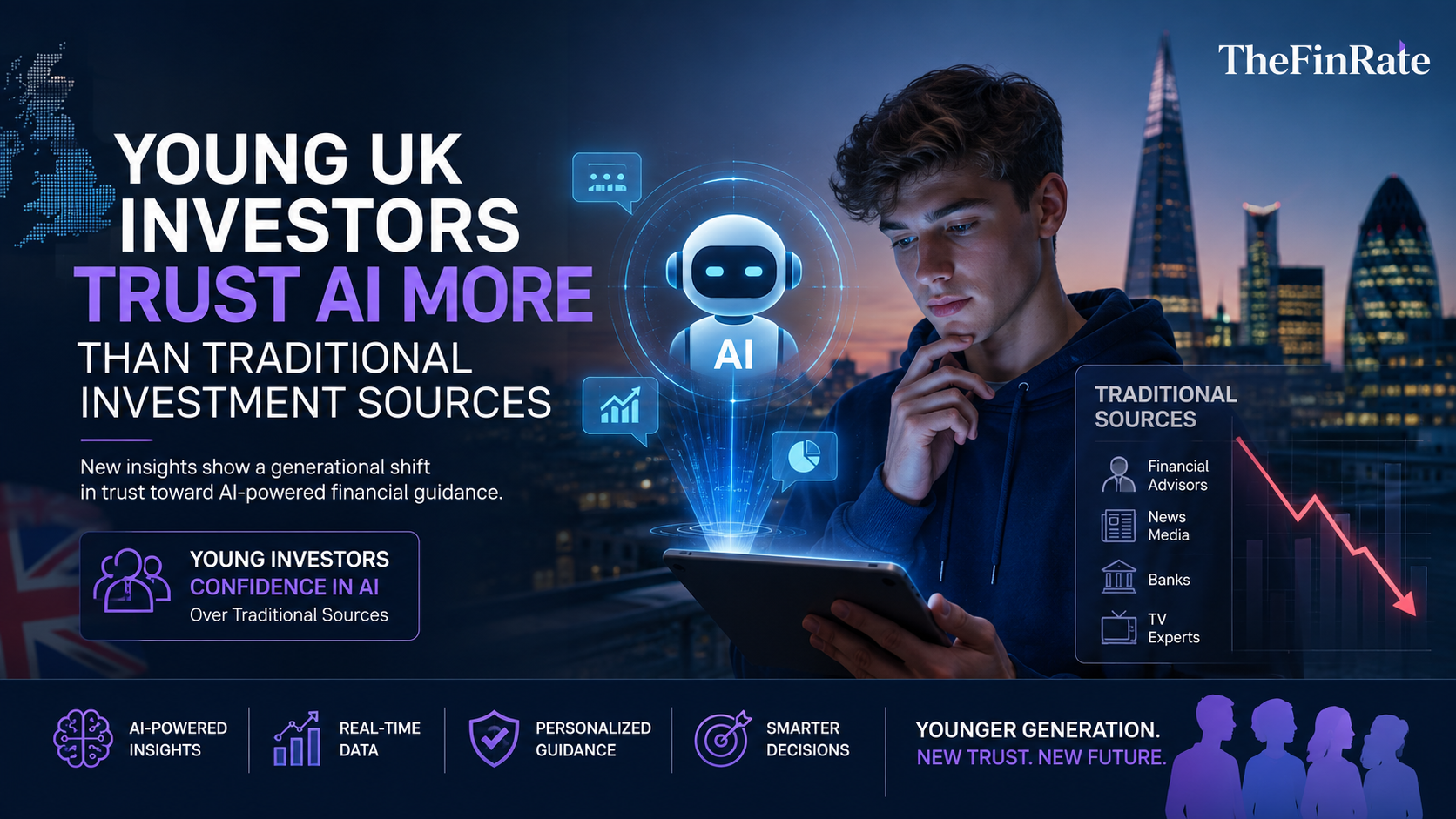
AI investment advice gains trust among young UK investors
AI investment advice is becoming a major source of information for younger UK investors, with new FCA research showing that many now place more trust in artificial intelligence tools than in traditional media or social media influencers.
The survey of 666 people aged 18 to 40 found that 56% trust AI tools when seeking investment information. That compares with 47% for TV and radio, 46% for the press and 29% for social media influencers.
The findings point to a clear shift in how younger consumers research financial decisions as AI tools become part of everyday life.
AI investing tools challenge traditional financial information
The growing use of AI investing tools reflects a wider change in how younger people access financial information.
Among less experienced investors surveyed by the FCA, four in five had used AI, while around two-thirds said they use it occasionally or regularly to help with investing.
AI can make financial research faster and easier by summarising complex information, explaining financial terms and helping users compare different ideas.
The FCA itself says general-purpose AI can be useful as a starting point for investment research, but warns that such tools are not regulated in the same way as advice from an authorised financial adviser.
Young investors may misunderstand AI protection
The rapid adoption of AI financial guidance is also creating concerns around consumer protection.
Almost half of the people surveyed incorrectly believed that financial information generated by AI is regulated. More than one-third also believed that it was acceptable to make an investment decision based only on an AI-generated answer.
Around one-third wrongly thought they could receive compensation from the Financial Services Compensation Scheme or the Financial Ombudsman Service if something went wrong with AI-generated investment information.
That misunderstanding could become a serious issue as AI becomes more closely involved in financial decisions.
FCA urges investors to check AI information
The FCA says consumers should treat AI as a research tool rather than automatically accepting its answers as financial advice.
There are some positive signs in the research. Nearly three-quarters of respondents understood that AI can provide inaccurate information, while 86% recognised the need to check the sources referenced by AI tools.
That distinction is important because AI systems can produce confident answers that may contain errors, outdated information or missing context.
The FCA’s own guidance says consumers should understand both the strengths and limits of AI when using it for investment research.
Artificial intelligence changes investor behaviour
The rise of artificial intelligence for investing comes as younger investors are already changing the way they make financial decisions.
Previous FCA research found that 66% of investors aged 18 to 40 took less than 24 hours to make an investment decision, while 14% made the decision in less than an hour.
That creates an important challenge. Faster access to information can help investors learn, but it can also encourage people to move from research to action too quickly.
For younger or less experienced investors, the difference between understanding an investment and simply following a recommendation can be significant.
AI is becoming part of the wider advice market
The shift toward AI is not limited to individual investors.
The FCA’s 2026 wealth management research found that 13% of firms were already using in-house or third-party AI tools, rising to 45% when firms considering AI adoption were included.
The regulator has also said AI could reshape retail financial services through changes to firm operations, consumer journeys, competition and fraud risks.
This means consumers are likely to encounter AI in more parts of the financial system, from research and customer support to investment guidance.
Comparison of AI and traditional investment sources
Information Source Trust Among Surveyed Investors
| Source | Percentage | |
|---|---|---|
| AI tools | 56% | |
| TV and radio | 47% | |
| Press | 46% | |
| Social media influencers | 29% |
The figures show how quickly AI has moved into the mainstream of investment research among younger consumers.
However, trust does not necessarily mean accuracy or regulatory protection.
AI financial research still needs human judgment
The growing use of digital investment research does not remove the need for investors to make their own decisions.
AI can help explain concepts and organize information, but it may not understand an individual’s income, risk tolerance, financial goals or wider circumstances.
That is especially important when dealing with high-risk investments, complex products or large financial commitments.
The FCA continues to encourage investors to understand the product, assess the risks and consider whether regulated financial advice is appropriate.
Finfluencers face a different trust challenge
The research also highlights a changing relationship between young investors and financial information providers.
Social media influencers attracted the lowest trust level in the latest comparison, at 29%. That comes after years of concern from regulators about the influence of so-called finfluencers.
The FCA has previously warned that many young people follow financial influencers and may act on their recommendations. It has also taken enforcement action against potentially illegal financial promotions on social media.
AI is therefore entering an information market where consumers are already navigating questions around credibility, bias and accountability.
Future outlook for AI investment advice
The use of AI investment advice is likely to grow as consumers become more comfortable with artificial intelligence and financial firms expand their own AI capabilities.
The key issue will be whether users understand the difference between AI-generated information and regulated financial advice.
For fintech companies, that creates an opportunity as well as a responsibility. Products that clearly explain sources, limitations, risks and regulatory status could gain greater trust as AI becomes more common.
Meanwhile, regulators will face the challenge of protecting consumers without blocking useful innovation.
Final Thoughts
The FCA research shows that AI is quickly becoming a trusted source of investment information for younger UK consumers.
With 56% of respondents trusting AI tools more than TV, radio, the press or social media influencers, the shift is hard to ignore.
But the research also highlights a gap between trust and understanding. Many young investors may not fully realise that general-purpose AI tools are not regulated financial advisers and may not provide the protections they expect.
The next phase of AI in finance will therefore be about more than better technology. It will also depend on transparency, financial education and helping consumers understand when an AI tool is useful — and when professional advice is still needed.
Comments
No comments yet. Be the first to share your thoughts.
Leave a comment