
Commerzbank CEO Orlopp Signals Exit if Strategy Deal With Orcel Fails
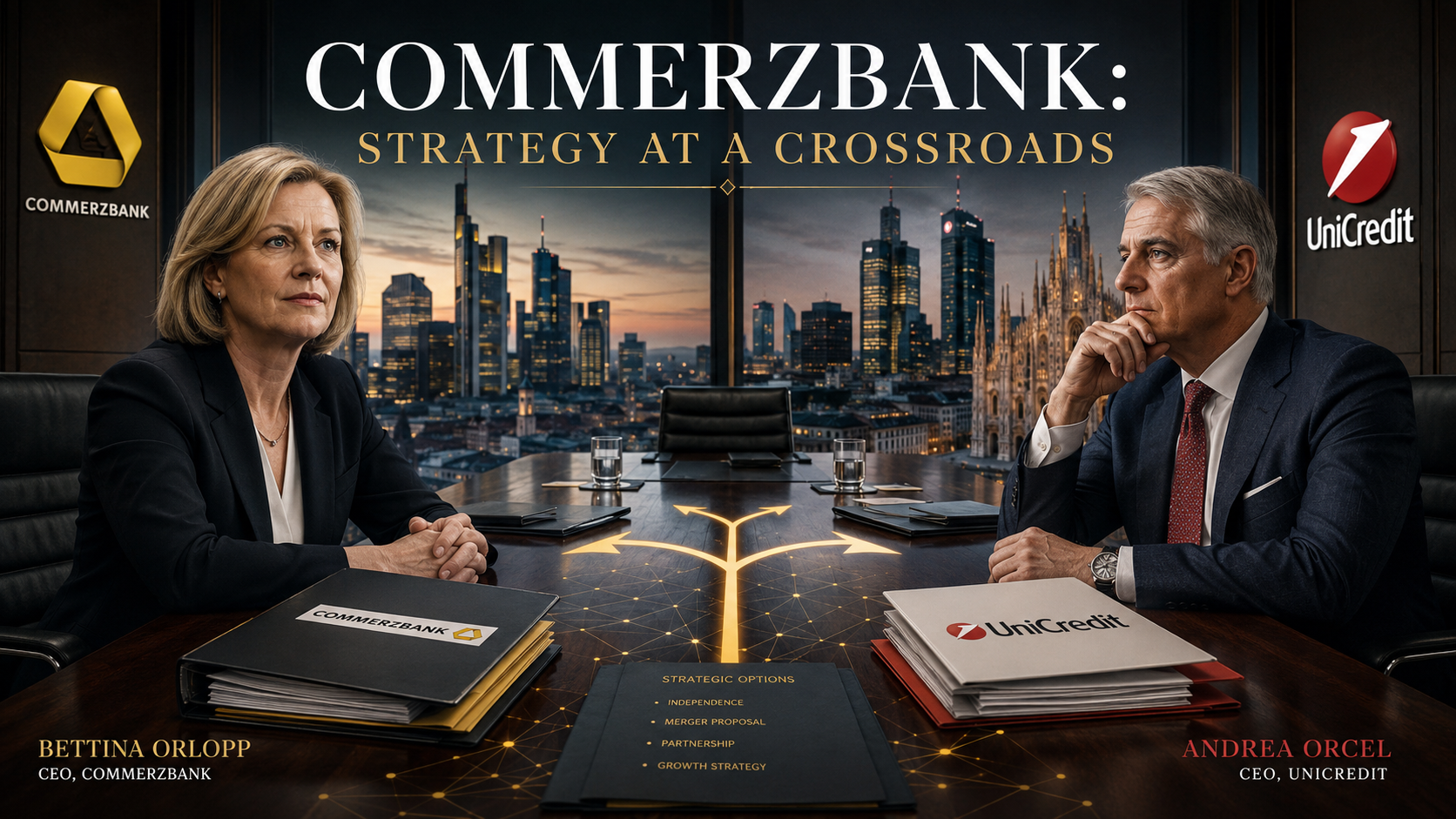
Commerzbank CEO Bettina Orlopp has signaled that her future at Germany’s second-largest bank could depend on whether she and UniCredit CEO Andrea Orcel can agree on the lender’s strategy and path forward, adding a new layer of uncertainty to UniCredit’s push for control.
The comments come as the long-running takeover battle enters a more consequential phase. UniCredit has built a position representing 47.59% of Commerzbank’s share capital and 49.65% of voting rights, according to its final July tender-offer results.
The shift is significant because Commerzbank management has spent much of the past two years resisting UniCredit’s advances. Now, discussions are moving toward what a potential combination could actually look like and whether the two sides can agree on the bank’s future.
For Orlopp, that means the question is no longer simply whether UniCredit can gain control.
It is increasingly about what happens to Commerzbank after it does.
Orlopp’s Future Depends on Strategic Agreement
Orlopp indicated that continuing to lead Commerzbank remains possible if she and Orcel can reach agreement on strategy and the way forward.
That does not amount to a resignation announcement.
Instead, it highlights the importance of strategic alignment as negotiations develop.
Orlopp has been one of the most visible opponents of UniCredit’s takeover ambitions. Her position has gradually evolved, however, as UniCredit has accumulated a near-majority voting position and the possibility of a transaction has become harder to dismiss.
Reuters reported in August that Orlopp had said she was optimistic the two sides could find common ground on corporate governance and the business model.
That represents a marked change in tone from earlier this year.
In April, Reuters reported that Orlopp told employees that Commerzbank management did not see a convincing combination plan from UniCredit.
The latest comments suggest the debate has moved from whether discussions should happen to whether the two banks can agree on the terms.
UniCredit Now Controls Nearly Half the Voting Rights
The balance of power has changed dramatically since UniCredit first began building its position in Commerzbank.
According to UniCredit’s final tender-offer results published in July, shareholders tendered shares representing 17.60% of Commerzbank’s outstanding capital.
Combined with UniCredit’s directly held 26.77% stake and financial instruments representing another 3.22%, the Italian lender reached 47.59% of Commerzbank’s share capital.
Because Commerzbank’s treasury shares do not carry voting rights, that position represented 49.65% of voting rights.
That gives Orcel considerable influence over the German lender even without outright 50% ownership.
It also changes the negotiating dynamics.
UniCredit is no longer approaching Commerzbank simply as an outside shareholder seeking to persuade management.
It has become a shareholder with enough voting power to shape important corporate decisions.
Orcel Sees Major Cost and Efficiency Potential
The strategic disagreement centres partly on how Commerzbank could be transformed under UniCredit ownership.
Orcel has argued that Commerzbank offers significant opportunities for efficiency improvements.
Reuters reported in August that Orcel’s approach includes reducing costs, removing management layers and increasing revenue growth — a strategy that has helped transform UniCredit itself into one of Europe’s most profitable banks.
The potential savings are therefore central to UniCredit’s investment case.
But those savings create one of the biggest points of tension with Commerzbank.
Cost reductions can mean changes to staffing, management structures and parts of the bank’s operating model.
That is particularly sensitive in Germany, where Commerzbank plays a major role in financing the country’s Mittelstand, or small and medium-sized businesses.
Jobs and the International Network Remain Key Issues
Commerzbank’s concerns extend beyond management control.
The bank has repeatedly emphasized the importance of its international network and its role in supporting German companies operating overseas.
UniCredit’s approach could involve a more streamlined business model focused on core European markets.
Reuters reported that Commerzbank fears a takeover could put jobs at risk and threaten its international network, while Orcel sees significant room to improve efficiency.
That creates a difficult negotiating equation.
Orcel needs to demonstrate that the combination can generate meaningful value.
Orlopp and Commerzbank’s stakeholders need confidence that the bank will retain enough strategic independence, employment and international reach to continue serving its core customers.
Finding that balance could determine whether the current discussions lead to a negotiated combination or another period of confrontation.
Germany Still Has a Seat at the Table
The German government remains another important factor.
Berlin still holds more than 12% of Commerzbank following its stake acquired during the bank’s financial crisis-era rescue.
For much of the takeover battle, the government’s position represented a major political obstacle to UniCredit.
That stance has softened.
Reuters reported in August that German Finance Minister Lars Klingbeil is scheduled to meet Orcel on September 14, marking the first direct discussions between the German government and UniCredit’s CEO over the takeover effort.
The meeting matters because Commerzbank is not simply another publicly traded company in the eyes of German policymakers.
It is deeply connected to the country’s corporate sector and Frankfurt’s position as a major European financial centre.
Berlin therefore has interests that extend beyond the value of its remaining shareholding.
The Deal Is Moving From Resistance to Negotiation
The biggest change in the Commerzbank story is the tone.
For months, the central question was whether Commerzbank and German political leaders could stop UniCredit from gaining control.
That question has become harder to answer after UniCredit accumulated its near-50% voting position.
Now, attention is moving toward the terms of a potential combination.
Reuters recently described the shift as one in which discussions are moving toward the deal’s terms rather than simply trying to prevent it.
That does not mean a merger is guaranteed.
There are still major issues to resolve, including governance, jobs, the future of Commerzbank’s international operations and the strategic role of the German lender within a larger UniCredit group.
Regulatory approvals also remain important.
However, the negotiating environment is fundamentally different from the one that existed when UniCredit first approached Commerzbank.
Orlopp and Orcel Represent Two Different Banking Models
The tension between Orlopp and Orcel is also a clash between two different visions of European banking.
Orlopp has built her case around Commerzbank’s standalone strategy, customer relationships and role in Germany’s economy.
Orcel has pursued a broader European consolidation strategy.
He sees scale as a competitive advantage for European banks competing with much larger U.S. institutions.
Reuters has described Orcel’s wider ambition as an effort to redraw Europe’s banking map through cross-border consolidation.
That makes Commerzbank strategically important beyond Germany.
A successful combination could create a banking group with a much larger footprint across Europe.
At the same time, it could become a test of whether national interests can coexist with Europe’s push toward a more integrated banking market.
What Orlopp’s Position Means for Commerzbank
Orlopp’s comments introduce a new uncertainty into that process.
If she and Orcel can agree on the strategic direction, she could potentially remain involved in leading Commerzbank through the next phase.
If they cannot, her departure would remove one of the central figures who has shaped Commerzbank’s response to UniCredit.
Either outcome would have consequences.
A negotiated agreement could provide continuity and help reduce uncertainty for employees, customers and investors.
A leadership change could signal a deeper restructuring of the German bank’s management and strategy.
For shareholders, meanwhile, the question is whether UniCredit can turn its near-majority position into the operational and financial benefits Orcel has outlined.
Europe’s Banking Consolidation Test
The Commerzbank battle has become much larger than a corporate takeover.
It is now a test of Europe’s banking consolidation ambitions.
European policymakers have long argued that the region needs larger and more integrated banks to compete globally.
Yet cross-border banking deals often collide with national concerns over jobs, headquarters, lending priorities and financial sovereignty.
Commerzbank sits directly at that intersection.
UniCredit wants to use its scale and existing German operations through HypoVereinsbank to create a stronger European banking group.
Germany wants to protect an institution that plays a major role in financing its corporate economy.
Orlopp is caught between those two objectives.
Her latest comments suggest that the next phase may ultimately depend on whether the two sides can bridge the gap.
The Bottom Line
UniCredit’s pursuit of Commerzbank has entered a new phase.
With nearly half of Commerzbank’s voting rights, Orcel has moved the discussion well beyond a speculative takeover attempt.
Now comes the harder part: agreeing on what the combined bank would actually become.
Orlopp’s willingness to continue could depend on whether she and Orcel can agree on that vision.
The unresolved questions are substantial — from cost savings and jobs to governance, international operations and the future of Commerzbank’s German identity.
The September 14 meeting between Orcel and Finance Minister Lars Klingbeil will add another important political dimension to the process.
For now, no final agreement has been announced.
But the battle has clearly moved.
The question is increasingly no longer whether UniCredit can gain influence over Commerzbank.
It is what kind of Commerzbank will emerge if Orcel succeeds — and whether Orlopp will be part of that future.
Comments
No comments yet. Be the first to share your thoughts.
Leave a comment