
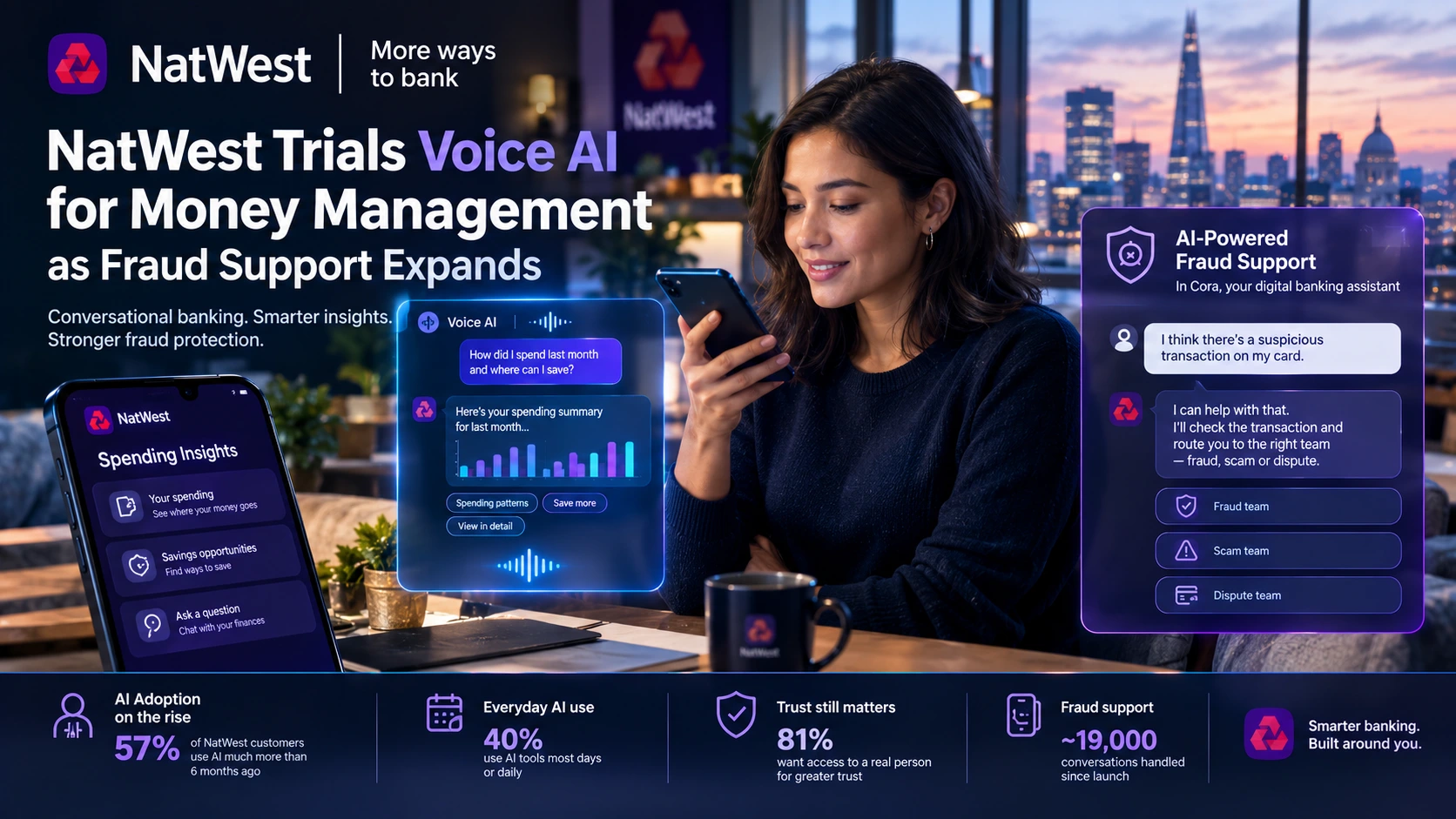
NatWest Group is stepping deeper into conversational banking. The bank has introduced a new generative AI tool that lets customers discuss their spending through voice and text. Alongside this, NatWest is also rolling out a new AI-powered fraud support service within Cora, its digital banking assistant.
On September 25, the bank announced it will trial a fully generative, audio-visual Spending Insights experience through Royal Bank of Scotland. The tool lets customers ask questions about their finances naturally. It supports follow-up questions and interruptions, so customers don’t need to navigate fixed menus or predefined prompts.
This move comes as NatWest’s research shows customer use of AI is accelerating. However, trust and human support still remain central to how people want the technology used in financial services.
NatWest brings voice conversations to Spending Insights.
NatWest’s Chief AI Research Office developed the new Spending Insights tool. It runs on the bank’s proprietary Small Language Model technology.
Customers taking part in the trial can use voice or text to explore their financial activity. The system turns transaction data into personalized insights and interactive graphs. As a result, customers can examine spending patterns, budgeting, and potential savings more easily.
Unlike traditional banking chatbots, which typically respond to individual prompts, this trial supports more natural conversations. Customers can ask follow-up questions, interrupt the interaction, and move between different financial topics. NatWest describes the trial as an industry-first test of a fully generative, real-time voice-to-voice banking experience.
Dr Maja Pantic, NatWest Group’s Chief AI Research Officer, said the bank is moving beyond simple written question-and-answer interactions. Instead, it’s building toward more natural audio-visual conversations.
Notably, NatWest’s focus on its own small language models stands out here. Rather than relying solely on general-purpose AI systems, the bank is developing models and applications built around specific banking use cases.
Cora adds AI-powered fraud triage.
NatWest is also expanding AI into fraud support. Its new Fraud Triage Agent lives within Cora and helps customers who are concerned about a suspicious credit card transaction.
Instead of requiring customers to work out whether their issue is a fraud case, scam, or payment dispute, they can simply explain what happened in their own words. The system then directs them to the appropriate fraud, scam, or dispute team.
So far, NatWest has handled nearly 19,000 customer conversations through the tool since launch. According to UK Finance’s 2026 Fraud Report, around 80% of fraud-related activity originates online and through telecommunications platforms. Therefore, the new service aims to reduce the effort customers face when finding the right support during stressful situations.
57% of NatWest customers say AI use has increased.
These new products arrive alongside NatWest’s AI Adoption Report. The research involved more than 2,400 NatWest customers, plus a benchmark sample of 1,800 UK consumers.
Overall, the findings point to a rapid increase in everyday AI use. NatWest reports that 57% of its customers now use AI much more than they did six months ago. Meanwhile, 40% say they use AI tools most days or daily, and 22% use AI platforms for financial information and advice.
Financial use cases are also becoming more practical. The most common uses customers report include
- 42% using AI to find deals and products
- 38% using AI for savings tips
- 38% using AI to explain financial terminology
- 36% using AI to check scams and fraud
Together, these findings suggest that consumers are moving well beyond experimentation. Increasingly, they’re using AI for everyday financial decisions.
Customer trust still depends on human support
Despite growing adoption, NatWest’s research highlights a significant trust requirement for banks deploying AI. In fact, 81% of respondents said access to a real person remains the most important factor in building trust in AI-powered financial services.
The research also found that 77% want AI-enabled services to work reliably, and another 77% want clarity over how their data is handled. Additionally, 75% said strong oversight by independent regulatory bodies matters to them.
This creates an important constraint for banks developing more autonomous customer-facing AI. Customers may feel increasingly comfortable using AI, but the research shows many still expect clear safeguards and a straightforward route to human assistance.
Solange Chamberlain, retail CEO at NatWest Group, said customers want banking experiences that feel simpler and more personalized. At the same time, they want to know that human expertise is available when it matters most.
NatWest’s AI strategy moves beyond chatbots.
NatWest’s latest launches reflect a broader shift in financial services AI. Increasingly, banks are moving from basic chatbot interactions toward systems designed to interpret context and support specific customer journeys.
The Spending Insights trial focuses on understanding financial behavior and presenting information conversationally. Meanwhile, the fraud triage agent focuses on identifying the nature of a customer’s problem and directing them to the right support. Both approaches place AI inside existing banking relationships, rather than presenting it as a standalone consumer assistant.
NatWest governs its AI use through its Artificial Intelligence & Data Ethics Code of Conduct. This code aims to support responsible innovation while protecting customers and their data.
The bank’s strategy also shows why proprietary AI models matter in financial services. Smaller, purpose-built models can be developed around specific tasks and banking data requirements. This potentially gives institutions greater control over how AI operates within customer-facing systems.
What NatWest’s AI trial means for banking
The next phase of banking AI is moving from simply answering questions toward helping customers understand, decide, and act. NatWest’s Spending Insights trial illustrates that shift clearly. Rather than searching through statements, customers can now have a conversation about their own transaction data.
Similarly, the Fraud Triage Agent applies the same principle to customer support. It uses conversational input to determine where a problem should be handled.
The bigger test will be whether customers trust these systems enough to rely on them for increasingly important financial decisions. NatWest’s own research points to both sides of that equation. AI adoption is rising quickly, yet customers still place high value on human involvement, reliability, data transparency, and independent oversight.
Ultimately, for banks, success may not come down to how natural the technology feels. Instead, it may depend on how effectively they combine automation with clear safeguards and genuine human support.
Comments
No comments yet. Be the first to share your thoughts.
Leave a comment