
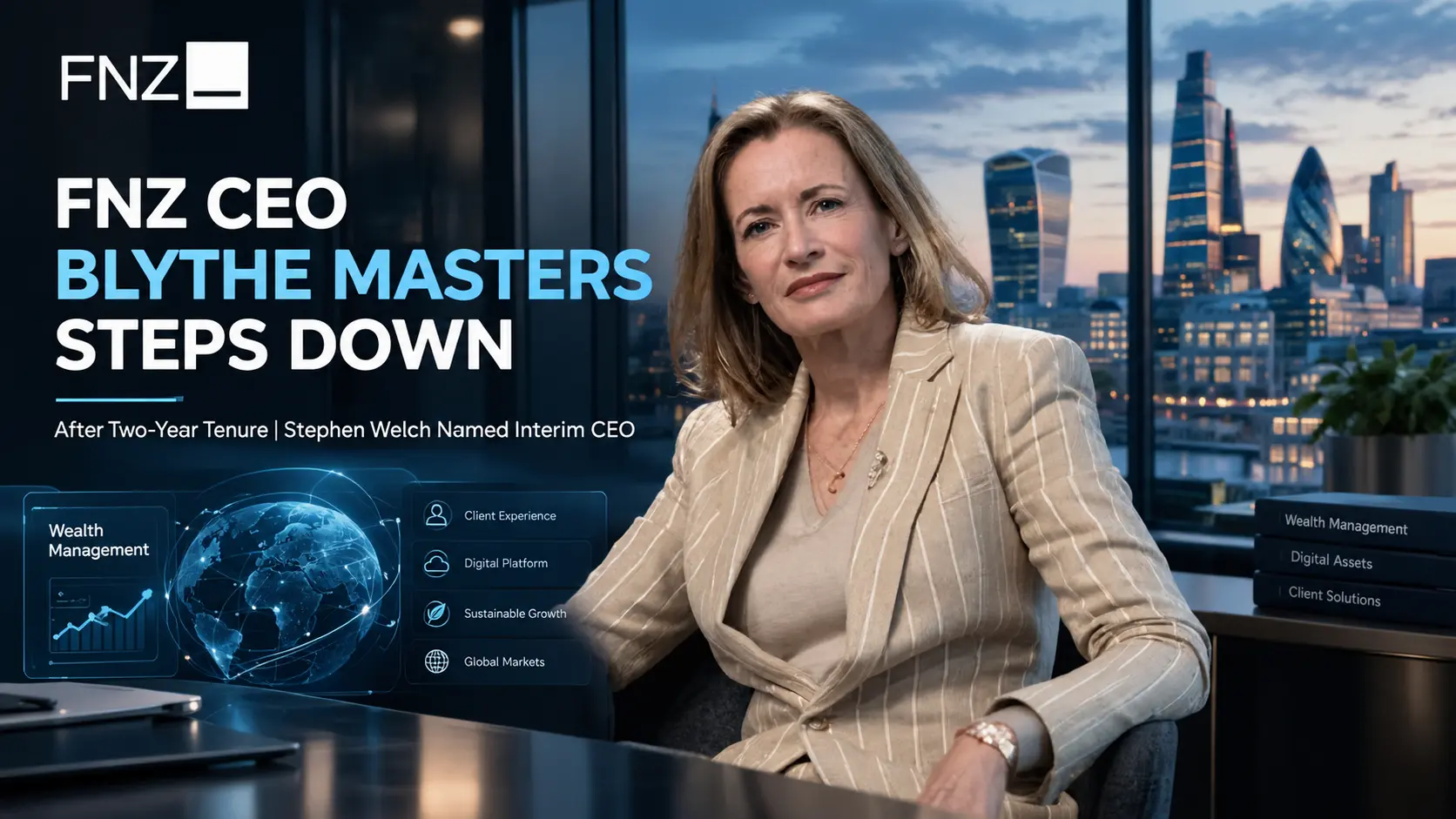
Blythe Masters is stepping down as Group CEO of FNZ after two years at the helm, as the global wealth management technology platform begins a search for her permanent successor.
FNZ announced the leadership transition on September 16, 2026, appointing Stephen Welch as Executive Group Chair and interim CEO. Welch will hold the interim CEO responsibilities alongside his position as Group Chair while the board searches for a permanent chief executive. Masters will remain involved with FNZ for six months in an advisory capacity to support the transition.
The change comes at an important point for FNZ. The company is reshaping its business around its core wealth-management technology platform while selling non-core operations and investing in technology, products, and client delivery.
FNZ says assets on its platform now exceed US$2.5 trillion, making the leadership change significant for a company serving financial institutions across global wealth markets.
Blythe Masters Leaves After Two Years as FNZ CEO
Masters became FNZ Group CEO in August 2024, succeeding founder Adrian Durham.
Her appointment came alongside a US$1 billion capital commitment from FNZ’s existing institutional shareholders, which included Motive Partners and CPP Investments. At the time, FNZ said the capital would support its next phase of growth and transformation.
Masters joined FNZ with a long background in financial services.
Before becoming CEO, she was a senior executive at J.P. Morgan, where her nearly three-decade career included leadership roles across commodities, regulatory affairs, credit, and investment banking. She later became CEO of Digital Asset Holdings and a founding partner of Motive Partners.
During her time at FNZ, the company pursued a strategy focused on simplifying the group, improving operational discipline, and sharpening its focus on wealth-management technology.
FNZ’s board said Masters made a significant contribution during her two-year tenure and helped advance the company’s transformation program, strengthen its financial position, and address key regulatory priorities.
Masters will now move into an advisory role for six months. FNZ has not announced what she plans to do after that period.
Stephen Welch Takes Over as Interim CEO
Stephen Welch will now lead FNZ on an interim basis while the search for a permanent CEO gets under way.
Welch only became Group Chair in July 2026, making his move into the executive role particularly recent. FNZ says he will serve as Executive Group Chair alongside his existing chair position during the transition.
Welch brings experience working with boards and leadership teams at regulated financial-services businesses. FNZ says his focus will be on helping the company execute its transformation program, improve client delivery, and continue its path toward long-term profitable growth.
In announcing the transition, Welch said FNZ has a strong business, established technology, and a significant institutional client base. He said his immediate focus would be continuing the transformation program and building on the progress already made.
The appointment also provides continuity while FNZ looks for a permanent leader.
FNZ Is Narrowing Its Focus on Wealth Technology
The leadership change comes as FNZ reshapes its business around its core wealth-management technology platform.
In recent months, the company has agreed to several disposals designed to reduce its exposure to businesses outside that central strategy.
In August, FNZ announced an agreement to sell FNZ Bank to Advent International and a consortium including HarbourVest Partners. The transaction is expected to complete in the second half of 2027, subject to regulatory and other approvals.
FNZ said the sale would help it focus on providing wealth-management technology to financial institutions rather than operating the German banking business itself.
The company has also been moving away from other non-core assets. Its September 2026 shareholder update referenced the sale of its German bank, Luxembourg-based fund platform IFSAM, and its Swiss core-banking software platform as part of the effort to focus resources on its strategic priorities.
That strategy gives the CEO transition an important backdrop.
FNZ is not simply changing leadership. It is doing so while reshaping the business around a clearer technology proposition.
The Company Has Recently Raised More Capital
FNZ’s financial position has also been strengthened during the transition.
On September 1, 2026, FNZ announced a US$450 million equity investment from existing institutional shareholders, including La Caisse, CPP Investments, Generation Investment Management, and Motive Partners.
FNZ said the new capital would support its transformation program and long-term plan for profitable growth.
The company plans to invest in its technology platform, products, and people while continuing to expand relationships with large financial institutions.
That announcement followed a larger US$650 million capital raise completed in November 2025. That earlier funding also came from institutional shareholders and major FNZ clients.
Taken together, the capital raises show that FNZ’s shareholders continue to provide financial backing as the company works through its transformation.
FNZ Platform Now Exceeds $2.5 Trillion
FNZ’s scale has also changed considerably since Masters took over.
The company says it now has more than US$2.5 trillion in assets on its platform and serves more than 30 million end customers.
FNZ’s technology is used by major financial institutions to provide wealth-management services to their customers.
Its platform spans areas including investment administration, financial advice, digital customer experiences, and the operational infrastructure needed to manage wealth products.
That scale means the CEO transition affects a company embedded deeply within the infrastructure of the wealth-management industry.
It also explains why FNZ is focused on maintaining continuity during the search for a permanent leader.
Technology and AI Remain Central to the Strategy
FNZ’s transformation is not only about corporate structure.
The company continues to invest heavily in technology and artificial intelligence as wealth managers look to modernize their platforms and improve advisor productivity.
Earlier this year, FNZ highlighted research conducted with ThoughtLab involving 500 financial institutions across 16 markets. The research found that 73% of firms surveyed believe AI is critical to their future, according to FNZ.
FNZ has also announced a strategic partnership with Microsoft to accelerate wealth-management transformation through AI, automation, and cloud capabilities.
That technology agenda is likely to remain important during the leadership transition.
The company has positioned AI as a tool for helping advisors work more efficiently rather than replacing them outright. Its broader platform strategy is focused on reducing friction for wealth managers and creating more personalized experiences for investors.
A More Focused FNZ Emerges
The past two years have therefore been about more than a change at the top.
Under Masters, FNZ has continued to invest in its platform while simplifying parts of the organization.
The disposals of banking and other non-core operations have pushed the company closer to its original technology proposition: providing infrastructure for wealth managers, asset managers, insurers, and other financial institutions.
FNZ’s September capital raise reinforced that direction, with the company saying the new funding would support its technology platform, people, and products.
The leadership transition now puts that strategy in the hands of Welch while the company searches for a permanent CEO.
The board says the company’s strategy and transformation program remain unchanged during the transition.
That means investors and clients should expect continuity rather than an immediate strategic reset.
What Happens Next at FNZ?
The immediate priority is finding a permanent group CEO.
FNZ has confirmed that a search process has begun, but it has not provided a timetable or identified potential candidates publicly.
Until then, Welch will oversee the business alongside his board responsibilities.
Several areas will be worth watching during the transition.
Client delivery will remain important as FNZ continues working with large financial institutions.
Transformation will remain a central focus as the company simplifies its operating model.
Technology investment will continue, particularly around AI, automation, and the firm’s core wealth platform.
Portfolio simplification is also likely to remain important as the company completes previously announced disposals.
And financial performance will be closely watched as FNZ moves toward its goal of long-term profitable growth.
TheFinRate Take
Blythe Masters’ departure marks the end of a two-year chapter for FNZ, but the company’s broader strategy is not changing with the leadership transition.
Since Masters took over in August 2024, FNZ has been simplifying its business, selling non-core operations, raising additional shareholder capital, and continuing to build its wealth-management technology platform.
The company now says assets on its platform exceed US$2.5 trillion, while more than 30 million end customers are served through its technology.
Stephen Welch’s interim appointment provides continuity while FNZ searches for a permanent CEO.
The bigger story will be what comes next.
FNZ is becoming more focused on wealth technology at a time when financial institutions are under pressure to modernize, improve digital experiences, and use AI more effectively.
The next permanent CEO will inherit a much more focused business, backed by substantial institutional capital and operating at a scale that makes its technology increasingly important to the global wealth-management market.
Comments
No comments yet. Be the first to share your thoughts.
Leave a comment