
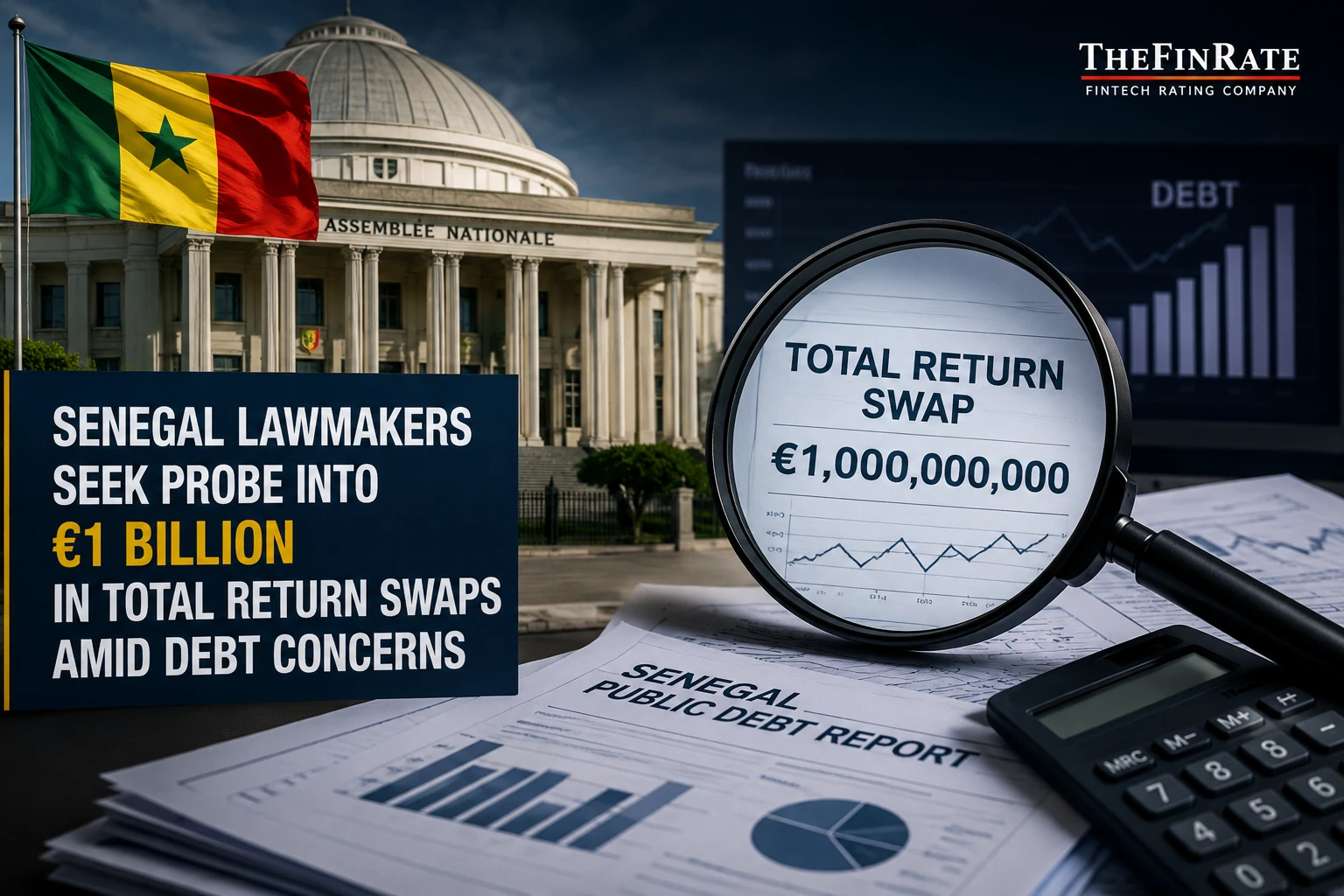
Senegal Lawmakers Seek Probe Into €1 Billion in Total Return Swaps Amid Debt Concerns
Senegal’s parliament is moving to investigate the government’s use of Total Return Swaps as questions grow over the structure, cost and impact of the financing on public debt.
Senegal is facing renewed scrutiny over its use of Total Return Swaps (TRS) to raise financing, with lawmakers seeking a parliamentary investigation into transactions that have become part of the country’s wider debate over debt transparency.
The latest parliamentary proposal focuses on a €650 million TRS transaction involving First Abu Dhabi Bank (FAB) and Africa Finance Corporation (AFC). Senegalese parliamentary documents say the investigation would examine the terms of the transaction, its guarantees, its risks and its impact on public debt.
The broader TRS financing has also been linked in reporting to structured borrowing that could bring the total amount under scrutiny toward €1 billion. However, the €650 million transaction is the amount specifically identified in the parliamentary proposal, so the figures should not be treated as interchangeable.
Senegal lawmakers seek investigation into TRS financing
The opposition parliamentary group Takku Wallu Sénégal has requested the creation of an investigative commission to examine the government’s use of TRS mechanisms.
A parliamentary proposal dated August 20, 2026, calls for an investigation into the €650 million transaction involving FAB and AFC. The proposed commission would examine the financing conditions, interest rates, guarantees and potential effects on Senegal’s public debt.
The proposal also calls for hearings involving senior officials, including the finance minister, the director general of public accounting and the treasury’s senior officials.
The commission would have 11 members, selected according to the representation of parliamentary groups.
What is a Total Return Swap?
A Total Return Swap is a financial derivative in which one party receives the economic return of an underlying asset while making payments to another party.
Governments and institutions can use structured transactions involving TRS arrangements as part of broader financing strategies.
The controversy in Senegal centers not simply on the use of the derivative itself, but on questions surrounding how the transactions were structured, disclosed and reflected in public debt.
That distinction is important because Senegal’s government has rejected claims that it used TRS arrangements to conceal borrowing.
Senegal says TRS transactions were legal and transparent
Senegal’s Ministry of Finance has defended the transactions.
In a March 24 clarification, the ministry said TRS operations formed part of a strategy to diversify financing sources and attract foreign investors to the regional financial market. It also said the transactions were designed to deepen the domestic market and improve liquidity.
Finance Minister Cheikh Diba separately argued in March that Senegal’s use of TRS instruments was conducted legally and transparently.
According to Senegal’s official position, the use of the instruments appeared in the economic and financial report attached to the 2026 Finance Act, while information about the financing plan was also shared with the IMF.
This creates an important divide at the center of the controversy: lawmakers are seeking greater scrutiny of the transactions, while the government says the financing was lawful and disclosed through established budgetary and financial processes.
Why the €650 million transaction matters
The parliamentary proposal identifies a €650 million contract involving FAB and AFC as a central subject of the investigation.
Lawmakers want to determine the actual conditions of the agreement and assess the risks and guarantees attached to it. They also want to understand its effect on Senegal’s public debt.
The investigation could therefore provide greater clarity about how the financing worked and how the obligations should be understood from a sovereign-debt perspective.
The issue is particularly sensitive because Senegal has already faced significant scrutiny over its public finances.
Senegal’s wider debt problem adds pressure
The TRS controversy comes against the backdrop of Senegal’s broader debt crisis.
The IMF has previously highlighted Senegal’s reliance on regional financing markets and noted that some 2025 issuances in the UMOA-Titres securities market were purchased as part of Total Return Swap operations. The IMF has also described Senegal as facing significant debt vulnerabilities and limited access to external financing.
The World Bank has also documented the financial-market impact of Senegal’s earlier debt revelations. Its June 2026 Global Economic Prospects report notes that the disclosure of previously unreported debt led to a sharp reassessment of Senegal’s fiscal position and significant pressure on sovereign bond markets.
That history makes any new questions about structured financing particularly important for investors and international lenders.
Why lawmakers are focusing on transparency
The parliamentary proposal seeks to establish whether the TRS arrangements created obligations or risks that were not sufficiently understood by lawmakers or the public.
Among the issues identified in the proposal are:
- The terms and interest costs of the transaction
- Guarantees attached to the financing
- Potential risks to public assets or resources
- The effect on Senegal’s public debt
- The circumstances surrounding the agreement
- The extent of prior communication with parliament
The investigation, if established, could therefore become an important test of how governments communicate complex financial instruments to lawmakers and the public.
TRS financing is already part of Senegal’s financial strategy
The government argues that TRS transactions should be understood within its broader effort to diversify financing sources.
Senegal’s Finance Ministry said tighter international market conditions encouraged the country to examine alternative financing instruments and attract additional investors to the regional market.
The IMF’s 2026 regional report confirms that some Senegalese securities issued through the UMOA-Titres market in 2025 were purchased as part of TRS operations.
This means the debate is not about an isolated financial transaction. It is part of a broader shift in how Senegal has sought financing during a period of restricted access to international capital markets.
What happens next?
The immediate question is whether Senegal’s National Assembly will establish the proposed investigative commission.
If the commission moves forward, lawmakers could examine the transaction documents, hear testimony from government officials and financial institutions, and assess the implications for Senegal’s public finances.
The investigation could also help clarify the difference between the €650 million transaction specifically identified in parliamentary documents and the wider estimates of TRS-related financing that have been reported elsewhere.
For investors, lenders and international institutions, greater clarity could help determine the actual financial obligations created by these structures.
A broader lesson for sovereign finance
The Senegal controversy highlights a wider issue in modern public finance: governments increasingly use sophisticated financial instruments to manage liquidity and diversify funding.
Such structures can provide access to capital when traditional borrowing becomes expensive or difficult.
At the same time, complex derivatives can make it harder for lawmakers, investors and citizens to understand the full economic exposure created by a transaction.
That makes disclosure, accounting treatment, risk assessment and parliamentary oversight increasingly important.
The bottom line
Senegal’s proposed parliamentary investigation puts the spotlight on the country’s use of Total Return Swaps at a time when its public finances remain under close scrutiny.
The specific transaction at the center of the parliamentary proposal is a €650 million agreement involving First Abu Dhabi Bank and Africa Finance Corporation.
While some reporting has linked Senegal’s broader TRS financing to amounts approaching €1 billion, the government maintains that its use of TRS instruments was legal, transparent and part of its financing strategy.
The proposed investigation could now provide a clearer picture of the transactions, their risks and their impact on Senegal’s debt position.
Comments
No comments yet. Be the first to share your thoughts.
Leave a comment