
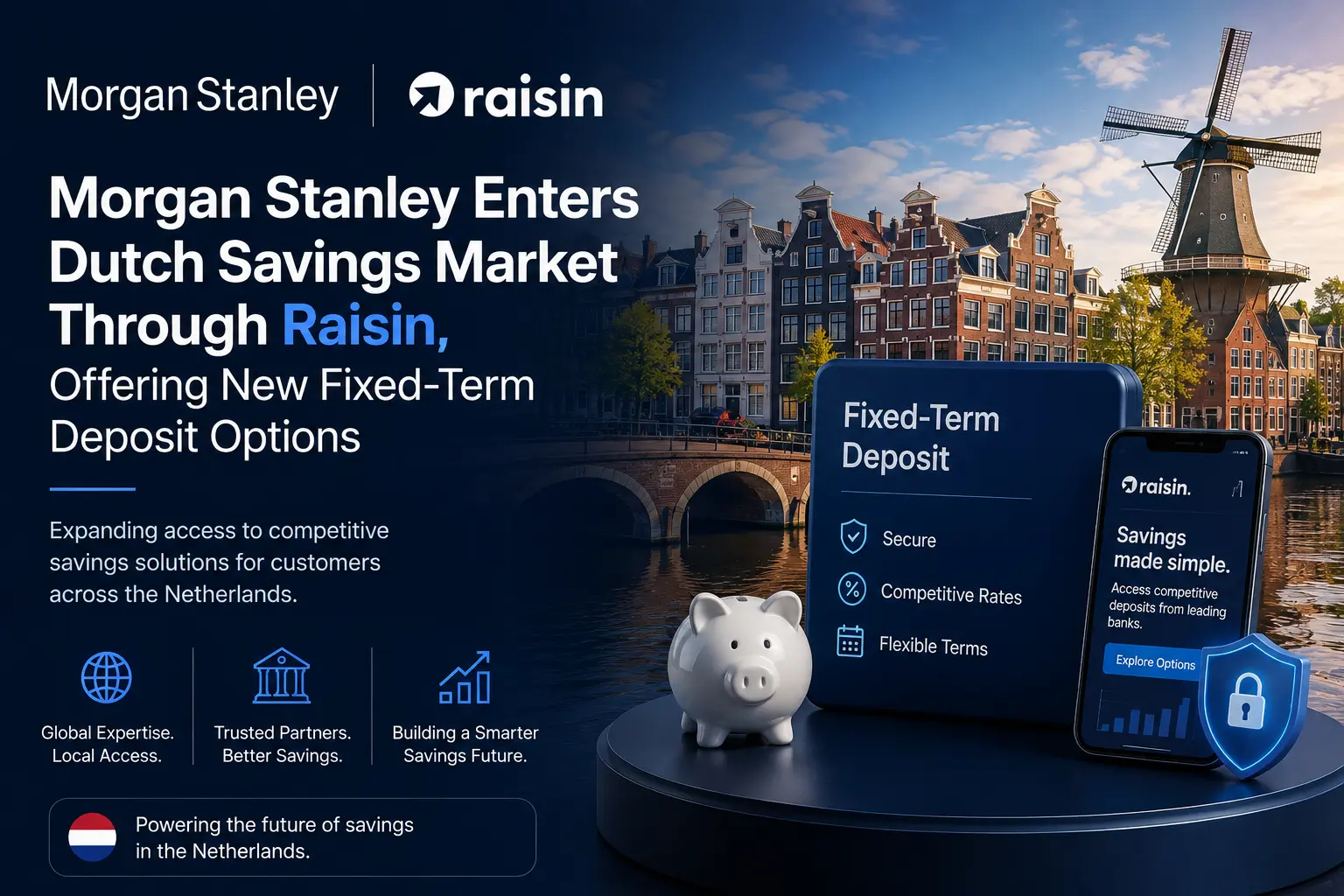
Morgan Stanley has entered the Dutch retail savings market through Raisin, giving Dutch savers access to fixed-term deposits offered by Morgan Stanley Europe SE in Germany.
The move marks a new step in Morgan Stanley’s European retail banking strategy and gives Dutch consumers access to deposit products from one of the world’s best-known financial institutions without requiring them to open a traditional banking relationship directly with Morgan Stanley in the Netherlands.
The new savings products are being offered through Raisin’s international savings platform, which connects consumers with deposit products from banks across different European markets.
Deposits can be opened from EUR 1,000, while eligible deposits of up to EUR 100,000 per saver are protected under Germany’s statutory deposit guarantee scheme.
For Dutch savers, the offering comes at a time when consumers are increasingly looking beyond traditional domestic savings accounts for more competitive interest rates and greater choice.
Morgan Stanley Offers Fixed-Term Deposits to Dutch Savers
Morgan Stanley Europe SE, which is headquartered in Germany, is offering several fixed-term deposit options to customers in the Netherlands through Raisin.
The three-month fixed-term deposit currently offers an interest rate of 2.50% per year. Savers choosing longer maturities can receive rates of up to 2.95% per year for deposits fixed for one or two years.
The products provide Dutch consumers with another option for putting their cash to work while maintaining the relatively straightforward structure of a traditional bank deposit.
The minimum deposit requirement is EUR 1,000, making the products accessible beyond the high-net-worth segment typically associated with Morgan Stanley’s investment banking and wealth management businesses.
The availability of statutory deposit protection is also significant. Eligible deposits of up to EUR 100,000 per saver are covered by Germany’s statutory deposit guarantee framework.
However, as with any fixed-term deposit, savers need to consider the maturity period and the conditions surrounding access to their funds before committing their money.
Why Morgan Stanley Is Entering the Dutch Savings Market
Morgan Stanley’s entry comes against a backdrop of changing consumer behaviour in Europe’s savings market.
Dutch households have increasingly demonstrated a willingness to place money outside their traditional domestic banking relationships.
According to European Central Bank data cited in the announcement, deposits held by Dutch households elsewhere in the eurozone increased by 14.2% over one year to EUR 22.4 billion.
The longer-term shift is even more notable. Such deposits have increased by 339.3% over five years, highlighting the growing willingness among Dutch consumers to consider savings products offered outside their home market.
This trend creates an opportunity for international banks to reach customers through digital distribution platforms rather than relying exclusively on physical branches or locally established retail banking operations.
Raisin provides precisely that distribution channel.
Instead of building a complete retail savings infrastructure in every European market, banks can use Raisin’s platform to make deposit products available to consumers in countries where they may not otherwise have a direct retail presence.
For Morgan Stanley, the partnership therefore provides a relatively efficient route into the Dutch retail deposit market.
Dutch Savers Are Increasingly Turning to Term Deposits
The Morgan Stanley launch also reflects a broader shift toward fixed-term savings products in the Netherlands.
Data from the Dutch Central Bank, or DNB, show that the volume of savings held in term deposits at Dutch banks has increased by more than 50% over five years.
The appeal is largely linked to the difference in interest rates.
Over the period referenced by the announcement, Dutch savers received an average interest rate of approximately 2.13% on term deposits, compared with around 0.93% per year on freely withdrawable savings accounts.
That gap illustrates why consumers may be willing to lock away their money for a predetermined period in exchange for a higher return.
Top interest rates on one- and two-year fixed-term deposits have also increased by roughly half a percentage point since the beginning of 2026.
As a result, competition among banks for household savings is becoming increasingly important.
For consumers, the development means that comparing deposit rates across banks and markets can potentially produce meaningful differences in returns.
Raisin’s Role in the Cross-Border Savings Market
Raisin has built its business around connecting consumers with savings and investment products from banks operating across Europe.
The platform allows savers to access deposit products beyond their domestic banking market, helping participating banks reach new customers without having to establish a full retail banking operation in every market.
This model has become increasingly relevant as digital banking reduces the importance of geographical boundaries.
A Dutch consumer can potentially open a deposit with a German-based bank through a digital platform, while the participating bank gains access to customers in another European market.
Morgan Stanley’s participation therefore highlights the growing role of fintech-enabled distribution in European banking.
Rather than entering the Netherlands through a traditional branch-led retail banking model, Morgan Stanley is using an established digital marketplace to reach consumers.
That approach could become increasingly attractive to other international financial institutions looking to expand their retail deposit bases.
Morgan Stanley Expands Its Dutch Presence
Although Morgan Stanley’s new savings offering represents a new development in Dutch retail banking, the firm is not new to the Netherlands.
Morgan Stanley has operated in the Dutch market for almost 30 years, maintaining a presence primarily focused on institutional and corporate financial services.
The partnership with Raisin extends that existing presence into the retail deposit market.
Peter Krowinkel, head of Morgan Stanley in the Netherlands, described the move as an extension of the firm’s longstanding Dutch presence into retail term deposits.
The strategy also reflects a broader evolution in financial services, where established investment banks and global financial institutions are increasingly exploring ways to reach consumers through digital channels.
For Morgan Stanley, the Dutch savings launch provides an opportunity to test and develop its retail deposit proposition while leveraging Raisin’s existing customer and technology infrastructure.
What the Move Means for Dutch Consumers
For Dutch savers, the arrival of Morgan Stanley adds another major international institution to the market for fixed-term deposits.
The most obvious benefit is greater choice.
Consumers can compare Morgan Stanley’s rates with offerings from domestic banks and other international institutions available through savings platforms.
The rates of 2.50% for three months and up to 2.95% for one- and two-year terms could be particularly relevant for savers seeking predictable returns without taking the market risk associated with equities or other investment products.
At the same time, consumers should consider more than the headline interest rate.
The maturity period, deposit protection framework, withdrawal conditions, tax implications and the financial institution providing the deposit are all important considerations.
The fact that the deposits are provided by Morgan Stanley Europe SE in Germany also means that eligible deposits fall under the German statutory deposit guarantee framework rather than the Dutch deposit guarantee scheme.
For consumers, understanding which entity holds the deposit and which national guarantee scheme applies is therefore essential.
A Wider Shift Toward Cross-Border Banking
Morgan Stanley’s move highlights a broader transformation taking place across European financial services.
Consumers are becoming increasingly comfortable using digital platforms to access financial products from institutions outside their home countries.
At the same time, banks are looking for more efficient ways to expand their customer bases without making large investments in physical infrastructure.
This creates a natural opportunity for platforms such as Raisin.
The model effectively separates the financial product from its traditional distribution channel.
A bank can provide the deposit, while a digital platform handles much of the customer acquisition and product discovery experience.
This could increase competition in savings markets and put additional pressure on established domestic banks to offer more attractive rates.
For consumers, increased competition can mean better pricing and more choice.
For banks, however, it also means that retaining deposits may become more difficult when customers can compare rates across multiple markets with just a few clicks.
What Comes Next for Morgan Stanley and Raisin?
Morgan Stanley’s entry into the Dutch savings market is relatively modest compared with the firm’s broader global financial services operations, but strategically it is significant.
It demonstrates how a major international financial institution can use fintech infrastructure to access a new retail market without following the traditional route of building an extensive local banking network.
For Raisin, the addition of Morgan Stanley further strengthens its role as a bridge between banks seeking deposits and consumers searching for competitive savings products.
The development could also encourage other global financial institutions to consider similar approaches as European consumers become more comfortable with cross-border financial products.
Meanwhile, Dutch banks face a familiar challenge: maintaining customer deposits in a market where consumers have more information, more digital access and more opportunities to compare rates.
The Bigger Picture for European Savings
The Morgan Stanley launch is ultimately part of a much larger trend.
European savings markets are becoming more competitive, digital and cross-border.
Consumers are no longer limited to the products available from the bank on their high street. Digital platforms allow them to compare products from institutions operating across national borders, while banks can use technology to reach customers in new markets.
The growing popularity of term deposits also shows that consumers continue to value predictable returns, particularly when rates on traditional instant-access savings accounts are less attractive.
Morgan Stanley’s partnership with Raisin brings together these trends: international banking, digital distribution, cross-border savings and increased competition for deposits.
The bigger question is whether more global banks will follow the same path and use digital savings platforms to expand their retail presence across Europe.
If they do, European savers could have significantly more choice over where and how they hold their cash.
For Dutch consumers, Morgan Stanley’s arrival through Raisin is another sign that the future of savings may be increasingly digital, competitive, and borderless.
Comments
No comments yet. Be the first to share your thoughts.
Leave a comment