
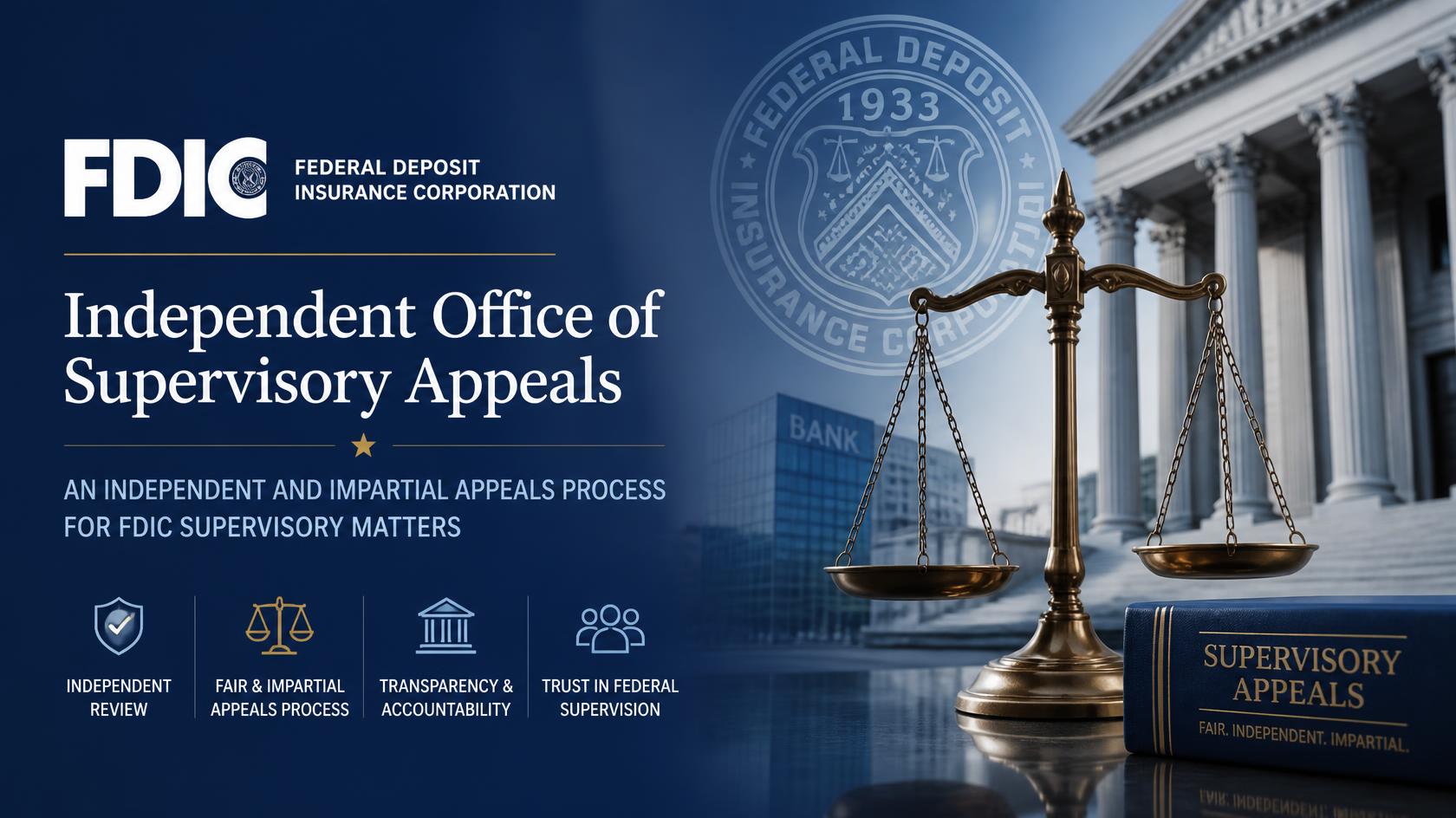
FDIC Starts a New Office That Helps Banks Challenge Rules
The Federal Deposit Insurance Corporation (FDIC) has started the Office of Supervisory Appeals (OSA), giving banks a new way to challenge certain decisions made by the agency.
The FDIC confirmed that the office is now operating and that the agency’s revised appeal guidelines have taken effect.
The new office replaces the Supervision Appeals Review Committee (SARC). It becomes the final step for banks that want to challenge eligible supervisory decisions.
For banks under FDIC supervision, the change creates a more independent review process. It also gives them additional opportunities to challenge decisions they believe are unfair or inconsistent with agency policy.
A way to get an independent review
The biggest change is that the office operates independently from the people who made the original supervisory decision.
A bank can request a review of certain supervisory determinations after the appropriate Division Director reviews the case.
The Office of Supervisory Appeals will then examine the issue independently.
Unlike the previous process, the office will not automatically rely on the original decision.
Instead, it will review the record on its own. It will decide whether the decision follows FDIC policies and whether both sides have provided enough evidence to support their positions.
Why this change matters
Supervisory decisions can affect banks in many ways.
They can influence capital requirements, examination findings, risk ratings, operational restrictions, and other regulatory matters.
An independent review process gives banks a clearer path to challenge decisions they believe were incorrect or inconsistent with FDIC policy.
The new system aims to improve fairness while preserving the agency’s supervisory authority.
People with real experience review the appeals
The FDIC said the appeal panels will include people with bank supervisory experience and banking industry expertise.
The agency also requires reviewing officials to follow confidentiality and conflict-of-interest rules.
These safeguards are designed to keep the process fair and trustworthy.
Banks may feel more confident knowing that experienced professionals will review their appeals.
More opportunities to challenge decisions
The revised guidelines do more than create a new office.
They also expand appeal rights in certain cases involving proposed or pending enforcement actions.
That change could give banks additional opportunities to challenge supervisory determinations before they become final.
Banks have long sought greater transparency and independence in the appeals process.
The new framework separates the appeals function more clearly from the supervisory divisions that make the original decisions.
A big step in FDIC reforms
The FDIC Board approved the Office of Supervisory Appeals in January 2026.
The revised guidelines took effect once the office became operational.
The August announcement confirmed that the transition from SARC to the new office is complete.
The move reflects the FDIC’s effort to improve transparency, accountability, and consistency in its supervisory process.
What banks should know
Banks that want to appeal eligible supervisory determinations must still follow the FDIC’s established procedures.
The Office of Supervisory Appeals becomes available after the Division Director completes the initial review.
The office will then conduct its own independent evaluation of the supervisory determination.
Because the process is separate, banks may receive a fresh assessment of the facts, regulatory analysis, and consistency with FDIC policy.
Looking ahead
The launch of the Office of Supervisory Appeals marks an important change in how the FDIC handles supervisory appeals.
The agency created an independent review office, expanded certain appeal rights, and established confidentiality and conflict-of-interest safeguards.
These changes reshape an important part of the FDIC’s supervisory framework.
For FDIC-supervised institutions, the new system provides a more independent way to challenge eligible supervisory determinations.
For the banking industry, it shows that the FDIC is working to make regulatory decisions more transparent, fair, and consistent while continuing to enforce its supervisory responsibilities.
Comments
No comments yet. Be the first to share your thoughts.
Leave a comment