
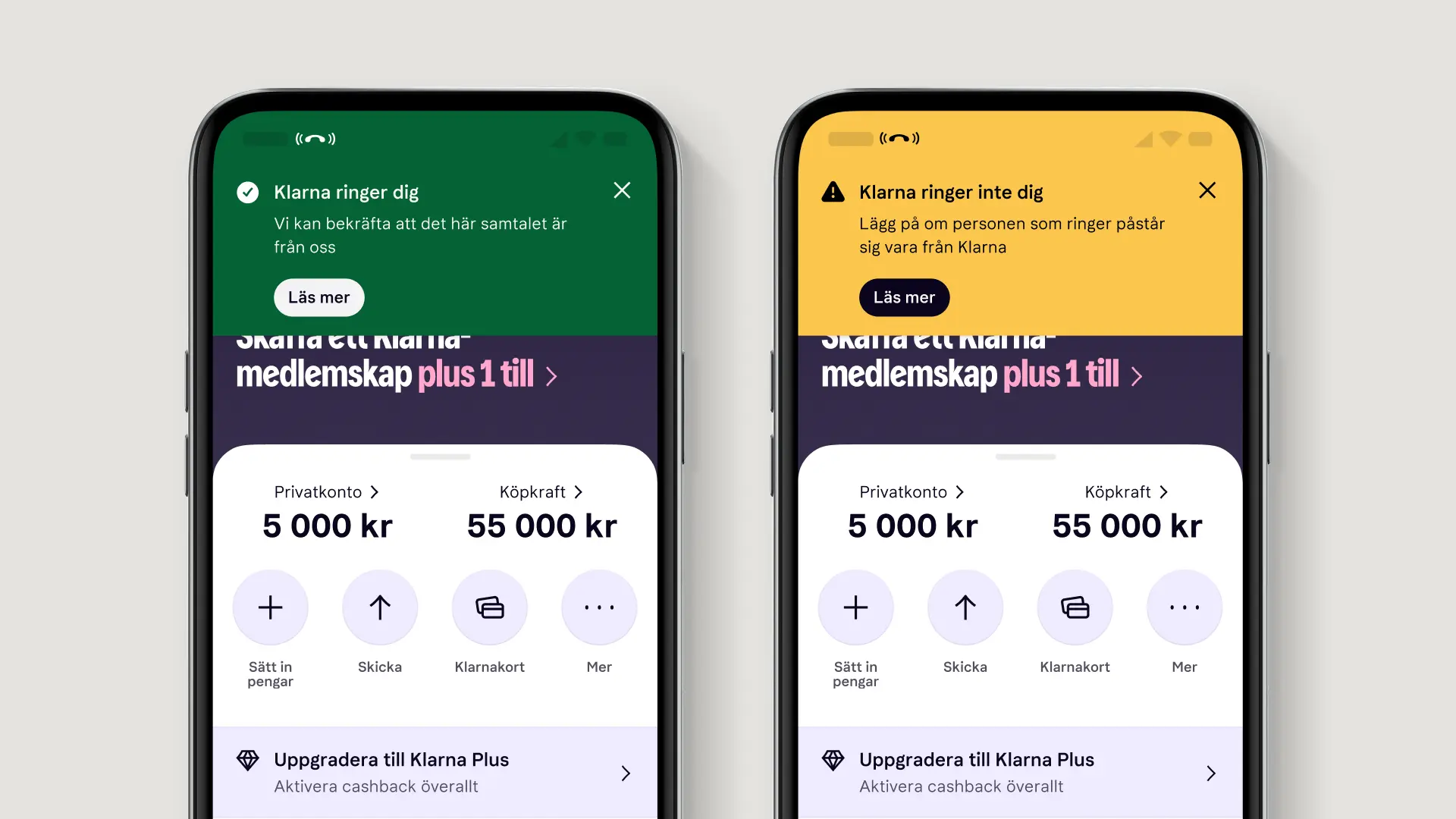
Klarna has launched a new in-app call verification feature across the Nordic region, giving customers a simple way to check whether a phone call genuinely comes from the company.
The feature, called Call Status Detection, is now live for Klarna users in Sweden, Norway, Finland, and Denmark. It is designed to help consumers identify impersonation scams, where fraudsters pretend to represent banks, payment providers, or financial technology companies.
The launch adds another layer to Klarna’s existing anti-fraud toolkit. It follows the company’s introduction of Klarna Inbox, which helps customers verify written communications, including emails, text messages, and letters.
How Klarna Call Status Detection Works
The new tool is designed around a simple customer action.
If a consumer receives a call from someone claiming to be from Klarna, they can open the Klarna app and check the banner displayed at the top of the screen.
The banner will show one of two statuses:
-
Green: The call has been verified by Klarna.
-
Amber: Klarna cannot verify the call, and the customer should hang up.
The process avoids the need for customers to rely only on the number shown on their phone. Instead, the Klarna app becomes the trusted channel through which the customer can check whether the call is genuine.
This matters because caller ID is not a reliable security measure. Fraudsters can spoof phone numbers and make a call appear to come from a legitimate financial institution.
Tackling the Rise of Impersonation Scams
Phone-based impersonation scams have become a serious concern for banks, payment companies, and consumers.
In these scams, criminals may claim that a customer’s account is at risk, that a suspicious payment has been detected or that urgent identity verification is required. They then try to persuade the victim to reveal sensitive information, share security codes, or approve a payment.
The pressure often comes from the apparent legitimacy of the call. A familiar company name or local phone number can make the request seem credible.
Klarna’s Call Status Detection is intended to interrupt that process. Rather than asking customers to make a difficult judgment during a stressful conversation, the feature provides a clear signal inside the company’s own application.
Klarna Head of Financial Crime Woody Malouf said the company wants to make it easier for consumers to identify genuine communications as fraudsters become more sophisticated.
The feature is therefore not just a technical security update. It is also a customer education tool. It encourages users to pause, open the official app, and verify the interaction before continuing.
Building on Klarna Inbox
Call Status Detection extends Klarna’s earlier work on communication verification.
Klarna Inbox was introduced to help customers determine whether written messages claiming to come from Klarna were authentic. That approach recognizes that scams can begin through several channels, including email, SMS, letters, and phone calls.
By adding live call verification, Klarna is bringing more of those communication channels into one security framework.
The broader objective is to make the company’s app a central place for customers to check important messages and interactions. This can reduce the risk of users responding directly to suspicious communications or following instructions provided by unknown callers.
The approach also reflects a wider trend in digital banking. Security features are increasingly being placed directly into customer journeys instead of operating only in the background through transaction monitoring and fraud analytics.
Why Caller ID Alone Is Not Enough
Caller ID can be useful, but it does not prove that a caller is genuine.
Criminals can manipulate the number or name displayed on a phone. They may also use information gathered from data breaches, social media, or previous interactions to make their story sound convincing.
A fraudster might know a customer’s name, recent purchase, or approximate account details. That information can create a false sense of trust.
In-app verification provides an additional layer because it uses a communication channel controlled by the financial services provider. It does not depend solely on the number presented by the incoming call.
However, customers should still follow basic security practices. A verified call does not mean that every request made during the conversation should be accepted without question. Customers should never share passwords, one-time passcodes, or sensitive security information unless they are certain that the request is appropriate.
The safest response to an unexpected or suspicious call remains to end the conversation and contact the company through an official app, website, or customer service number.
European Fraud Losses Highlight the Challenge
The launch comes against a backdrop of significant fraud losses across Europe.
The European Central Bank has said that more than €4 billion is stolen by fraudsters each year across Europe. The figure illustrates the scale of the problem facing financial institutions and consumers.
Fraud is also becoming more complex. Criminals increasingly combine social engineering, spoofed identities, and convincing digital communication. As a result, stopping fraud requires more than identifying unusual transactions after they occur.
Companies must also help customers recognize suspicious activity before a payment is made.
This is especially important for digital-first financial providers. Their customers often manage payments, credit, and account services through mobile applications. That makes the app a natural place to deliver warnings, confirmations, and verification tools.
Nordic Rollout Begins With iOS
Klarna’s initial rollout covers users in four Nordic markets:
-
Sweden
-
Norway
-
Finland
-
Denmark
For iOS users, Call Status Detection will be enabled by default in the Klarna app.
Android users will need to activate the feature through their Klarna app settings.
Klarna said the feature will be introduced in more regions over time. The company has not indicated that the Nordic launch represents the final geographic scope of the service.
The decision to begin in the Nordics gives Klarna an opportunity to test how customers respond to the feature in markets where digital banking and mobile payments are widely used. It may also help the company refine the customer experience before expanding the tool to additional countries.
A Broader Shift Toward Embedded Fraud Prevention
Klarna’s latest product update points to a broader change in how financial companies approach fraud prevention.
Traditional fraud systems often focus on payment behavior, transaction patterns, and account activity. Those controls remain important, but they may not stop a scam that begins with a convincing phone call.
In an impersonation attack, the customer may authorize the payment themselves after being manipulated by a fraudster. From a technical perspective, the transaction may appear legitimate even though the customer was deceived.
This makes trust and communication security increasingly important.
Features such as call status detection can help move fraud prevention closer to the moment when a customer is being influenced. A simple green or amber status may not eliminate scams, but it can give users a reason to pause before following instructions.
For payment providers, the lesson is clear: protecting customers increasingly involves securing the conversation around a payment, not only the payment itself.
Conclusion
Klarna’s Call Status Detection gives customers in Sweden, Norway, Finland, and Denmark a practical way to verify calls that claim to come from the company.
By combining live call verification with Klarna Inbox, the company is expanding its anti-fraud toolkit across both voice and written communication.
As impersonation scams become more convincing, in-app verification could become an important feature of digital banking security. The challenge will be ensuring that customers understand the warnings, use them consistently, and continue to treat unexpected financial requests with caution.
Klarna expands Nordics anti-fraud toolkit with new live call verification tool
Comments
No comments yet. Be the first to share your thoughts.
Leave a comment