
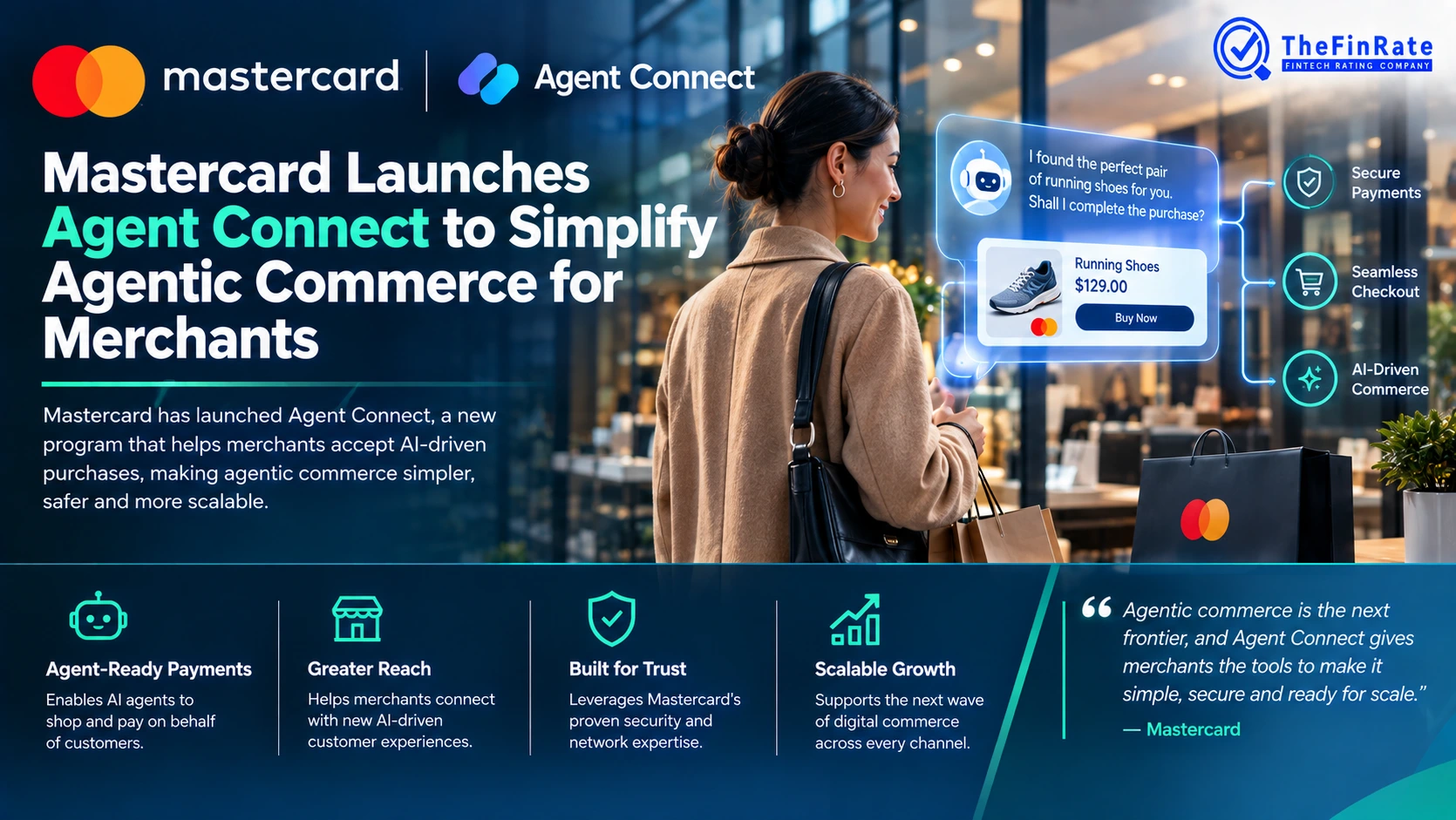
Mastercard has launched Agent Connect, a new infrastructure layer designed to connect merchants, AI agents, digital platforms and payment providers through a single integration as commerce moves toward AI-led discovery, purchasing and payments.
The announcement expands Mastercard’s broader Agent Suite for Merchants, positioning the payments network not simply as a way to process an eventual AI-led transaction, but as infrastructure connecting the different participants involved in agentic commerce.
That distinction is important. If AI agents become a new interface for shopping, merchants will need to make products discoverable to those agents while retaining control over pricing, fulfilment, customer relationships and transaction rules.
Mastercard is trying to address that problem with one connection rather than thousands of individual integrations.
Agent Connect creates a single connection point
Mastercard Agent Connect is designed to connect AI agents, merchants, commerce platforms and payment providers through a common integration.
Instead of merchants maintaining separate technical relationships with individual AI platforms and commerce providers, Agent Connect provides access to a growing network through one connection. Mastercard says the architecture is intended to support multiple protocols over time rather than locking participants into a single protocol.
For merchants, that could significantly reduce one of the biggest obstacles to agentic commerce: integration complexity.
The idea is similar to the role payment networks have historically played in connecting different participants in commerce. The difference is that the new ecosystem includes autonomous or semi-autonomous software agents making decisions and potentially executing purchases on behalf of consumers.
From product discovery to payment
Agent Connect covers three important stages of the shopping journey.
First, an AI agent can access merchant-authorised product information, including details such as availability.
Second, the agent can help build a cart and confirm final information such as pricing, taxes, shipping and fulfilment.
Finally, the transaction can be completed using secure payment credentials. Mastercard says this can support cards from Mastercard and other payment networks.
That makes Agent Connect more than a product-discovery API.
It is an attempt to connect the entire path from AI recommendation to transaction execution.
Merchants retain control
One of the central issues around agentic commerce is who controls the customer relationship when an AI assistant becomes the primary shopping interface.
Mastercard’s answer is to give merchants controls over how they participate.
Businesses can determine which AI experiences they connect to while retaining control over pricing, fulfilment, customer relationships, brand experiences and business rules. Mastercard also says participating merchants can maintain merchant-of-record status for incremental sales generated through the ecosystem.
That could become increasingly important as consumers rely less on individual retailer websites for product discovery.
The risk for merchants is not simply losing website traffic. It is potentially losing control over how products are presented, compared and purchased.
Agent Connect is designed to let merchants participate in AI-led commerce without completely surrendering that control.
Agent Suite for Merchants expands beyond connectivity
Agent Connect is being introduced as part of an expanded Mastercard Agent Suite for Merchants.
The suite combines Agent Connect with Mastercard’s shopping-agent capabilities, allowing businesses to create AI-powered shopping experiences within their own websites and applications while also making their products discoverable through external AI ecosystems.
Mastercard initially introduced the Agent Suite in January 2026.
The expanded offering also builds on Mastercard’s collaboration with Anthropic. Mastercard says Anthropic’s commerce agent blueprint will be made available through the suite, allowing merchants to build shopping agents using Claude models alongside Mastercard’s commerce intelligence, controls, personalisation and payments capabilities.
This gives Mastercard a role on both sides of the emerging ecosystem: helping merchants build their own agents and connecting them to agents operated elsewhere.
Security becomes critical when agents can pay
Discovery is relatively straightforward.
Payment is where the stakes become much higher.
An AI agent that recommends a product is one thing. An agent that actually purchases it using a consumer’s payment credentials creates new questions around authentication, authorization, fraud and accountability.
Mastercard is addressing this through Agent Pay, which uses its Verifiable Intent capability to help ensure that agentic transactions are completed with consumer authorization.
Mastercard has also indicated that agents could eventually benefit from network-agnostic tokenisation capabilities.
That points toward a broader industry challenge: AI agents need to become identifiable and trustworthy participants in payments rather than simply another type of software interface.
That issue is becoming an industry-wide priority. On September 10, Mastercard, Visa and Ant International separately announced work on a Know-Your-Agent interoperability framework designed to help payment networks, wallets, agent platforms and marketplaces identify and verify AI agents across different ecosystems.
US launch brings major industry participants
Mastercard says Agent Connect will launch first in the United States.
The initial group of companies and platforms expected to leverage the solution includes Bemobi, Getnet, Glance, Global Payments, Planet, Network International, Nexi, Samsung, Trip.com, Vodafone Egypt, Wizard and Wompi.
Mastercard also lists companies including Castlery, Fabrick, Fiserv, FreedomPay, Global Payments, Moneris, Nexi, Network International, Trip.com and Worldline among businesses and commerce platforms planning to use its broader Agent Suite for Merchants.
The breadth of participants illustrates the fragmented nature of agentic commerce.
Merchants, payment service providers, marketplaces, technology companies and AI platforms all need to interact. Without common infrastructure, every participant could end up maintaining multiple bilateral integrations.
Why Agent Connect matters for merchants
The strategic value of Agent Connect is therefore less about another payment product and more about distribution.
If consumers increasingly ask AI agents to find products, compare options and complete purchases, merchants need their catalogues to be visible inside those new interfaces.
Mastercard’s Agent Connect provides a route for merchants to expose dynamic product information while maintaining control over the underlying commerce experience. Its platform supports merchant-authorized catalogue information and real-time access to dynamic product data through APIs.
For merchants, the objective is straightforward: become discoverable without having to build a separate integration for every AI platform.
The bigger shift: AI becomes the commerce interface
The launch comes as the payments industry increasingly prepares for a world in which consumers may delegate parts of the purchasing journey to AI.
Mastercard has already been building toward that model. In February, the company demonstrated a fully authenticated agentic commerce transaction in India involving Mastercard cards issued by Axis Bank and RBL Bank, payment aggregators including Cashfree Payments, Juspay, PayU and Razorpay, and merchants including Swiggy, Instamart, Vi, Tira and Zepto.
The significance of Agent Connect is that Mastercard is now working on the commercial infrastructure around those transactions, not just the payment authentication layer.
That is a much bigger opportunity.
The winning infrastructure will need to connect product data, AI agents, merchant systems, payment providers, authentication and fulfilment without making the experience feel like a collection of disconnected services.
Mastercard is betting on interoperability
There is another important detail in the launch.
Mastercard says Agent Connect is designed to be protocol-agnostic, with support for multiple protocols expected over time.
That matters because agentic commerce is still early.
No single AI platform, agent protocol, or payment architecture has emerged as the definitive standard. Building infrastructure that can connect different systems may therefore be more valuable than betting everything on one protocol.
The industry appears to be moving in the same direction. Mastercard’s separate collaboration with Visa and Ant International around Know-Your-Agent interoperability suggests that payment companies increasingly see cross-network trust as necessary for agentic commerce to scale.
The bottom line
Mastercard Agent Connect is essentially an attempt to build the connectivity layer for agentic commerce.
Its success will depend on whether merchants, AI agents, payment providers and commerce platforms actually converge around the network.
But the strategic direction is clear.
The next generation of commerce may not begin with a consumer opening a retailer’s website. It may begin with a conversation with an AI agent.
When that happens, the infrastructure connecting discovery, recommendation, authorization and payment becomes just as important as the checkout itself.
Mastercard is positioning Agent Connect to be part of that infrastructure.
Comments
No comments yet. Be the first to share your thoughts.
Leave a comment