
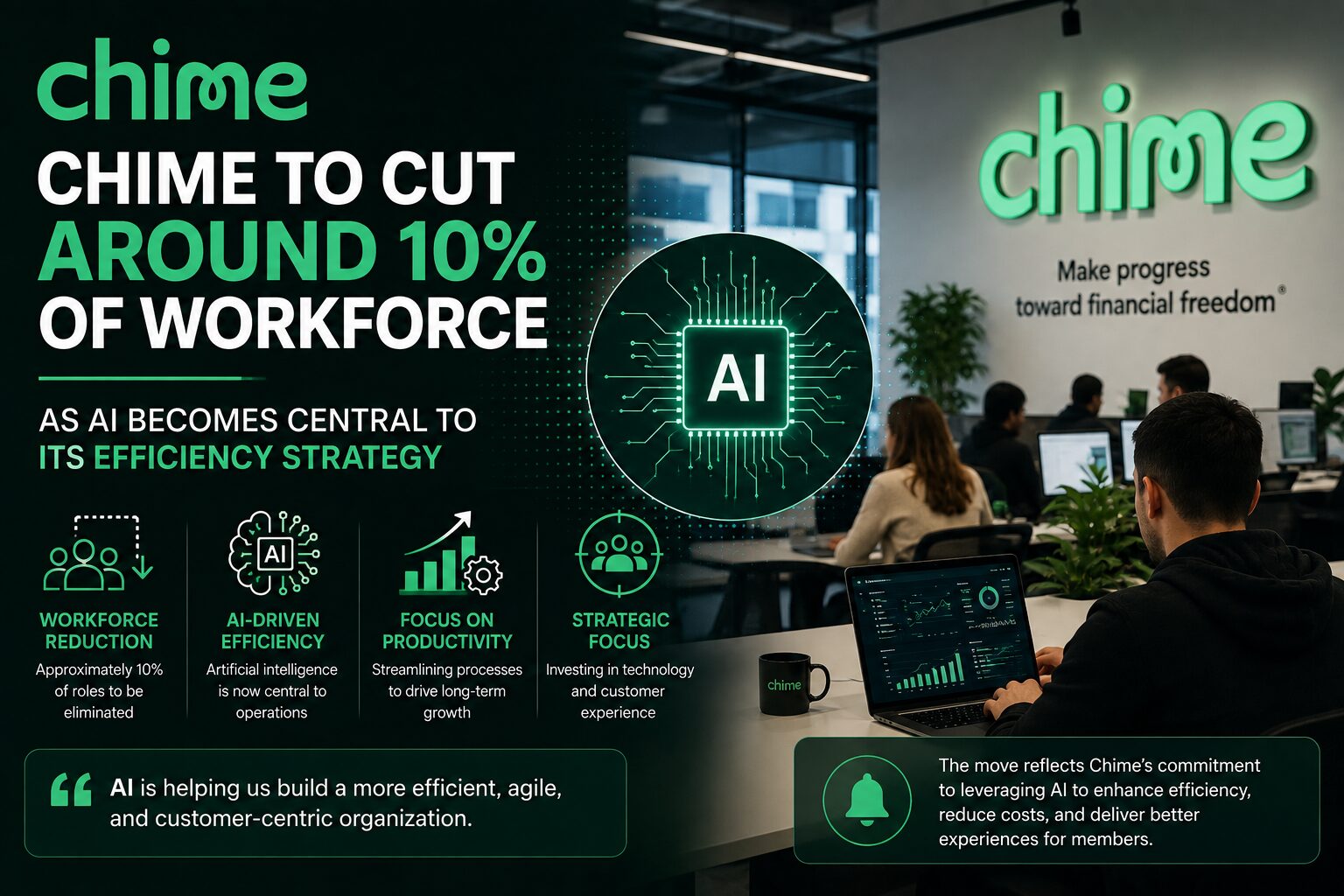
Chime to Cut Around 10% of Workforce as AI Becomes Central to Its Efficiency Strategy
Chime is reportedly cutting about 10% of its workforce as the digital banking company accelerates its use of artificial intelligence and reshapes its operations around efficiency, automation, and long-term profitability.
The San Francisco-based fintech company is expected to eliminate approximately 150 roles, according to reports. The move is part of a broader effort to streamline operations and increase productivity through AI-driven tools and automation.
Importantly, the decision highlights a major shift across the fintech industry. Companies are increasingly using AI to improve efficiency while reducing operational complexity.
Chime is restructuring for an AI-driven future
Chime has grown into one of the largest digital banking platforms in the United States. It achieved that position by focusing on low-cost banking services, mobile-first customer experiences, and technology-driven operations.
Now, however, the company appears to be entering a new phase.
According to reports, CEO Chris Britt believes AI can help employees work faster and make better decisions. In addition, AI can improve productivity across the organization.
Rather than treating AI as a standalone technology initiative, Chime is integrating it into its broader operating model. As a result, the company is redesigning teams and workflows around AI-assisted productivity.
Why this workforce reduction matters
The layoffs matter because they reflect a broader shift in fintech.
For years, many digital banking companies prioritized customer growth, product expansion, and rapid hiring. Today, by contrast, investors are placing greater emphasis on profitability, operational discipline, and sustainable growth.
AI has become one of the main ways companies are pursuing those goals.
For example, automation can reduce repetitive work and improve internal processes. Consequently, fintech firms can lower costs while maintaining growth momentum.
Chime’s reported workforce reduction shows that AI is becoming a core business strategy rather than an experimental technology investment.
AI is changing how fintech companies operate
Financial technology companies are rapidly expanding the use of artificial intelligence across multiple functions.
Common AI applications include:
- Customer service automation
- Fraud detection
- Risk assessment
- Product development
- Internal workflow automation
- Data analysis
- Financial insights and personalization
These tools can improve speed, reduce manual work, and support faster decision-making. Furthermore, they can help organizations scale more efficiently.
For digital banks, AI also creates opportunities to deliver more personalized financial services.
Chime’s focus on operational discipline
The restructuring comes during a period when fintech companies are balancing growth with cost management.
Since becoming publicly listed in 2025, Chime has faced many of the same pressures affecting the broader fintech industry. Specifically, higher operating costs and stronger investor scrutiny have increased the focus on efficiency.
Chime appears to be responding by building a leaner organizational structure that relies more heavily on AI-enabled productivity.
At the same time, the company is not necessarily reducing innovation. Instead, management appears to believe AI can support innovation with fewer organizational layers and lower operating costs.
AI is reshaping the fintech workforce
Chime is not alone in making these changes.
Across financial services, banks, payment companies, and fintech firms are reassessing workforce needs as artificial intelligence becomes more capable.
Many organizations are investing simultaneously in AI infrastructure and workforce restructuring. As a result, they hope to increase output without expanding headcount at the same pace as previous growth cycles.
This represents a significant change from the fintech hiring boom of the previous decade.
The industry is moving from scale through hiring to scale through technology.
What this means for customers
For customers, the impact may not be immediately visible.
Chime is expected to continue investing in digital banking experiences, customer support, and financial tools. In fact, AI could improve several customer-facing services.
Potential benefits include:
- Faster customer support
- More accurate fraud detection
- Better financial recommendations
- Improved account management
- Faster product updates
However, workforce reductions can create execution risks. Therefore, the company must ensure that automation improves service quality rather than creating new friction for customers.
The broader fintech trend
Chime’s restructuring reflects a larger transformation across the financial technology industry.
Fintech companies are increasingly using AI to improve margins, accelerate product development, and automate operational processes. Meanwhile, they are becoming more disciplined about hiring and organizational growth.
This trend is likely to continue as AI tools become more powerful.
The companies that successfully combine automation with strong customer experience may gain a significant competitive advantage.
What investors should watch
Investors will likely focus on whether Chime’s AI strategy produces measurable financial improvements.
Key areas to monitor include:
- Operating expense reductions
- Productivity improvements
- Customer retention
- Product development speed
- Profitability trends
- AI-driven revenue opportunities
The workforce reduction is only one part of the story.
More importantly, investors will ask whether AI can create a more efficient operating model without weakening innovation or customer satisfaction.
The bigger picture
Chime’s reported decision to reduce its workforce highlights an important reality. Artificial intelligence is increasingly becoming an operating model, not just a technology tool.
Digital banks are redesigning organizations around automation, data, and AI-assisted decision-making. Consequently, that shift could fundamentally change how fintech companies allocate capital, manage talent, and compete.
For the financial technology industry, the AI transition is no longer theoretical. Instead, it is becoming a central driver of efficiency, profitability, and long-term competitiveness.
Bottom line
Chime’s reported plan to cut about 10% of its workforce marks a significant step in its AI-driven transformation strategy. By combining workforce restructuring with increased investment in artificial intelligence, the company is signaling that operational efficiency and technology-enabled productivity will play a much larger role in its future growth model.
Ultimately, as AI adoption accelerates across financial services, Chime’s move could become a powerful example of how digital banks are reshaping their organizations for a more automated and competitive future.
Chime to cut 10% of total workforce on AI driven efficiencies Reuters
Comments
No comments yet. Be the first to share your thoughts.
Leave a comment