
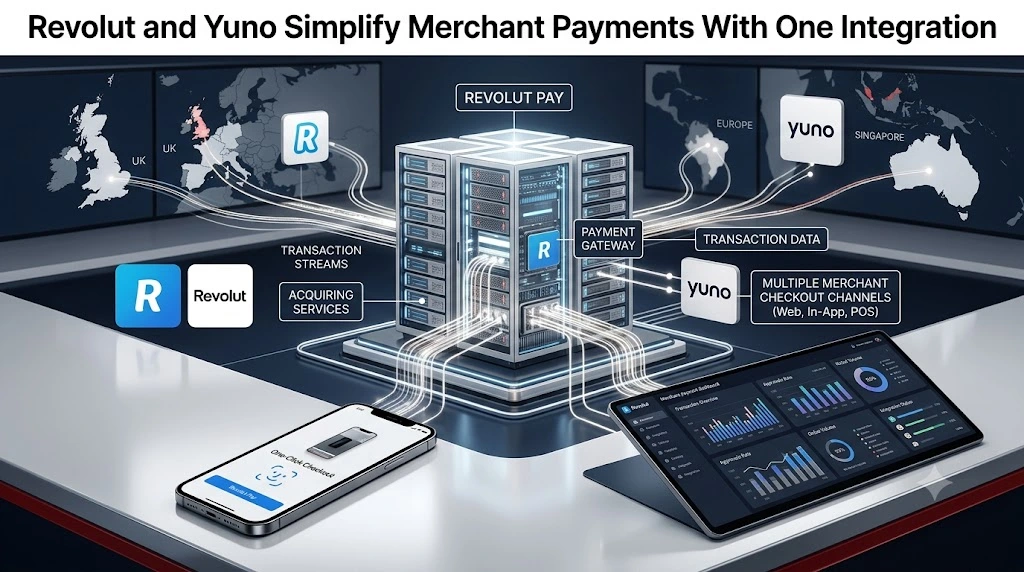
Revolut Business and Yuno have partnered to give merchants access to Revolut Pay, acquiring and gateway services through a single integration across the UK, European Economic Area, Singapore and Australia.
The partnership is already moving into deployment, with the first merchants going live. Yuno said an online travel agency has activated Revolut Pay without having to build a new integration.
The arrangement gives eligible merchants on Yuno’s platform access to Revolut’s broader payment offering through one connection, rather than integrating separately with each service.
For Revolut, the partnership expands the distribution of its merchant payment capabilities. For Yuno, it adds another major wallet and payment provider to its global orchestration platform.
Revolut Expands Its Merchant Payment Reach
Revolut’s offering through the partnership combines Revolut Pay, acquiring and gateway services.
Revolut Pay provides a one-click checkout experience for eligible customers, while the acquiring and gateway capabilities extend the relationship beyond the checkout button into payment processing infrastructure.
The integration currently covers the UK, EEA, Singapore and Australia, where Revolut Pay is available at checkout.
Revolut said it serves more than 80 million retail customers and more than 800,000 business customers globally. The company has been expanding its financial-services infrastructure across markets as it develops Revolut Business into a broader platform for companies.
The Yuno connection gives merchants another route to reach Revolut customers without creating a separate technical integration.
Yuno Turns One Integration Into Multiple Payment Connections
Yuno operates as a payment orchestration and financial infrastructure layer between merchants and payment providers.
Its platform connects merchants with more than 1,000 payment methods and 460 integrations across 190-plus countries, according to the company.
That model is becoming increasingly important as global merchants face a fragmented payments landscape.
Different markets require different wallets, local payment methods, acquiring relationships and regulatory arrangements. Building and maintaining every connection independently can add significant technical and operational complexity.
Yuno’s model is designed to reduce that burden.
Under the Revolut partnership, Revolut connects its payment stack to Yuno once. Eligible merchants using Yuno can then activate Revolut’s offering through the existing connection.
The result is a simpler route to adding Revolut Pay alongside acquiring and gateway services.
First Merchants Are Already Going Live
The partnership is not limited to a future integration roadmap.
Yuno said the first merchants have already signed up, with an online travel agency activating Revolut Pay through the platform.
The merchant was able to switch on the payment capability without writing new integration code, according to Yuno.
That detail illustrates the commercial proposition behind the partnership.
For large merchants, adding another payment method can involve technical development, testing, certification, routing decisions, and ongoing maintenance. An orchestration layer can instead turn the addition of a new provider into a configuration exercise.
The potential benefit becomes greater as merchants expand into multiple markets and need to support a growing number of payment options.
Wallets Are Becoming Payment Acceptance Networks
The partnership also reflects a broader change in the payments industry.
Digital wallets are increasingly moving beyond their traditional role as stored payment credentials. Large wallets can bring their own customer bases, authentication systems and checkout experiences.
That makes access to those wallets strategically important for merchants.
Yuno co-founder and CEO Juan Pablo Ortega described large wallets as increasingly becoming acceptance networks in their own right.
From a merchant perspective, that creates a new integration challenge. A business that wants to offer multiple major wallets could otherwise end up maintaining separate connections to each provider.
Payment orchestration can provide an alternative.
Instead of treating every wallet as an independent technology project, merchants can use a common infrastructure layer to access multiple payment providers.
Revolut Pay Adds One-Click Checkout
A key part of the integration is Revolut Pay.
Revolut describes the service as a one-click checkout product using biometric authentication, allowing eligible customers to complete payments without repeatedly entering payment details.
For merchants, the appeal is a faster checkout experience that can potentially reduce friction during online purchases.
The partnership places that checkout option alongside Revolut’s acquiring and gateway capabilities.
That combination is important because it gives merchants access to more than a payment method. They can also connect to infrastructure supporting payment acceptance and processing through the same Yuno relationship.
The Partnership Comes as Yuno Expands Its Infrastructure Platform
The Revolut agreement follows a period of rapid expansion for Yuno.
In August, the company announced a $45 million Series B funding round led by Global PayTech Ventures. Yuno said the financing would support product expansion, including in-person payments, agentic commerce and growth in the United States.
The company said it is targeting $100 billion in annual transaction volume within the next 12 months.
Yuno has also been expanding its financial infrastructure capabilities beyond conventional payment orchestration. Its platform covers areas including pay-ins, payouts, fraud prevention, KYC/KYB and stablecoin connectivity.
That broader strategy positions the company as more than a conventional payment gateway.
What It Means for Merchants
For merchants, the biggest benefit of the Revolut-Yuno partnership is potentially simpler access to a growing payment ecosystem.
A merchant using Yuno can add Revolut Pay without building a separate connection from scratch. The same integration also provides access to Revolut’s acquiring and gateway services, subject to eligibility and applicable terms.
This can matter particularly for businesses operating across multiple regions.
Travel, e-commerce, marketplaces and digital services companies often need to support different payment preferences across markets. The ability to activate new payment methods through an existing infrastructure layer can reduce the time and resources required to expand payment acceptance.
It also gives merchants greater flexibility as consumer payment preferences change.
A Shift Toward Modular Payment Infrastructure
The Revolut-Yuno partnership points toward a broader evolution in payment technology.
Merchants increasingly want payments infrastructure that can be configured rather than rebuilt every time a new provider or payment method becomes important.
For providers, meanwhile, connecting to orchestration platforms can create a distribution channel that reaches a much larger merchant base without requiring each merchant to undertake a separate technical integration.
That creates a two-sided benefit.
Payment providers gain distribution, while merchants gain flexibility.
Revolut’s decision to connect its Pay, acquiring and gateway capabilities through Yuno illustrates how that model can work in practice.
Revolut and Yuno Push Payments Toward Simpler Integration
The partnership gives merchants in the UK, EEA, Singapore and Australia a new way to activate Revolut’s payment capabilities through a single Yuno connection.
With the first merchants already live, the arrangement has moved beyond a strategic announcement into practical deployment.
For Revolut, the deal can extend the reach of its growing merchant payments business. For Yuno, it strengthens a platform designed to connect merchants with a wide range of payment providers through a common infrastructure layer.
The bigger industry trend is clear: payment acceptance is becoming increasingly modular.
As wallets, local payment methods, acquirers and new forms of commerce continue to multiply, merchants are unlikely to want a separate integration for every new payment option.
Platforms that can simplify that complexity could become an increasingly important layer in global payments infrastructure.
Comments
No comments yet. Be the first to share your thoughts.
Leave a comment