
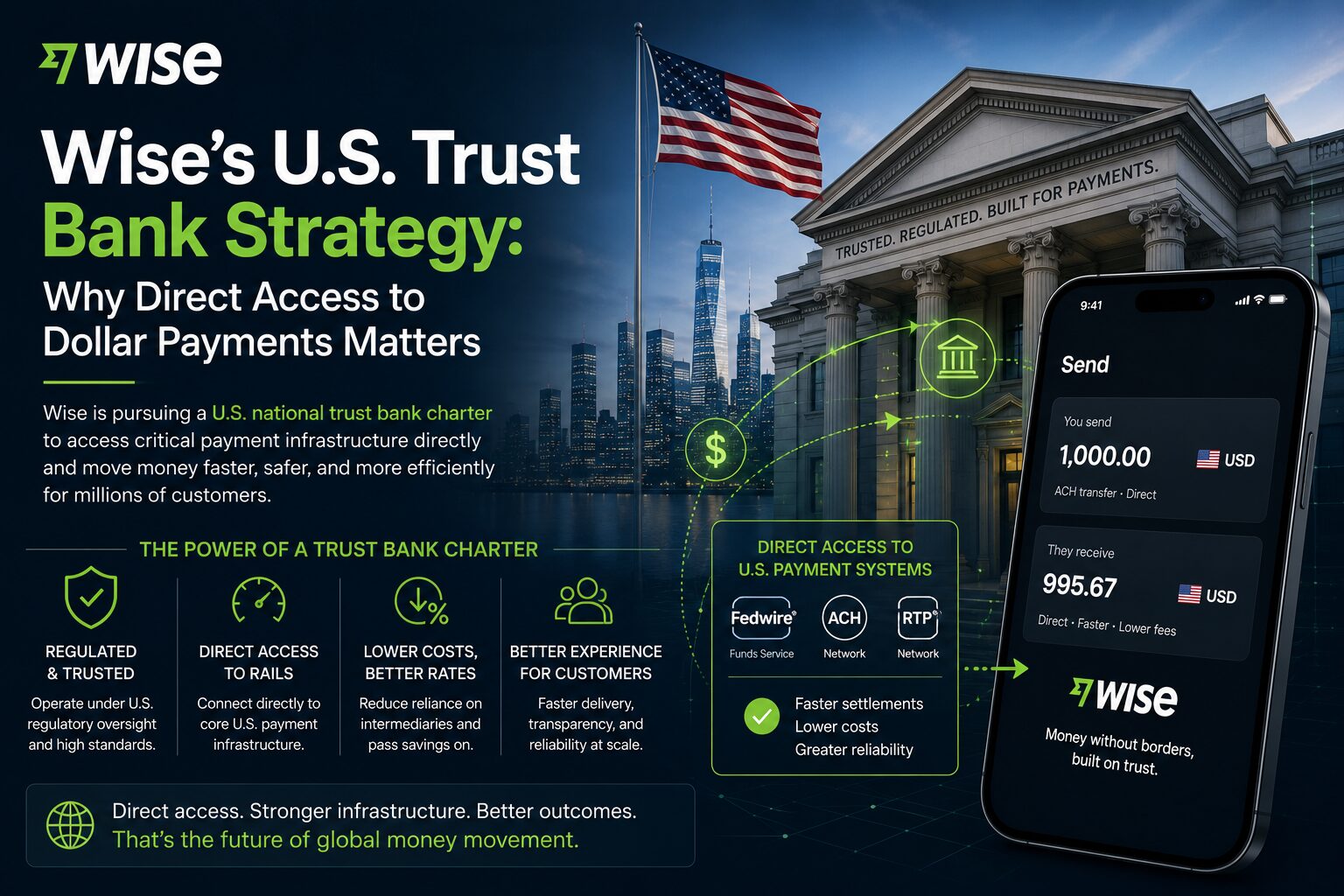
Wise’s U.S. Trust Bank Bet: Why Direct Access to Dollar Payments Could Change Cross-Border Banking
For most fintech companies, getting a banking charter is a badge of credibility. For Wise, it’s something much bigger.
The London-listed payments company isn’t trying to become another retail bank. Instead, it wants to move closer to the core infrastructure that powers U.S. dollar payments. That could give it greater control over how money moves across borders while reducing its dependence on traditional banking partners.
Although Wise recently hit a setback after the U.S. Office of the Comptroller of the Currency (OCC) rejected its original application for a national trust bank charter, the company isn’t backing away. Instead, it plans to submit a revised application.
That decision highlights a much bigger story. The future of fintech competition may not depend on who builds the best app—but on who controls the payment rails underneath it.
Why Wise Wants a U.S. Trust Bank Charter
Every international payment relies on financial infrastructure.
Today, Wise uses banking partners and correspondent banks to move U.S. dollars around the world. While that model works, it also creates extra steps, higher costs, and less control over settlement.
Wise believes there is a better way.
By securing a U.S. national trust bank charter, the company could bring more of its dollar-payment operations under direct federal supervision and move closer to the country’s payment infrastructure.
However, it’s important to understand what this charter actually means.
Unlike a traditional commercial bank, a national trust bank generally:
- Does not accept insured retail deposits
- Does not operate consumer checking accounts
- Focuses on trust, custody, payment, and fiduciary services
- Operates under OCC supervision instead of becoming a full-service retail bank
In other words, Wise isn’t trying to compete with JPMorgan or Bank of America. Instead, it wants greater control over how international payments are processed.
The Bigger Goal: Direct Access to U.S. Payment Rails
This is where the strategy becomes especially interesting.
The U.S. dollar remains the world’s dominant settlement currency. As a result, a huge share of international payments eventually moves through U.S. payment infrastructure.
Today, those payments often pass through several intermediary banks before reaching their destination.
Each additional intermediary can create:
- Higher processing costs
- Longer settlement times
- Extra compliance checks
- Reduced payment visibility
- Less operational flexibility
Wise wants to remove as much of that friction as possible.
If the company gains more direct access to U.S. payment rails, it could improve settlement speed, lower operating costs, manage liquidity more efficiently, and deliver an even smoother customer experience.
More importantly, it would strengthen the company’s long-standing mission of making international payments cheaper and more transparent.
Rather than simply improving legacy banking infrastructure, Wise wants to become part of the infrastructure itself.
Why the OCC Rejected the Application
Despite the strategic benefits, regulators were not convinced by Wise’s original proposal.
According to the OCC, the application raised concerns around anti-money laundering (AML) controls, governance, compliance oversight, and the company’s readiness to operate under a banking framework.
At the same time, the regulatory environment changed.
When Wise originally submitted its application, uninsured national trust banks appeared more likely to receive direct access to Federal Reserve payment accounts.
However, that policy landscape shifted significantly during the review process.
As a result, the structure supporting Wise’s original application became much less practical.
Wise responded by saying its compliance capabilities have strengthened considerably since the application was first submitted.
The company says it has:
- Enhanced AML monitoring
- Expanded compliance teams
- Improved governance frameworks
- Strengthened reporting procedures
- Invested heavily in financial crime controls
Importantly, the OCC’s decision does not affect Wise’s existing U.S. business.
The company continues to operate through money transmitter licenses across 48 U.S. states and four territories, alongside more than 80 regulatory licenses worldwide.
Why This Matters Beyond Wise
This story isn’t just about one fintech company.
Instead, it reflects a broader shift happening across financial services.
For years, fintech firms built products on top of traditional banking infrastructure. Now, many want direct access to the infrastructure itself.
That trend is being driven by several factors.
Fintechs Want Greater Control
Owning more of the payment stack gives companies greater control over settlement, pricing, liquidity, and customer experience.
Regulation Has Become a Competitive Advantage
Strong compliance is no longer just about satisfying regulators.
Increasingly, it determines which companies gain access to critical financial infrastructure.
Payments Are Becoming Infrastructure Businesses
Competition is shifting.
Winning customers is still important, but controlling settlement, reducing intermediaries, and improving operational efficiency may become even bigger competitive advantages.
Wise’s strategy fits squarely within this industry transformation.
The Risks Behind the Strategy
Of course, a banking charter also raises the stakes.
Operating under federal banking supervision requires far higher standards than operating as a licensed money transmitter.
Wise would need to continue investing heavily in governance, compliance, operational resilience, and financial crime controls.
Some of the biggest challenges include:
Compliance Risk
Direct payment access requires sophisticated AML monitoring, sanctions screening, and ongoing regulatory reporting.
Operational Risk
Removing intermediaries improves efficiency. However, it also means Wise becomes directly responsible for system resilience and payment reliability.
Regulatory Risk
The recent OCC decision shows how quickly regulatory policy can reshape an otherwise well-designed business strategy.
Strategic Risk
Even if Wise eventually receives approval, the additional compliance costs could reduce some of the efficiency gains the company hopes to achieve.
Comments
No comments yet. Be the first to share your thoughts.
Leave a comment